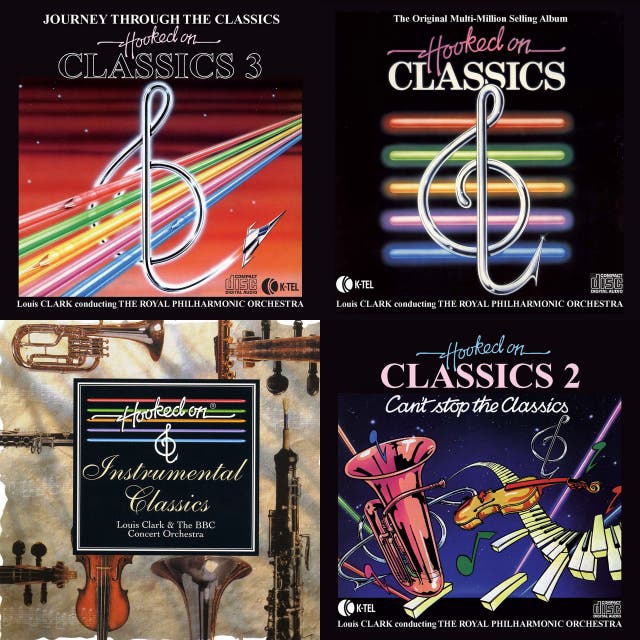
In 1978 the London Symphony Orchestra released the LP “Classic Rock” which was a collection of pop songs given the symphonic treatment. It wasn’t pop music and it wasn’t classical music. It was a hybrid and a tremendous success. A success based on some good tunes, well arranged and well marketed. Around the same time there were many other similar offers like the RPOs “Hooked on Classics”.
Purists were sniffy. They shouldn’t have been. Running an orchestra is a costly business and if “Beethoven’s Greatest Hits” sells (it did) what’s not to like?
These thoughts came to mind when I was considering my response to cricket’s “The Hundred”. Could it be argued that the adaptation of cricket that this tournament has been and its repackaging of the game for the elusive “new audience” is just like what happened to music as it was popularised (vulgarised some would say of course). Up to a point, but there is a crucial difference.
“Hooked on Classics” did not mean that there were fewer Symphony Concerts or Orchestras. Classical music fans could largely ignore it and the vast majority did. There was space enough for the bastard child whilst Symphony concerts, opera, the Proms and the rest carried on unaffected.
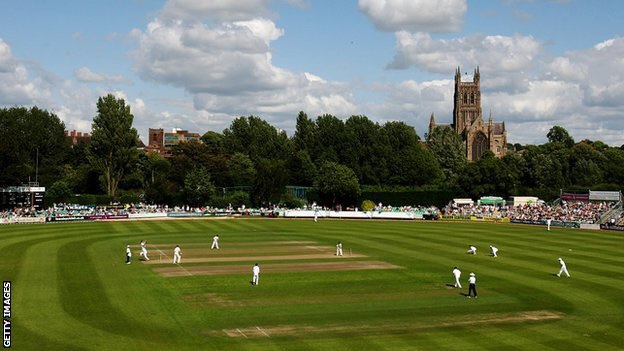
But with “The Hundred” it occupies space in high summer and the school holidays which was previously occupied by the Counties. Grounds and players are turned over to a tournament played by teams with no traditions and in a format played nowhere else in the world.
Many of us will ignore “The Hundred” because of what it is – a vulgar parody of the historic great game of cricket. But it’s there – noisy, simplistic, trivial and trite. It’s the Andre Rieu of cricket without the subtlety. Once you let the Goths and the Vandals in you’ll never get rid of them.
Cricket has always been more than just a business. But as T20 tournaments in India, Australia and elsewhere have shown there’s a buck to be made. The irony is that if a new audience has in part been tapped they haven’t experienced real cricket but a mutant variety of it. They won’t say “I enjoyed that, I’ll go to a County Championship game or a Test Match”.
County cricket at Taunton. A thing to love.
English cricket has been impoverished by The Hundred. Evolutionary science shows that the stronger species always wins. If the Hundred becomes established it’s rivals, especially in domestic cricket, will wither and die. Yes each man kills the thing he loves. And when it’s gone – that’s it. RIP.
Extinction Rebellion will be having one of their often very aggressive protest demonstrations this week. They are usually loud on what they don’t like but quiet on solutions. They certainly tell us who they don’t like – it includes people like me who spent my whole career working for an oil company!
The key consideration in almost any public policy issue is to have a realistic grip on timescale. For climate change and its effects that timescale is very long term indeed. Some actions taken today may not have any noticeable effects for a decade or more. Politicians doing “good things” want instant results so that they can boast about them. Equally they are reluctant to take tough decisions that could be electorally unpopular. So there’s often a lot of hot air, but very little action.
We could cut road mileage by 4% overnight as the Tony Blair Institute suggests if we had the guts substantially to raise tax/duty on road fuels (petrol and diesel). Blair himself introduced a freeze on tax increases in the light of protests. This measure would be fair in that the biggest polluters (high mileage drivers) would have the biggest incentive to reduce their journeys, switch to public transport or electric vehicles.
Extinction Rebellion are either ignorant or disingenuous (probably both) in attacking Oil companies. These corporations are very small scale polluters themselves and their activities are very energy efficient. It is Big Oil’s customers that are the contributors to climate change – that’s you and me by the way. The days of oil companies creating demand are long gone. Their role is to satisfy demand not create it. This fact is largely ignored by the protesters as Shell, BP or Exxon are easier targets.
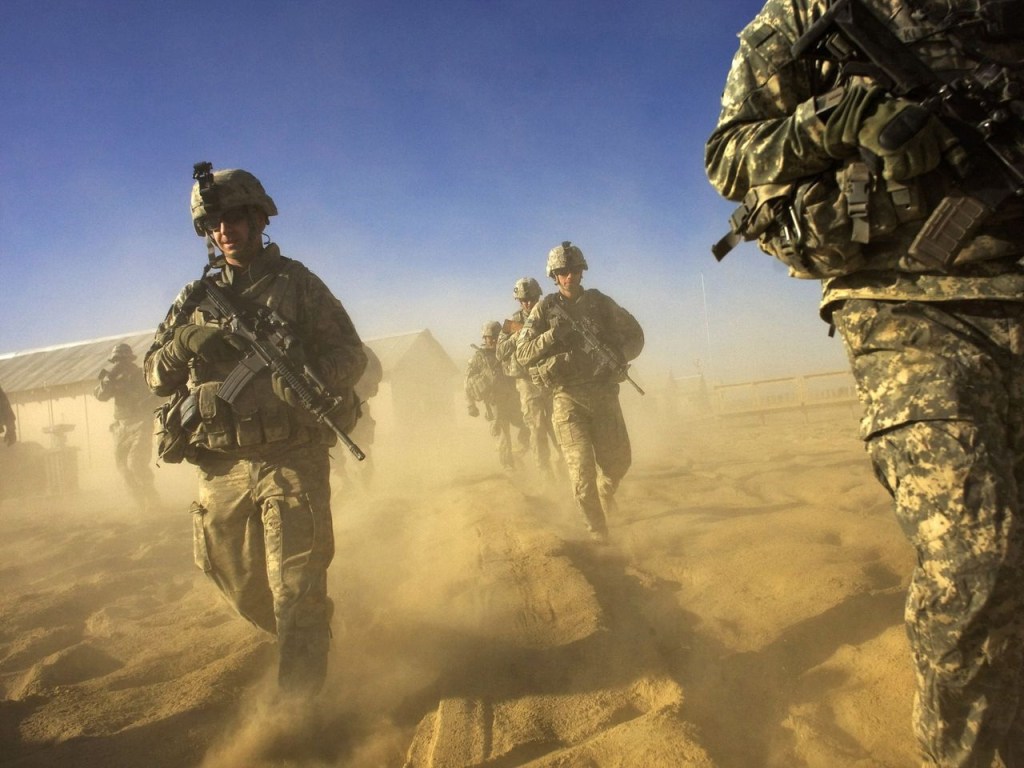
We assembled the most incredible, technologically advanced alliance the world has ever seen, … and we are being defeated by an insurgency”Matthew Parris in The Times today.
More of the same
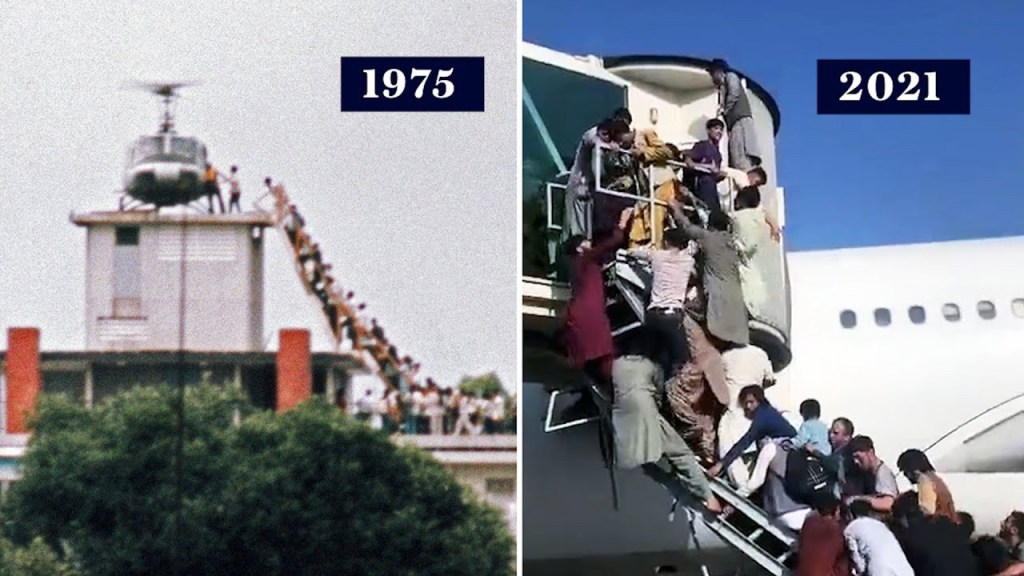
Yes, and what is worse, it happened before. President Biden was uncomfortable with the Vietnam parallels but they are precise. You do not beat determined but unconventional forces with a conventional army or with B52s. They disappear into the hills, regroup and come back to hit you when they choose to.
You also do not win when your own public turns against you. The cumulative effect of body bags and military funerals is understandable revulsion. The war for the hearts and minds of parents and spouses of the fallen, and of the public at large, was lost as the futility of the enterprise became daily more obvious.
It was not the Taliban that perpetrated 9/11 and the terrorists were not Afghanis . The Taliban did not do a Pearl Harbour. The justification for attacking them was weak. The same had applied decades earlier to the Vietcong. We never learn.
John Kennedy’s inaugural speech cast America in the role of moral policeman: “We shall pay any price, bear any burden, meet any hardship, support any friend, oppose any foe to assure the survival and the success of liberty”. It was stirring stuff but it was wrong. Korea was fresh in the memory as a fiasco, Vietnam rumbling to become another one. Might may be Right sometimes. But not if you have no post conflict plan – that was Iraq as well as Afghanistan.
Harold Wilson kept Britain from being dragged into Vietnam on America’s coat tails. Sadly Tony Blair failed to do the same. So Afghanistan became our tragedy too. They died in vain
Addendum: I have just discovered this interview that William Dalrymple gave about Afghanistan ten years ago ! Essential viewing.
The Americans have been in Afghanistan for very nearly twenty years. They didn’t charge in to defeat the Taliban dominated Afghan government but to kill Osama bin Laden. They made one hell of a meal of that and eventually had to go, uninvited, into Pakistan to do it. The West actually had no quarrel with the Afghan government initially other than that it gave a home to Al-Qaeda. A big “other” admittedly.
The Neocons changed a specific task driven invasion into Regime Change. As in Iraq this has ended in disaster. The US has a long record of failure in its Regime change ambitions. To defeat a government or system you disapprove of may be a noble thing but it can and usually does have unintended consequences. Around the world there are some pretty sordid governments of which the Taliban was just one. Will the US at last learn that it has neither the diplomatic skills nor the capability or the local and international support and credibility to be the planet’s moral policeman?
The evidence of 9/11 was, of course, that Al-Qaeda operating from Afghanistan and protected by the Taliban was an existential threat to the world. But removing its head may not have removed the threat. To have the Taliban restored increases the risk but the extent of this is unknown. A modern terrorist is as likely to operate from a house in Plymouth as from a cave in Afghanistan.
For the West still to be spouting certitudes about freedom and democracy and point the finger, or a weapon, at governments it doesn’t like is surely passé, as well as dangerous. America’s diplomacy is also at a low point. Teddy Roosevelt said “Speak softly and carry a big stick”. Neither seems to work any more.
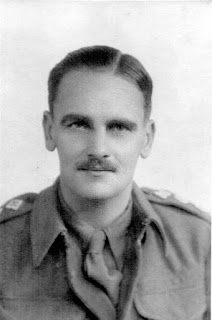
Dad wasn’t a hero. He would have been disapproving of the ubiquity of the whole “Help for Heroes” thing which suggests that as soon as you put on a military uniform you become heroic. He volunteered in 1941 because he had a sense of duty – the vast majority of the British people, one way or another, did the same thing. He was an intelligent, fit young man (24) about to be married and a few years into a career as a Transport Manager. That was his thing, he was good with vehicles. Quiet. Good at sport. Honourable. Decent. The Army gave him a commission and allocated him to the Royal Army Service Corps, who did transport. He married as planned and then, like thousands of others, he was in a troop ship bound for…? He didn’t know, and it changed along the way but in early February 1942 he found himself in Singapore one of those sent to reinforce the garrison island. Not great timing.
In the days before Singapore fell Dad was involved in the action. But it was a hopeless cause. The British and Commonwealth troops were rounded up, placed first in Changi, and then moved to Thailand where work on the Thai/Burma railway began. It was to be a year before my mother, who was pregnant and expecting their first child in April knew his fate. At the end of March, six weeks after Singapore fell, she had a communication saying that Dad was “missing”. Over a year later, on April 3rd 1943, she finally received a telegram from the War Office that he was a Prisoner of War.
On VJ Day, 15th August 1945, my mother celebrated in a muted way. She was not to know Dad’s fate until 10th September when a cable confirmed that he was on his way home. He sailed from Rangoon on the 32 year old HMT Orduna on 21st September and arrived in Liverpool on 19th October. He had been away from England, and my mother, for nearly four years.
As with so many Far East Prisoners of War Dad rarely talked about his experiences. I know that he was involved in the Camp radio – he kept an earphone in his shoe. I know that he was part of a small group of Officers who made contact with Thai locals to smuggle some food into the Camp. I know that if he’d been discovered in these activities he’d have been shot – or worse. Somehow he survived. He survived privations that books like the Booker prize-winning “The Narrow Road to the Deep North” describe so graphically. Officers had a better chance of survival than other ranks. Young, fit men perhaps survived better than older ones. But luck played its part. The serendipity of his incarceration and survival didn’t turn my father into a hero. He lived to be 75 . He lived a fulfilling life after the War. He never forgot what he’d been through. And he never forgave his captors.
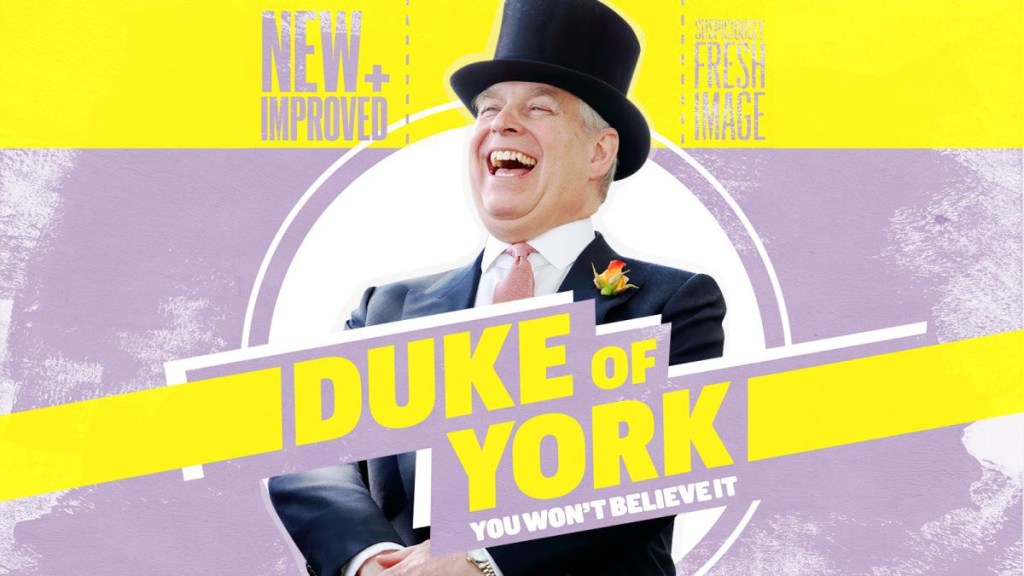
The Times today muses today on the PR challenge presented by Prince Andrew. Having worked for a while in PR for a major brand I would say that the only option is to tell the truth. If you don’t someone will find out and what is bad becomes disastrous. The art of apology is a tricky one to learn when pride is a dominant element. How often do we hear phrases like “I’m sorry if anyone is offended by my actions” when the proper wording should be “I’m sorry that my actions caused offence” – subtly but crucially different.
I’ve met Andrew a couple of times and found him thick and pompous. Power is different in all cases but in his case it seems to come solely from position rather than achievement. His Falklands war service may be praiseworthy – I’ve no idea. But there’s not much else on the credit side. A PR nightmare is to have to promote a brand with few or any positive values.
John Profumo, a good man brought down by a sordid liaison and mendacity, devoted the rest of his life to good works. He sought no publicity and made no attempt at public rehabilitation. I doubt that this is a model for Andrew – one cannot imagine him quietly doing good.
The “MeToo” movement has been a good thing in that it has shown how even the rich and famous can be held accountable for their actions. PR has to be based on truth but even then some brands and some people are too soiled ever to recover.
If you want to read Mr Forsyth’s article it’s here, but I don’t recommend it !
Voting and choosing those who govern us is quite a good thing. Fallible of course if the electoral system is undemocratic (Britain’s is) or if the candidates are poor (likewise). But better than dictatorship and/or government by appointment or hereditary right.
That Elizabeth Windsor has been a good monarch does not make the undemocratic system that makes her our head of State have merit. There is something about a Republic that is morally comforting especially if the President’s role is ceremonial and apolitical – as in Germany or Ireland for (good) example.
We have been a couple of accidents away from having Andrew Windsor as our Head of State a thought that should concentrate the mind. As should memories of the ghastly Edward VIII. Yes Republics can elect dangerous fools but in the main in modern times the system doesn’t throw up Trumps. Andrew, aside from any moral inadequacies, was a joke as a representative for Trade. I saw him close up in this position and he was an arrogant, pompous, ignorant cypher. The idea that Britain would benefit from his “Hosting drinks receptions on a new national flagship” (as Forsyth suggests) is satire worthy of Monty Python.
There is so much needing change in our governance system and I would accept that moving to become a Republic is not an urgent priority. Abolishing the House of Lords as presently constituted and introducing a fair electoral system are higher priority. But one day we may have the courage to abolish the monarchy. I hope we do.
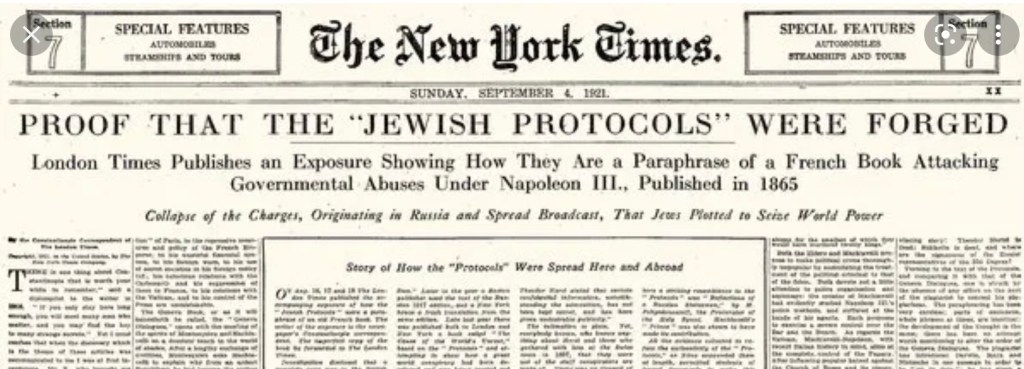
David Aaranovitch in the Times today records how it was a Times journalist, Philip Graves, who, one hundred years ago, bust open “The Jewish Peril” conspiracy and proved it to be fiction,
A hundred years ago, as now, life was confusing – maybe it always is? There are two responses to confusion – to hide or to enquire. What those who seek to benefit from ignorance do is pitch a solution that removes the need for the hard work of enquiry. And they do it with such vigour and noise that even those hiding cannot ignore it.
The “Europe is to blame” deception is a modern day “Elders of Zion” . A small group of politically motivated men and women decided that a route to power was to offer a solution to people’s concerns – especially about the influence of not Jews, but foreigners generally and Europeans in particular.
And so the “Leave the EU”movement was born. The goal was “to subvert the world order and replace it with their own.” Well maybe not the world order, but certainly the British bit of it.
The driver of the revolution is always lies. Tyrants cannot gain power by telling the truth only by distorting it, and by invention. The “Elders” of the European Union were power mad bureaucrats bent on creating a superstate with ultimate power over brave little England. It too was “twaddle” and “balderdash” but it presented a credible explanation to help us resolve our confusion.
We too have had our Philip Graves, many of them, proving that a conspiracy to gain power was underway. But they were ignored by too many as the participators in the fraud gained support. The waving of the flag and the raw appeal to patriotism was decisive. Brussels was the enemy. 🇬🇧
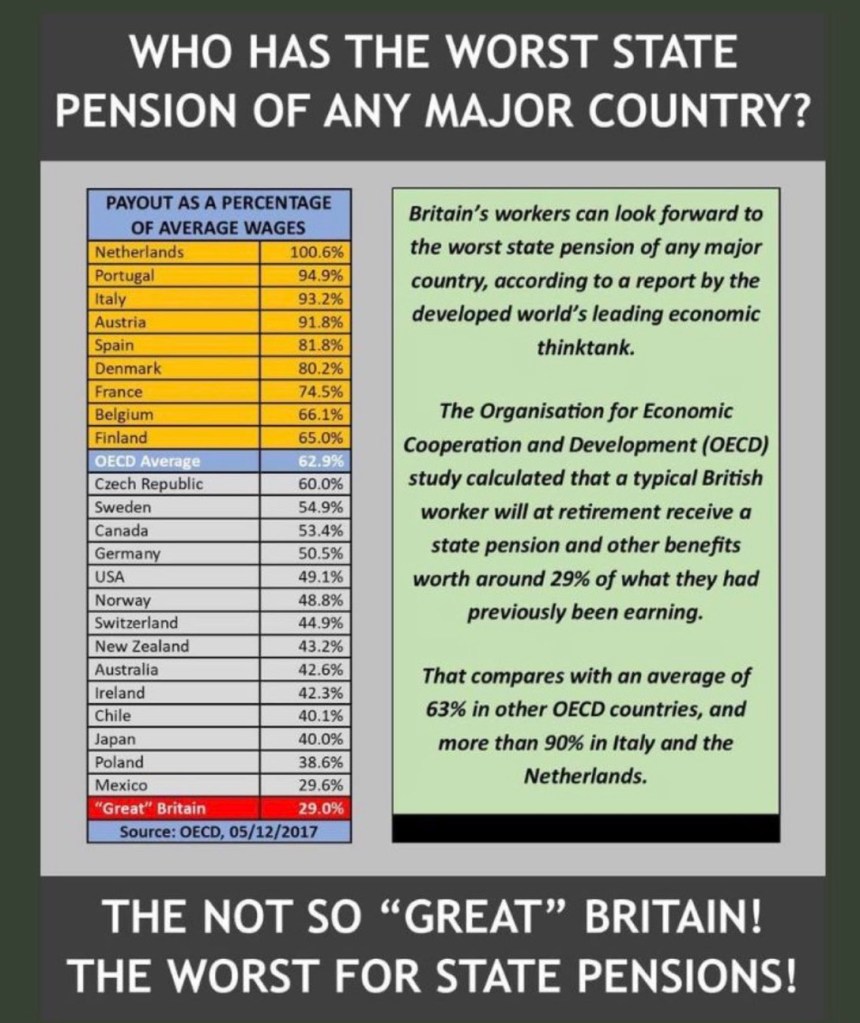
The above table is accurate, but a tad misleading. This is because many British pensioners of my immediate post war generation enjoy workplace pensions from an established Defined Benefit (DB) scheme. These schemes, which first appeared in the late 1940s, give employees on retirement a guaranteed pension related to their final salary and are index-linked.
Millions of us have DB pensions to which can of course be added our State Pension. Elsewhere in the world there are also workplace pensions and for a fair comparison to be made we should show a table which adds average workplace pension to state pension to get total pension.
Ex Pensions Minister Ros Altmann told me “It is true that the UK pays the lowest state pension in the developed world. It has always has. Low state pension was supposed to be supplemented by a private [workplace] Pension top up.”
Ros makes the point that from a Government perspective the tax benefits of workplace pensions are a cost to the exchequer that needs to be factored in “The tax reliefs given to private pensions cost huge sums but are meant to help ensure people have enough to live on in later life.” In effect there is a choice between giving tax relief to workplace pensions and a lower State pension or, in theory, reducing the tax benefit but increasing the State pension to compensate.
The Pension situation of my generation is far superior to that of many younger people who when they retire in many cases will have far lower and far less inflation-proofed workplace pensions. As Ros puts it “Sadly private pensions are not evenly spread and many pensioners have no private pension.” This is a snapshot of the current position and one that will get worse in the decades ahead. The reason for this changed situation is that most employers no longer offer new recruits DB scheme pensions even where they maintain “heritage” Pension Funds to honour their obligations to the retired. These schemes have for some time mostly been closed to new entrants.
I am writing here about mostly private sector workplace pensions. In the public sector DB schemes (or equivalent pension arrangements) do provide employees with significantly better prospects of final salary linked (average salary in some cases) and an inflation proofed retirement income. I have covered this subject in a video which you can watch here.
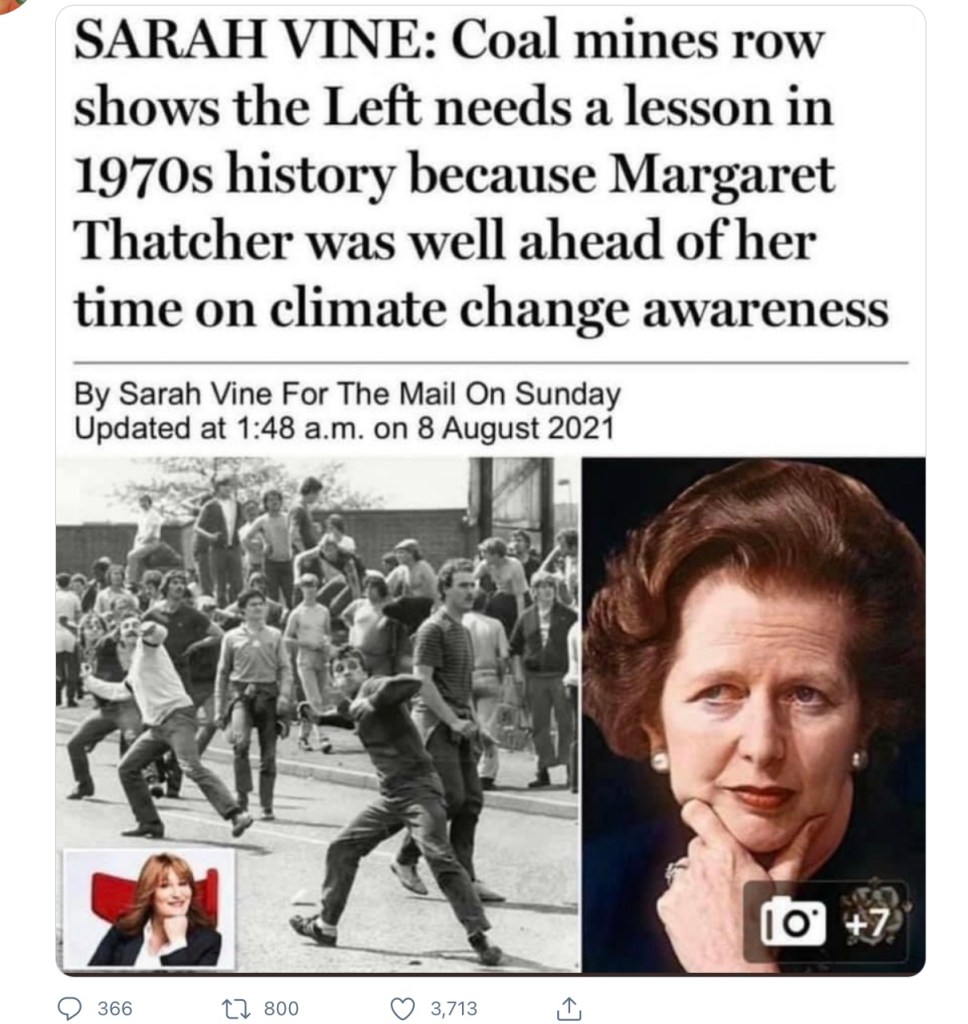
There is something quintessentially typical about this piece by Sarah Vine. Does she really think that there is even the slightest rationale for claiming that Mrs Thatcher’s “Climate Change awareness” was in any way behind her taking on the National Union of Mineworkers? I call the piece “typical” because it is a classic example of a supporter of the political Right inventing “facts” and peddling them in high circulation online outlets.
Vine conflates two things that at the time were unconnected. Margaret Thatcher’s genuine (if short-lived) concern about the dangers of climate change, on the one hand, and her determination to defeat the NUM on the other. To anyone with the smallest knowledge about, or recollection of, the 1980s this conflation is Fake News.
As I made clear in my piece on Boris Johnson’s claim that Thatcher was motivated by environmental considerations in respect of the mining sector is bunkum. Later in the decade she did have a short-lived Green period and it is fair to praise her insight on this. But it certainly was not in any way a factor in her handling of the Miners’ strike and her determination to go ahead with a swingeing pit closure programme.
But Sarah Vine isn’t interested in the truth which she could easily have checked – the story is hardly a secret. I was close to the issue when I worked in Scotland during the Miners’ strike. This is a personal story and for me a memorable one. Vine berates the “Left” in her piece but she is wrong to do so. Many on the Left, whilst horrified by Thatcher, were less than enthusiastic supporters of Arthur Scargill.
I don’t think anyone on the Left “needs a lesson on 1970s history”, but Sarah Vine certainly does. When Edward Heath’s Conservatives came to power in 1970 Britain’s Energy industry was relatively stable. Coal to Fuel Oil conversion was well underway in the industrial sector but for power generation this was more problematic. Coal was institutionalised as the primary energy source and most power stations were strongly linked to coal mines. When the price of oil tripled the development of the then alternatives to coal (oil and gas) pretty much ceased for a time. This strengthened the hand of the already strong Miners’ Union.
Edward Heath unwisely and incompetently took on the NUM. He fought a battle at the wrong time and in the wrong way. In 1974 he fought and lost two elections on the issue of “Who governs Britain”. The Callaghan government of 1976-79 received a hospital pass from Heath (after a brief spell of comparative peace under the wiley Harold Wilson). Callaghan tried but failed to do a deal with an intransigent Trades Union movement. The Unions, not Margaret Thatcher, brought him down.
So the Conservatives were as responsible as Labour for the troubled 1970s decade. From Harold Wilson’s first administration in 1964 onwards successive British governments of both Parties failed to curb Union power. Energy lay at the heart of this. Power generation was insufficiently diversified and the only alternative to British coal was imported coal.
Thatcher won the post Falklands 1983 General Election and in her manifesto she had said this:
“In the next Parliament, the interests of the whole country require Britain’s massive coal industry, on which we depend for the overwhelming bulk of our electricity generation, to return to economic viability.”
To some extent this was code and there was no overt promise of confrontation with the miners. But “economic viability” could only come from reducing costs. In effect by closing loss-making mines and switching gradually to other energy sources (Natural Gas and Nuclear)
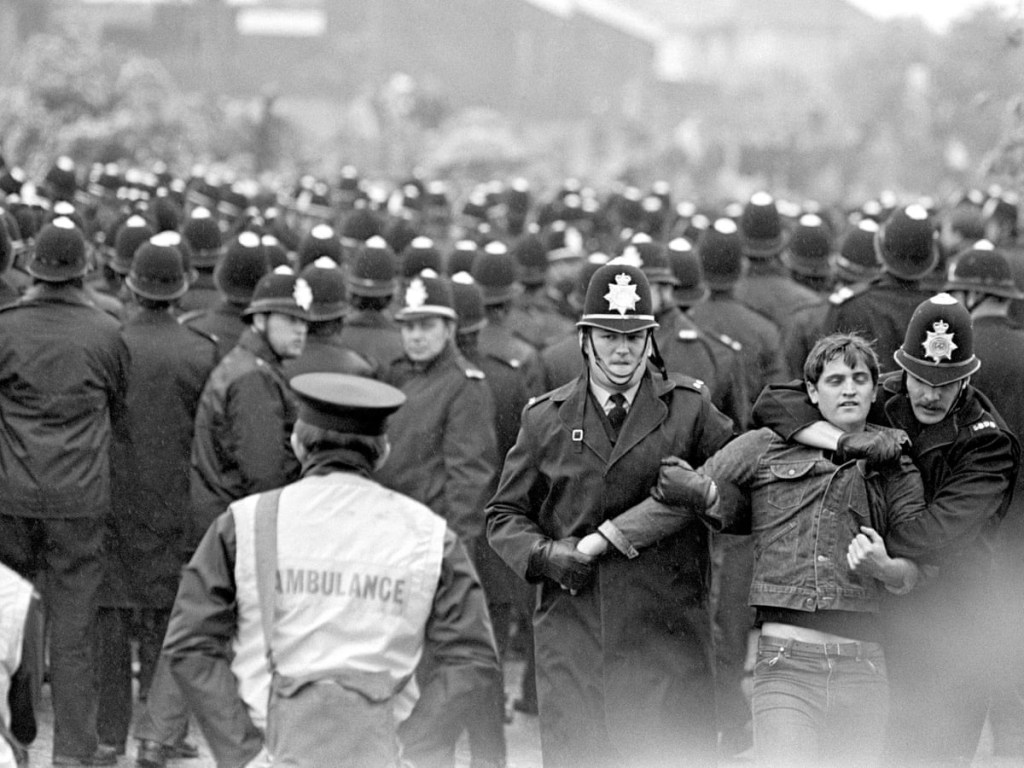
So Margaret Thatcher took on Arthur Scargill and won. But the damage to the social order was enormous. Politics descended into street fighting and the scars of that terrible time still remain.
The battle of Orgreave in 1984
Thatcher was re-elected in 1987 and the working class vote facilitated this. Notwithstanding the bitter class divisions of the Miners’ strike Thatcher received support across the board.
Millions of working class people, previously solid Labour, voted for Margaret Thatcher’s Conservatives in the 1980s. Sound familiar ? Then as now extremism of the Left was a turn off for the majority of voters. Voter motivations can be complex but it is fair to hazard a guess that nobody who voted for Thatcher did so because she was “ahead of her time on climate change awareness”.
The Conservative manifesto in 1987 said “The world’s resources of fossil fuels will come under increasing strain during the 21st century; so may the global environment if the build-up of carbon dioxide the so-called “greenhouse effect” significantly raises temperatures and changes climates.” This was, of course, well after the end of the Miners’ strike. The Tory solution was a commitment to Nuclear Power, though, to be fair, Renewables do get a passing reference.
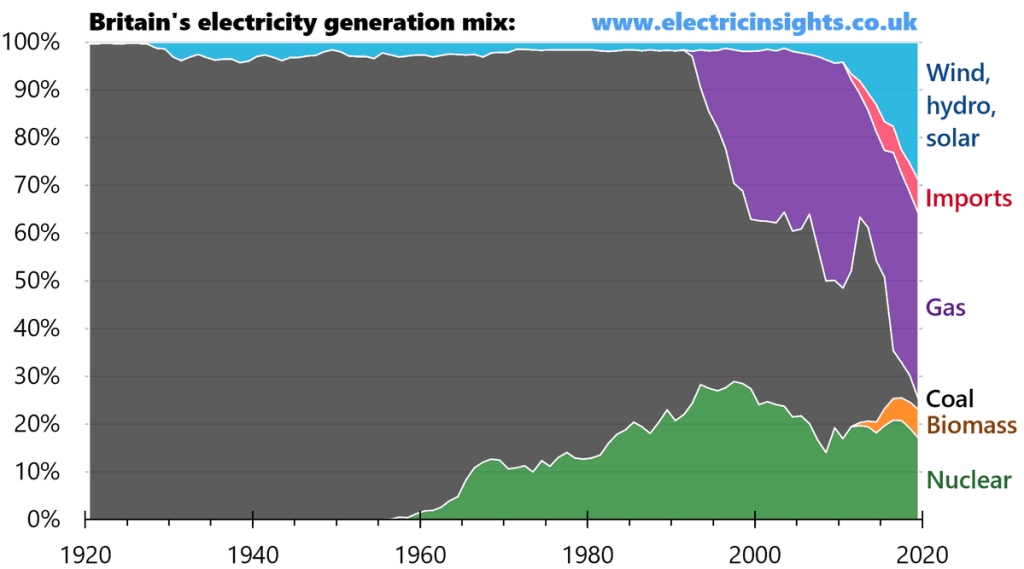
Boris Johnson was being disingenuous in his assertion, joke or not, that Thatcher “gave the UK a head start in its efforts to reduce its carbon emissions by closing so many coal mines across the country”. In defending the Prime Minister Sarah Vine misses a trick. The key contributor to the decline of Coal was the rise of the use of Gas in power stations (see above) and this started towards the end of the Thatcher years. Gas firing is still threatening to the environment but far less polluting than Coal. North Sea gas as part of the energy mix was driven mainly by its increasing availability and the Thatcher governments helped facilitate this. But again the driver was not the Environment but economics.
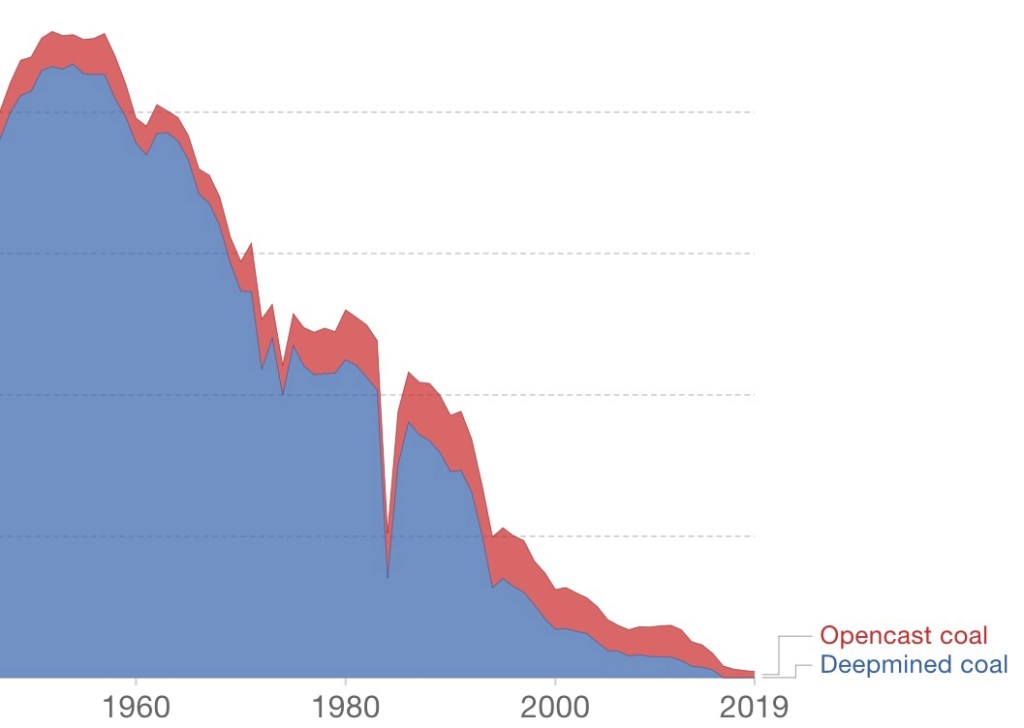
U.K. Coal production
The reduction in U.K. coal production started long before Thatcher took on the miners and continued in the decades that followed irrespective of whether it was a Conservative or a Labour government. Thatcher’s failure was not to manage the ongoing and inevitable decline in U.K. Coal production sensitively. I have argued that switching away from coal in the long term was desirable but that the confrontational way that it was done was deplorable.