There are writers who build imaginary worlds, and there are writers who discover that the world already inhabits us, like an uninvited tenant, rearranging the furniture of our desires. Sally Rooney belongs to the second category. Her novels take place in a recognisable Ireland of university corridors, rented rooms, cafés, country houses and kitchens where the tea goes cold while somebody fails to say the thing that might save them. Nothing much happens, one might suppose. Two people fall in love. They misunderstand each other. They fall in love again. And yet, beneath these modest catastrophes, history is grinding its enormous teeth.
Rooney, born in County Mayo, emerged into literary consciousness with Conversations with Friends (2017), followed by Normal People (2018), a novel whose title possesses the quiet audacity of a philosophical challenge. What, after all, constitutes normality? Is it a bank balance, a family background, a particular fluency in the rituals of belonging? Or is it merely the name we give to the arrangements that permit some people to feel at home in the world while others apologise for occupying space? Rooney’s characters understand these questions intellectually long before they can answer them emotionally. This discrepancy is her territory.
Marianne and Connell, the lovers of Normal People, are divided by class, though not by any dramatic social gulf that a Victorian novelist might have populated with dukes and starving orphans. Their distance is subtler, more insidious: the difference between knowing how to enter a room and wondering whether one has the right to be there. They possess the vocabulary of contemporary enlightenment, yet remain almost helpless before the ancient hieroglyphics of embarrassment, longing and shame. They can discuss power more readily than they can exercise it; they can diagnose their unhappiness with admirable precision while continuing to manufacture it.
This is Rooney’s peculiar comedy. Her characters are clever enough to recognise the machinery imprisoning them, but recognition does not open the door. Indeed, sometimes it furnishes the prison with better wallpaper.
Her prose, stripped of ornamental fuss, moves with the apparent innocence of conversation. The effect is deceptive. What remains unsaid acquires a pressure almost geological. A hesitation, a delayed reply, a sentence ending just short of confession: these become events of tremendous consequence. Rooney understands that modern intimacy is conducted partly through language and partly through the elaborate systems of evasion we construct around it. We speak, but we also send signals; we confess, but only to what can safely be denied.
In Beautiful World, Where Are You, her gaze widens towards art, capitalism, friendship and the approaching ecological catastrophe. Intermezzo, meanwhile, turns towards grief and brotherhood, asking whether love might survive the failure of our familiar emotional instruments. The private life, Rooney suggests, is never entirely private. The economy sits at the dinner table. History occupies the spare bedroom. Even desire has a class consciousness.
Her achievement is not to reconcile politics and tenderness but to reveal their uncomfortable proximity. People may believe in equality and behave selfishly; they may understand injustice and remain implicated in it. Rooney refuses the consolations of uncomplicated virtue.
Perhaps this is why her novels feel so intimately contemporary without being merely topical. They understand that the modern predicament is not an absence of feeling but an excess of interpretation: we know so much about ourselves, and remain, in the decisive moments, so magnificently unreadable to one another.
Rooney’s people keep trying. In that persistence, awkward, compromised and faintly absurd, there is something resembling hope.
“Blues Twentieth century blues They’re getting me down Who’s Escaped those weary Twentieth century blues?
In this strange illusion Chaos and confusion People seem to lose their way What is there to strive for Love or keep alive for Say, ‘Hey, hey!’ Call it a day”
I don’t think the great Noel Coward, whose song this of course is, ever really thought of “calling it a day” but being born a week or so before the Century began he lived through enough events to give anyone the “blues” – though in the main his personal life was a happy, if unconventional, one.
I was born 47 years after Sir Noel and my generation, certainly in Britain, is regarded as “lucky” – rightly I think. This can make us sometimes self-satisfied and arrogant. We are privileged in many ways, not least in never having to wear uniform unless we chose to. We’ve had good healthcare and education – new Universities were built for us! There have mostly been jobs for us, foreign travel and freedoms even our parents couldn’t have imagined were possible. We have a few whingers though and a bit of an “entitlement” mindset. But mostly we never “had it so good”.
Twenty-first century Blues in Nuremberg
But has the bubble burst, and are we to blame? I went to a new production of Wagner’s “Meistersinger” in Düsseldorf on Saturday. In it law and order breaks down in the Nuremberg of the 2030s and by 2035 there is a military dictatorship. Yesterday morning as I waited for a flight home I saw footage from France of just such a serious breakdown in order. Last night some in the audience booed Daniel Kramer’s dystopian portrayal of a newly fascist Germany. Are they booing now?
Leadership is a continuum from genuinely engaging and participative at one end to dictatorship at the other. Sometimes the switch from the former to the latter is missed as it happens. The insanity of Trump a present-day example. Just read the history of the Weimar Republic if you think I exaggerate. Liberties had gone a long time before there were tanks in the streets. (Unburdened by democratic sensibilities the Chinese sent in the tanks in Beijing in 1989 as soon as there was trouble.)
The key is the presence, or absence, of checks and balances. The United States is proud of its Constitution. A great legacy of the Founding Fathers. But it failed to prevent the Civil War. It failed to protect the post-Civil War rights of the African American population. And in the Trump autocracy it’s failing again. Noble words can’t always prevent ignoble actions.
In this “chaos and confusion” many are indeed “losing their way”. Britain post-2010 has had seven Prime Ministers – an unprecedented turnover. In Daniel Kramer’s Meistersinger model this could surely only lead to an extra-constitutional power grab by a man, or group, in uniform. Do we have the strength here, or in France or Germany democratically to resist this? I’m not sure that we do. In America even if Trump departs the scene the likely successor cabal is terrifying. “Far worse than Trump” as perceptive commentator Louise Mensch put it to me.
Complacency is the biggest threat but almost as big is the search for figures to blame. The ubiquity and availability of media is such that it’s hard to avoid the disturbing events around us. They inevitably, all too often, lead to people trying to identify someone or something to blame. Refugees didn’t escape from what they saw as oppression on a whim. But when they arrive in a safe haven in Western Europe and Britain they are routinely vilified by people who see them as a threat. That was one of the themes in Düsseldorf.
The “Twenty-first Century Blues” have common characteristics with the previous century. Power still corrupts and absolute power absolutely. Trump again, but not just him. Once respected institutions from the British Royal Family, to famous branded companies and sports teams and celebrities in all walks of life fall seem to fall from grace daily. Column inches ( and the digital equivalent) can cause a loss of public trust instantly.
Dialogue, especially on Social Media, all too often descends to abuse. Where once there was informed debate now there is inflexibility of opinions and a shouting match. Positions are defended with a stubborn refusal to accept the possibility of having been mistaken. After ten years of living with first the threat and then the gruesome reality of Brexit few if any of its original proponents have admitted they were wrong. Despite the unshakable evidence all around.
In these circumstances, despite there being plenty to “strive for” and “keep alive for”, the fact that honest politicians and truthful commentators are a rarity could well make us shrug and say “why bother” ?
The writer and theologian Thomas Merton said “Art enables us to find ourselves and lose ourselves at the same time.” That was my take on the “Deutsche Oper am Rhein’s” Meistersinger. Setting it in the present day challenged us in a way a more traditional historical setting would not. And moving into a frightening future even more so. Daniel Kramer’s timing was no doubt coincidental. But to see masked rioters clad in black on the stage in Düsseldorf at precisely the same time that they were rioting in Paris was chilling.
To call the characters and behaviour of the “Royals” a Soap Opera is a bit of a cliché. But the series “The Crown” worked perfectly as a sort of posh “Eastenders”. The overwhelming learning was of a shallow family whose only claim to fame was that they were born into (or married into) privilege. The only one of them that successfully competed on a level playing field with normal people was Anne on her horse (good for her).
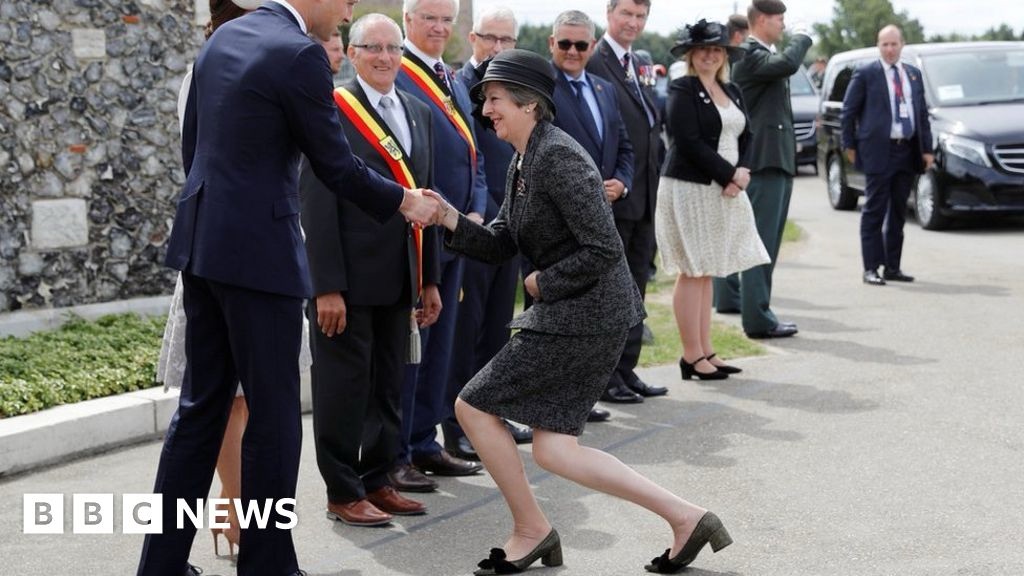
This is where the obligation for deference becomes unsupportable. The sight of an elected Prime Minister kowtowing to one of them was particularly repellent. But there was a symbolism here. To be impressed by genuine achievement is healthy and commendable. To show admiration for someone solely because of the accident of their birth is not.
When countries become republics, however shaky the democracy may be, they abandon the absurd contention of birthright. Some monarchists argue that to have a non-political Royal head of state is preferable because oh his/her neutrality. But if that Head of State comes randomly from a very narrow cohort it’s very risky. To cite the late Queen to prove that Monarchy works is specious. Edward VIII was a horror , and we could have had a King Andrew if there’d been a fatal virus to carry of the Queen and her elder son during the 22 years when Andrew was second in line to the throne!
The amount of media coverage the current spat between the Windsors and the Spencers is getting makes us look ridiculous. The revelations about Andrew should make us question the whole idea of inherited wealth and power. And in public the Royals’ behaviour often makes it look as if we’re stuck in a Gilbert and Sullivan operetta. Then there’s the institutionalised lies and cover ups. We don’t hear about gay members of the Royals, but they’ve been some of course. Or how the late Queen’s consort lived much of the time with his mistress. But he did.
There are encouraging signs that the public is becoming weary of the Soap Opera, but don’t hold your breath. They hang on.
My Question: “Is there a rational explanation as to why citizens of the former Communist GDR are now embracing the Hard Right AfD ?”
ChatGPT (AI) answer
Yes. There is a quite rational, historically grounded explanation—although it is important not to reduce AfD voters to either “Nazis” or “victims of economic deprivation.” The eastern German story is more complicated.
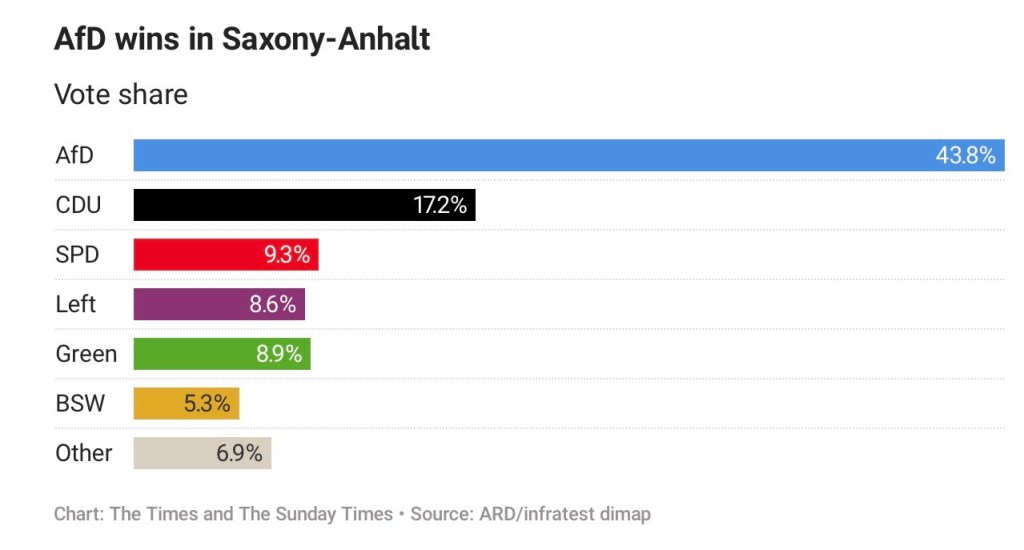
And the timing is striking: yesterday, 6 September 2026, the AfD won 43.8% in Saxony-Anhalt, its strongest state-election result ever.
The apparent paradox is: How can people who lived under a communist dictatorship end up voting for a party on the hard right? The answer is that the AfD is not offering a return to communism’s opposite in every dimension. It is exploiting several long-standing East German experiences that don’t map neatly onto the conventional left–right spectrum.
1. Reunification was experienced by many as something that happened to them
This is probably the most important piece.
For many West Germans, reunification was essentially a national triumph. For many East Germans, it was also an abrupt institutional, economic and social takeover.
The West German constitution, currency, legal system, political parties, companies and administrative structures were essentially extended eastwards. Millions of East German jobs disappeared as inefficient state industries were rapidly dismantled or privatised. Western Germans disproportionately occupied senior positions in the new institutions.
So there developed a feeling that:
We lost our country, our careers and our social status—and then we were told that the West had generously rescued us.
That produces a very different psychological relationship with the Federal Republic.
Research on eastern Germany repeatedly finds unusually strong feelings of social marginalisation and under-representation, even after substantial economic convergence.
And there’s an important distinction here: you don’t have to believe the GDR was good to resent what happened after it disappeared.
Someone can simultaneously think:
“The GDR was an authoritarian dictatorship.”
“Communism failed.”
“Reunification was necessary.”
“But the way reunification happened was humiliating and unfair.”
Those aren’t contradictory propositions.
2. The East has a particularly strong anti-establishment political culture
There’s an interesting historical irony here.
East Germans have had very little reason to develop the same unquestioning institutional trust that developed in West Germany after 1949.
They experienced one political system collapse in 1989–90. Then they were incorporated into another political system whose institutions were largely unfamiliar and whose elites were predominantly western.
Consequently, distrust of established institutions is unusually pronounced.
And that makes the AfD’s basic pitch—
“The political establishment doesn’t represent you; the system is rigged against ordinary people; let’s tear it up”
—particularly potent.
The German Federal Agency for Civic Education has documented substantially lower levels of trust in political institutions in eastern Germany and notes that the AfD replaced Die Linke as the principal protest party in much of the East.
That’s an important point: some AfD votes aren’t really votes for the AfD’s entire ideological programme. They’re votes against the establishment.
Of course, that distinction can disappear once a protest movement becomes powerful.
3. Economic deprivation matters—but not quite in the way people sometimes assume
The East is no longer simply “poor Germany.” Enormous economic progress has occurred since reunification.
But relative disadvantage and perceptions of disadvantage matter politically.
Eastern Germany still has lower wages and wealth, fewer major corporate headquarters, an older population, demographic decline and some areas with substantially weaker economic prospects. Reuters noted in 2024 that median wages were about €3,013 in the East versus €3,655 in the West, while unemployment remained higher.
More interestingly, research from the ifo Institute found that increasing economic deprivation produces a stronger increase in far-right voting in eastern Germany than in western Germany.
But this doesn’t mean:
poor → AfD
It’s more like:
economic insecurity + perceived disrespect + demographic decline + political alienation → receptiveness to populism.
That’s much closer to what the evidence suggests.
4. There’s also a profound status issue
This is arguably even more important than income.
Imagine being 55 in 1990.
You had spent your entire adult life in the GDR. Perhaps you had a respected position in a factory, railway, school, local administration or technical profession.
Suddenly, the entire institutional world that had validated your status disappears.
Your qualifications may no longer count in quite the same way. Your workplace disappears. Your children move west. Western managers arrive. You are repeatedly told that the West has the more advanced culture, economy and political system.
You aren’t necessarily poor.
But you can feel that your biography has been devalued.
This is one reason why the politics of recognition is so powerful in eastern Germany.
The message isn’t simply:
“We’ll make you richer.”
It’s:
“We know why you’re angry. They look down on you. We don’t.”
That is extremely powerful political messaging.
5. The AfD has cleverly turned East German identity into a political identity
This is particularly visible now.
The AfD has increasingly presented itself as the party of the “real” East German—ordinary, socially conservative, sceptical of Berlin elites and hostile to what it portrays as western liberal cultural norms.
Its campaign in 2026 has even incorporated East German cultural symbols such as the Simson moped, deliberately invoking regional nostalgia and identity.
That’s clever because it allows someone to say:
“I’m not voting for extremism. I’m voting for us.”
And that is psychologically quite different.
6. The East is also somewhat more socially conservative
This is where the explanation gets uncomfortable.
It isn’t all grievance.
Research comparing eastern and western Germans has found somewhat stronger nativist and populist attitudes in the East, particularly among older generations who were politically socialised during the GDR period. Nativism is also more strongly associated with AfD voting in the East.
There are several possible reasons.
The GDR was officially internationalist, but it wasn’t a liberal multicultural democracy. Everyday social life was comparatively homogeneous, and immigration was limited and highly controlled.
After 1990, Germany entered an increasingly globalised, multicultural and socially liberal world.
For some people, that represents progress.
For others, it represents another enormous cultural transformation imposed from above.
The AfD tells the latter group:
“You aren’t backward. Your instincts are legitimate.”
Again, that’s an extraordinarily effective political proposition.
7. And there is a fascinating Russia dimension
This is another legacy of the GDR.
Older East Germans spent their lives in a society whose geopolitical orientation was towards the Soviet Union. Many had direct experiences of Russians—through Soviet military bases, education, work, friendships and cultural exchange.
That doesn’t mean they are pro-Putin.
But Russia is psychologically less alien to many eastern Germans than it is to many western Germans.
That difference has become politically significant since Ukraine.
The AfD’s opposition to sanctions, hostility toward German military support for Ukraine and advocacy of renewed relations with Moscow therefore resonate particularly strongly in parts of the East. Reuters reported this week that memories of the Soviet presence remain politically significant in Saxony-Anhalt.
But here’s the really interesting paradox
There is actually a continuity between some East German political behaviour before and after 1990.
During the GDR, people couldn’t meaningfully change the government through competitive elections.
So political culture developed around:
“The rulers are illegitimate; we have to find ways around them.”
After 1990, that instinct didn’t necessarily disappear.
It could manifest as:
“Berlin doesn’t listen to us.”
And then:
“Vote for the party that Berlin is terrified of.”
That’s one reason the AfD can function simultaneously as an ideological party and as a giant middle finger to the political establishment.
But I wouldn’t say “former Communists became fascists”
That explanation is too simplistic.
In fact, one of the most revealing facts about eastern German politics is that the same underlying electorate has historically been capable of voting for both the radical left and the radical right.
The successor to the East German communist party, Die Linke, was for years extraordinarily strong in the East.
Then the AfD began taking some of that protest vote.
And more recently, Sahra Wagenknecht’s BSW has attracted voters combining left-wing economics with socially conservative and anti-war positions.
That suggests something important:
The underlying political axis isn’t necessarily “left versus right.”
It’s often:
establishment vs. anti-establishment
combined with
social liberalism vs. social conservatism
and
globalisation vs. local/national identity.
The AfD happens to occupy the most electorally successful corner of that space.
And there’s one final irony
The AfD’s success isn’t really evidence that East Germans have forgotten what authoritarianism looks like.
It may partly demonstrate something else:
having experienced one authoritarian system does not automatically immunise a population against another form of authoritarian politics.
People don’t vote according to a historical lesson book.
They vote according to how they perceive their present circumstances, identity, status and future.
And if someone feels that:
their region was humiliated by reunification,
their children had to leave,
their community is declining,
Berlin doesn’t understand them,
mainstream parties don’t listen,
immigration is changing their country,
their cultural values are being dismissed,
and their economic future looks uncertain,
then an AfD message of “They abandoned you; we will put you first” can make considerable emotional and political sense—even if an outside observer finds the resulting choice deeply disturbing.
That’s probably the most rational way of understanding the phenomenon without either excusing the AfD’s extremism or caricaturing its voters.
And yesterday’s extraordinary 43.8% AfD result in Saxony-Anhalt suggests that this isn’t merely an interesting historical residue anymore; it has become one of the central political cleavages in contemporary Germany.
Musical theatre came of age on Broadway when “Oklahoma!” stunned audiences for the first time in March 1943. The American Musical was born – surely one of the great artistic creations of modern times. Before Rodgers and Hammerstein, on screen and stage, popular musical theatre had been jolly, often tuneful, but shallow fluff. You might leave the theatre or the cinema whistling the tunes – but you won’t remember the banal and trivial story. Chichester Festival Theatre did one of those period pieces last year with “Top Hat”. Bouncy, breezy and energetic it was – but instantly forgettable. But this year they have atoned themselves with a production of one of Broadway’s greatest achievements – Lerner and Loewe’s “My Fair Lady”.
Tony Jayawardena (Pickering), Keziah Ibe (Eliza) and Hadley Fraser (Henry Higgins) in the Chichester Festival Theatre’s production of “My Fair Lady “
It took Americans to tell a quintessentially English story. “Pygmalion” was George Bernard Shaw’s characteristically uncomfortable (for some) telling of a story that dramatised some of the social and behavioural conflicts of Edwardian England. It held a mirror up to the class and wealth differences in the London of those times. The gap between the lifestyle of Henry Higgins in Wimpole Street (rich and privileged) and Eliza Doolittle in Lisson Grove (an area notorious at the time for extreme poverty, alcohol abuse and crime) is unbridgeable. “My Fair Lady” interrogates the rigid constraints of the Edwardian class system, demonstrating how social status in Britain is artificially manufactured through speech and phonetics. It critiques the commodification of Eliza Doolittle by upper-class intellectuals who treat human identity as an experimental project.
So “My Fair Lady” is very much part of the genre of American Musicals with a subtle but visible openness about social issues that emerged strongly in the 1950s and 1960s :
“Oklahoma!” Premiering during the final years of World War II, it is often viewed as a patriotic celebration of American pioneering spirit, but it subverts standard pastoral tropes by examining the deep-seated friction between settled farmers and nomadic cowhands. The darker undercurrents surface most clearly through Jud Fry—an isolated, working-class outcast whose ostracisation and tragic fate expose the violent exclusions upon which orderly agrarian communities were built.
“South Pacific” Set on a South Pacific island during World War II, the musical directly confronts American racial prejudice through the song “You’ve Got to Be Carefully Taught,” which argues that hatred is a learned behaviour passed down by society.
“The King and I” Examines the friction between Western modernity and traditional Eastern hierarchy, highlighting the plight of enslaved concubines and advocating for female autonomy within absolute monarchy.
“Finian’s Rainbow” A whimsical fantasy that grounds its satire in real-world American bigotry, featuring a bigoted Southern senator who is magically turned Black, forcing him to experience systemic discrimination firsthand.
“West Side Story” Transposes Shakespeare’s Romeo and Juliet to the Upper West Side, addressing the hostility faced by Puerto Rican immigrants and the systemic failure of social institutions to help marginalized youth.
“Cabaret” Uses the decadent, amoral atmosphere of Weimar Berlin as a warning mirror for contemporary American complacency in the face of creeping fascism and antisemitism.
The Chichester production deftly honours the Oklahoma! (and later) trend for acute social observation in the American Musical theatre. It sticks closely to the plot and action created by Lerner and Loewe. The production thankfully eschews the regrettable trend to mess with the classics. In 2023 there was a production of Oklahoma! at Wyndhams Theatre which was boasted as “Oklahoma! as you’ve never seen it before – re-orchestrated and reimagined for the 21st century.” Ithought that it was beyond ghastly!
The Chichester audience is mostly elderly and many if not all will have seen My Fair Lady on the stage before and certainly the movie. The latter did not greatly deviate from the theatre productions. I don’t think they would have welcomed a “reimagined” version and I’m pleased to say they didn’t get one !
My Fair Lady is a long musical and a challenge for any cast and production team. The Chichester Festival Theatre met this challenge totally. It was musically outstanding and well sung. The dancing was exceptional – “I’m getting married in the morning” a tour de force. The principals – Hadley Fraser as Higgins and Keziah Ibe as Eliza couldn’t have been more contrasting castings. Fraser is a hugely experienced actor including major roles in Les Miserables and Phantom of the Opera. But it was Ibe’s professional debut. Both were outstanding. The theatre took a risk with the casting of the tyro Ibe in the key role of Eliza but she was a triumph. The two accents, cockney and posh, she handled with equal facility. She also sang well and acted this difficult part believably. A star is born.
We have too many juke box musicals cluttering up our stages these days. From Mamma Mia onwards the offering may have good song and dance but the story, if there is one, is secondary to that. My list earlier in this blog of musical theatre that matters is far from complete. “My Fair Lady” is one of the great American musicals. The Chichester production confidently confirms this.
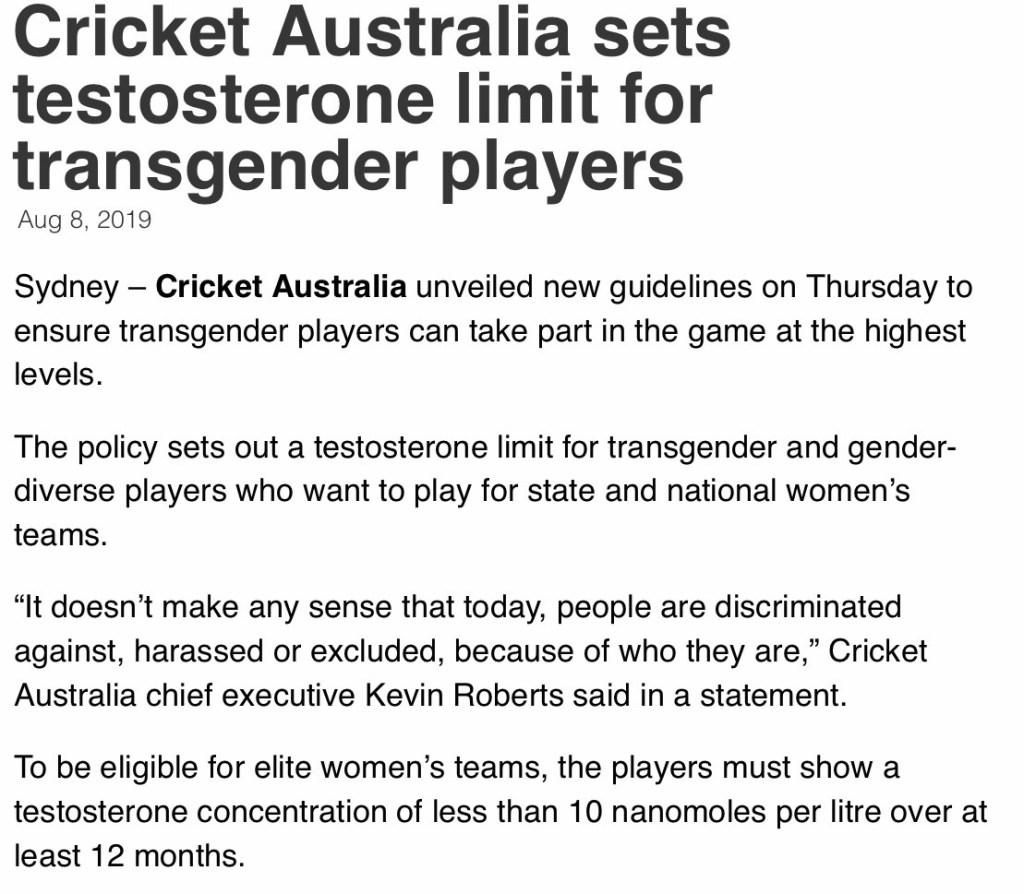
While testosterone is a major and highly visible driver of secondary sexual characteristics, biological sex differentiation is a complex, multi-layered process that extends far beyond a single hormone check.
From a physiological and developmental standpoint, biological sex is determined and expressed through several interconnected levels:
Chromosomes and Genetics: The foundational blueprint is typically set at fertilization by the 23rd pair of chromosomes—usually XX for females and XY for males. However, research has shown that genetic differences go well beyond just the presence of the X and Y chromosomes. Transcriptomic studies indicate that thousands of genes across the entire genome (not just the sex chromosomes) exhibit sex-biased expression, behaving differently in male and female cells and tissues due to complex regulatory networks.
Primary Sex Characteristics: These are the reproductive organs (testes and ovaries) that develop during embryonic and fetal life driven by genetic cascades (such as the SRY gene on the Y chromosome).
Endocrine Profiles: While testosterone is predominant in males, both males and females produce and utilize androgens, estrogens, and progesterones, albeit in vastly different baseline proportions and cyclical patterns.
Secondary Sex Characteristics: Developmental changes during puberty—such as bone structure, muscle mass distribution, fat distribution, vocal cord development, and body hair—are influenced by the long-term interaction of hormones, genetics, and cellular memory.
Cellular and Systemic Differences: Every nucleated cell in the body carries a sex chromosome complement (XX or XY), which influences cellular metabolism, immune responses, and how various tissues function. For instance, medical research shows that men and women experience different vulnerabilities and presentations in cardiovascular disease, neurological conditions, and autoimmune disorders, differences that are rooted in cellular and genetic architecture rather than circulating testosterone alone.
Because these systems are deeply integrated across development, checking a single hormone level provides only a snapshot of an individual’s current endocrine status, rather than capturing the full scope of biological sex architecture.
“ I’ve been wondering for years why so many people believe things that are obviously false so I decided to do some research on how propaganda actually works on the human brain because there is a pattern here. The people who fall for propaganda are not randomly distributed across the population they share very specific psychological vulnerability that propaganda is deliberately designed to exploit.
Propaganda has been a science for almost almost 100 years and the people using propaganda against you right now know exactly what they’re doing. Here are the ways propaganda actually works on your brain:
The repetition trap. Repeat the same lies so many times you’ve stopped noticing that they are lies. That is not by accident ! In 1977 psychologists Lin Hasher, David Goldstein and Thomas Topino at Villanova and Temple universities conducted a study where they showed volunteers a series of statements. Some of those statements were true and some of those statements were false. They showed these statements across multiple sessions weeks apart from each other. What they found destroyed the assumption that people can simply recognise false information. Statements that were repeated over multiple sessions were rated as significantly more truthful than statements they had only seen once. Itdidn’t matter whether that statement was actually true. It didn’t matter whether the person knew the statement was false before going into the study. Repetition overrode prior knowledge almost almost every time.
Psychologists call it the “illusionary truth effect” when the brain mistakes familiarity with truth – more times you hear something the more times your brain processes that thing is credible not because the evidence changed but because repetition makes information easier to process and your brain interprets at ease as reliability. That is why the stolen election lie did not die after sixty one courts rejected it. That is why the claim that immigrants caused more crime persists after every study shows the opposite. That is why vaccines and autism remain linked in many peoples minds despite the original study being retracted and its author losing his medical license for fraud. These people were not persuaded by evidence. They were worn down by volume – say it enough times and the brain starts to believe it. That is a default setting for most human brains – the only way to defeat that is with education.
The engineering of consent propaganda does not work by changing your mind it works by bypassing your mind entirely. In 1928 Edward Bernas, the man widely regarded as the father of modern public relations, published a book called “Propaganda ”. In the book he described with remarkable truth exactly how public opinion is manufactured and controlled. He believed that manipulating the public is not just acceptable in a democracy it’s necessary! He considered himself one of the people doing it. It is called the “engineering of consent” – the deliberate manipulation of public opinion not through argument or evidence but through the strategic control of symbols, emotions and associations that bypass rational thought entirely.
You do not convince people you make them feel something and then you attach that feeling to whatever you want them to believe. This is the entire operating model of right wing media. Fox News does not deliver information, it delivers outrage contempt – the warm satisfaction of having an enemy to blame – the facts are not important.
The feeling is the product you do not come away more informed you come away more afraid more angry and more certain that the people on the other side of your enemies. Bernas named this method in 1928 and it has been running at an industrial scale in American right wing media for 30 years.
If the fire hose of falsehood repetition is not enough enough on its own if repetition creates belief and emotion bypasses reason the most powerful propaganda strategy is not to tell just one convincing lie it’s the hundreds of unconnected lies simultaneously at maximum volume across every available channel faster than anyone can fact check them
in 2016 researchers Christopher Paul and Miriam Matthews at the Ryan corporation published the study on how certain political movements use lies as deliberate weapon weapons. research researchers called this the “fire hose of falsehood”. It’s when a political movement deliberately floods every information channel with so many lies so fast that the population loses its ability to identify what’s true or not anymore. The goal is not to convince anyone of any specific thing – the goal is to destroy the shared factual foundation that makes coherent public debate possible. That is when nobody agrees on what is true.
Watch any of the Trump press conferences from the last 10 years – researchers at the Washington Post counted over 30,000 false or misleading statements during his first term alone. The volume of lies is not incompetence it’s a strategy no fact checking operation on earth can keep up with. So it does not need to win any argument, it just needs to make argument itself.
There is another mechanism that makes propaganda almost impossible to reverse once it has taken hold. In 1957 psychologist Leon Feser at Stanford University published his landmark research on cognitive dissonance. He found that when people hold a belief that is contradicted by evidence, they do not update their beliefs but experience psychological pain and then construct whatever justification is necessary to protect that belief from the evidence. Psychologists call this this “ protective cognition” when a belief becomes so fused with a person’s sense of who they are that someone challenging that belief stops processing incoming information at all – it processes that information as a threat responds to such threats the way it always does with aggression. This is why Trump supporters who lost their jobs because of tariffs still defend tariffs. This is why every piece of evidence that Trump committed crimes is processed not as evidence but as proof of the conspiracy against Trump
Propaganda is not designed to convince everyone it’s designed to find the most vulnerable people in the room and exploit them. the people with fragile identities, the people who lost community, the people who need belonging badly enough to accept any story that provides it.
If you can see the mechanism behind propaganda you were never the target but the people who cannot see it are everywhere – and there were enough of these people to change the outcome of an election. The people running this operation are not trying to convince you they’re counting on you doing nothing while they convince everyone else.
Some people will wake up when the lies finally cost them something they cannot ignore. But most people won’t. The answer is not to argue louder it’s to understand exactly what we’re up against. Propaganda is a science and so is the resistance. The propaganda machine is running on the most vulnerable people in your life right now and it won’t stop until it costs them something they cannot explain away.”
To illustrate how short-term weather fluctuations sit on top of a long-term climate trend, think of climate as the underlying baseline signal and weather as the day-to-day or year-to-year noise.
The graph below illustrates this exact relationship over a 50-year span:
Key Concepts Illustrated in the Graph:
1. Climate as a Continuum (The Dark Red Line)
What it represents: The 50-year moving average or underlying trend in global/regional climate (such as mean temperature anomaly).
The progression: It shows a steady, continuous progression over time. Even if individual years or months vary, the overall climate baseline moves predictably upward over multi-decade scales.
2. Weather as Short-Term Noise (The Light Pink Jagged Line)
What it represents: Local atmospheric events, seasonal shifts, natural ocean oscillations (like El Niño/La Niña), and sudden weather fronts.
The volatility: Notice how wildly the pink line swings from month to month and year to year. In any short window (e.g., Year 10 to Year 15), you will see sharp drops that resemble cooling or dramatic spikes that look like sudden extreme heat.
n.b. This was produced for me, at my request, by AI. (Gemini).
I wrote this in February 2018. It’s a bit long-winded but there may be indications that I was right
The reasons people gave for voting “Leave” in the EU Referendum fall broadly into two categories – though they overlap and both can be characterised under the slogan “Take Back Control”. The clinching argument which gave “Leave” their narrow victory was concerns about “Immigration”. The other argument – the one given by the more sophisticated Brexiteers – was about “Sovereignty”. Those who personally voted “Leave” , giving “Sovereignty ” as the reason, also tend to deny that immigration concerns were the principal reason “Leave” won. They are squeamish about associating themselves with a position which could be borderline racist, Islamaphobic or xenophobic and for which the main proponents were UKIP and its even further to the Right fellow travellers. In particular the Leave.co.uk campaign led by Nigel Farage, Arron Banks and Kate Hoey. There is a strong dose of disingenuousness about all this. Some of the Conservative “Leave” campaigners jumped on the “Turkey is joining the EU” meme – including the new Defence Secretary Penny Mordaunt. The “Official” “Leave” campaign ran an advertising campaign saying this. It was, of course, a barely coded message about immigration, especially Muslim immigration. At least the advertising of Banks, Farage and co. was more open about its “Don’t open the floodgates to more migrants” pitch.
“Take Back Control” was often linked to “our borders”. Essentially a positioning which says that “Freedom of Movement” – one of the “Four Freedoms” essential to the EU’s “Single Market” – meant that anyone from 30 countries (not just EU countries) could come and live and work in Britain as a right. And when here they would be treated as a British citizen in respect of (say) healthcare or welfare. The “Take Back Control” slogan and all its surrounding rhetoric implied that FoM is a bad thing and we should have full control of our borders again and not have who enters Britain decided but Brussels. In fact studies show that the presence of European nationals is strongly net positive to the UK economy. But such truths were casualties in the febrile and often squalid times of the Referendum.
A Sovereign nation certainly controls its border itself unlike the 28 countries of the European Union, along with Switzerland, Norway and Iceland which are open to citizens from across the continent. But it is surely the case that the 27+3 nations that will continue to be open if Britain leaves have made a conscious decision to do so. In effect they have pooled their Sovereignty on this matter. And for good reason. The Single Market offers huge mutual benefits and the freedom of movement of two factors of production – Labour and Capital – is an integral part of this.
Those who voted “Leave” citing “Sovereignty” no doubt had control of borders as one of the reasons but, they argue, it goes beyond that. “Isn’t it better that Britain takes its own decisions rather than having slavishly to follow the same path as 27 other countries?” There is a strong nationalistic element to this reminiscent of Flanders and Swann’s “The English, the English, the English are best – I wouldn’t give tuppence for all of the rest”. In essence where a decision needs to be made and who makes it is more important than the quality of the decision – or so this implies.
Rationally in most cases it really doesn’t matter where a decision is taken or who takes it so long as we perceive the outcome as being beneficial to us. To me two of the most important developments of the past decade or so were taken thousands of miles from Britain’s shores. Amazon and Apple launched products and service which literally changed my life. To be able to buy virtually anything online from Amazon at a fair price and have it swiftly delivered to my home is a boon. And to be able to make this purchase lying on a hotel bed (as I am now) using my iPad? Well ! Exactly the same applies to political decisions. If the European Parliament approves a regulation that benefits me does it matter that it was taken in Brussels rather than Westminster. Of course not. In a global, interdependent world the best decisions on crucial matters are better taken cooperatively. The English are not necessarily best. The EU recognises that local matters should be resolved locally. “Subsidiarity” is a key EU principle. The idea that you take decisions at the lowest level practical is inherent in how the EU works – far more so than in England where (unlike Wales, Scotland and Northern Ireland) we have few political institutions below Westminster to devolve decision-making to.
The other benefit of joint sovereignty in certain areas is that there are more checks and balances .and greater pooling of experiences. If the EU proposes a new regulation there are 28 nations to consider it from their own experiences. If the British Government proposes a new law no such checks exist. It may take longer at an EU level, but any significant new regulation will have been considered from a broad not narrow perspective.
The mention of Amazon and Apple – and I could have chosen a hundred or more examples – was just to illustrate that 21st Century life is complex and major influences on our lives come from people or organisations we only engage with indirectly. This may seem a statement of the obvious – it is – but this fact is at the heart of any discussion about “Sovereignty” , or should be. At a basic level many of us would like the maximum of control over our own lives. It is possible to do this – perhaps by moving away from the complexities of modern living to some cottage in the country, growing our own vegetables and making our own entertainment. Even if we do that we cannot truly escape. We still have to pay our taxes and fulfil some bare minimum citizen obligations. The world is always with us.
In modern history some of the greatest horrors come from when peoples , or specific groups of people, are forced to do something against their will. Ethnic cleansing. Fleeing war or a natural catastrophe. It is natural to want to choose what we do and when we cannot do that for whatever reason we are aggrieved. And in a democracy it is likely that legitimate governments will pass laws that some citizens will object to. Here the concept of the “greater good” applies. You won’t please all the people all the time but so long as a particular law or regulation benefits significantly more people than those who object to it it’s probably worthwhile. So long as the democratic process was fair and followed and the consequences properly managed.
Which brings us back to the decision-making process in governance. Can we accept that in principle it really doesn’t matter who takes a decision or where it is taken – only whether it was a quality decision? Are lower level decisions always better than higher level ones or does there need to be a pragmatism which accepts remote decision-making if the outcomes are desirable? I think the answer is obvious. Major social, economic environmental and other changes can only really be taken at a high level. You couldn’t have had London boroughs opting out of the “Clean Air Act” at will. There had to be a decision at a much higher level of Government if the fogs and smogs of 1950s London were to be eradicated. Which they were.
Politics has always been in part about the struggle between freedom and compulsion those polarising goals of the Right and the Left. The battleground is at the heart of political discourse. The gut cry “Too much regulation stifles our freedoms” is not a modern idea. In power parties of whatever political persuasion will always have to consider whether more or less regulation is desirable – there is rarely a credible ideological answer (or even guideline) to help resolve these questions. That regulation has generally increased in the post war decades is broadly true. This is in part a response to lifestyle changes and in part a consequence of having a better understanding of science. The “Clean Air Act” was necessary because people were dying prematurely and unnecessarily from pollution. The heavy regulations applied to smoking and tobacco were the same. Public health was the driver.
As citizens our first obligation is to obey the law. Even if we disagree with it. The “greater good” argument should persuade us if we take our citizenship seriously. But how the law should operate and what new laws should apply (or existing laws be relaxed or changed) can be contentious. Perceived fairness is crucial – are those to whom a new law will apply being treated “fairly” ? If we are non smokers we probably don’t care that much about tobacco duty increases. But, I would argue, we should care that smokers are being treated fairly – smoking is a legal pursuit. We accept discriminations across society that are for the “greater good”. The banning of smoking in public places was certainly discriminatory – but few or any would now argue that it was the wrong thing to do. My 40-a-day mother would be astonished if she was here. But she isn’t. She died prematurely of cancer in 1978.
Modern life is not only complex but we also live in a world of far greater interdependence than even our closest forefathers. “No man is an island entire in itself” wrote John Donne 300 years ago but the apotheosis of this appeared in the twentieth century and has grown exponentially. Even an island race is no more entire in itself, and certainly not one as large and diverse as Britain. The primary context in which we live and work is now a global one and, especially, European. The British economy is inextricably part of the greater European one. The drivers are freedoms that we and fellow Europeans have created for our mutual benefit. Crucially three of Adam Smith’s four “Factors of Production” can and do move freely across the 28 countries. Labour, Capital and Enterprise move according to classic economic supply/demand drivers. A Greek Bank can invest in a Swedish car plant without restriction if its sees a good return. A Swedish student can study in Athens. A Greek Doctor can work in Britain’s National Health Service. And so on tens of thousands of times over.
Change can be stressful and some manage it better than others. Whilst Britain is certainly not a closed society it can be insular – more so, perhaps, than those among our fellow European nations with contiguous borders. The joy of driving across national borders without the need to stop for any customs or other checks has been a part of mainland Europe for decades. They don’t talk about “going abroad” – that concept doesn’t exist. That doesn’t mean that going from (say) Germany to France isn’t noticed. Of course not. The distinctive cultures of the two countries is enjoyed, even celebrated but moving between them is no big deal. But those 21 miles of sea between Britain and “Europe” though no longer any sort of physical barrier thanks to the Tunnel are still a psychological barrier. We do go “abroad”.
The biggest divide in Britain is not North/South or even Class – it is between those who see nationality as horizontal – and those who see it as vertical and hierarchical. The latter group were the ones satirised by Flanders and Swann. They are often older, less educated and far less travelled. They see nationalities as having a hierarchy with Britain at the top. They often put Anglophone Countries next – indeed many of the Eurosceptics who became Brexiteers are supporters of the mythical “Anglosphere” a concept not acknowledged by anyone in the countries like Australia or New Zealand who the Eurosceptics say would be part of it. It’s all bunkum. Those of us who see nationality as horizontal don’t deny differences of culture and behaviour – we just don’t think British culture and the way we behave are better than those who are different.
So “Sovereignty” or “taking back control” is a consequence not of logic but of bias. The idea that decisions that Britain takes on her own are likely to be “better” than those taken co-jointly with others is based on the same highly questionable ideological slant that sees nationality as vertical and hierarchical. It conflicts with the adages like “Two heads are better than one “ or “A problem shared is a problem halved”. It is proudly individualistic , even nationalistic, rather than collegiate and trans-national.
What we are dealing with in the “Sovereignty” question is not empirical. You cannot “prove” that “taking back control” will produce better outcomes (or that the opposite will for that matter). The issue amounts to this. Should Britain really become the only country in Europe outside the EU and it’s close associates like Norway and Switzerland in the Single Market because of some highly spurious claim that we need to “restore our Sovereignty”. Can we really be that foolish?
A key United States stat is ‘income share of top 1%’. The US IS TWO NATIONS. Rather as England was in Victorian times. Here’s what Disraeli said in “Sybil”:
“Two nations; between whom there is no intercourse and no sympathy; who are as ignorant of each other’s habits, thoughts, and feelings, as if they were dwellers in different zones, or inhabitants of different planets; who are formed by a different breeding, are fed by a different food, are ordered by different manners, and are not governed by the same laws. THE RICH AND THE POOR.”
When you average the rich and the poor you get numbers that are representative of neither. Many of us have seen the lifestyle of those Americans with money. Especially on the East and West coasts and in islands of wealth like Florida or Vegas. But go to the poorer parts of the great cities or the boondocks and it’s a different story.
The median family income in Massachusetts is $100k, in Mississippi it’s half that. With far more limited welfare support than in Europe there are Victorian levels of poverty almost everywhere. The conspicuous consumption of the rich, starting in the White House, would make Louis XVI blush ! Batten down the hatches you fat cats.