But we do Rod, that’s exactly what we need. One of the roles of Government is to protect us from others, and from ourselves. As long as I can remember people have railed against “Health and Safety” as some sort of infringement of our personal liberty. Which of course it is. Our liberty to kill ourselves or others accidentally.
I remember my Dad back in the 1960s exploding against Barbara Castle over the breathalyser and seat belts. He and his golfing friends were outraged at this restriction of our freedom – our freedom to be arrogant tosspots actually.
As citizens we have to accept that government and the law curbs what we do.— that a civilised society has to have rules. We must hope that Government acts rationally – which means that it takes due regard of expert advice. A good test is to look at what others are doing. Across Europe countries, taking expert advice, are responding to the Second Wave with a Second Lockdown. It’s not just us.
A driver of populist politics is libertarianism. The idea that we, especially we English, must have the right to do what we like. Whatever the experts say. All of those who truly understood economics knew that Brexit was a very bad idea indeed. But Michael Gove told us that it was alright to stop listening to experts. The same with lockdown. We responded far too late to impose the first lockdown and lifted it too soon. Plus ça change.
Getting the balance between authoritarianism and freedom right isn’t easy. But when increasing numbers of our fellow citizens are dying horrible deaths caused by a virulent and hugely contagious disease to restrict freedoms to prevent its spread ought to be uncontentious. But then you know Rod – he knows best…
“Furthermore, Mr Cummings, although right wing, isn’t a Tory — that’s to say, a believer in the wisdom of institutions.” Paul Goodman in The Times today.
Well you could have fooled me. Not about Cummings – like his erstwhile biggest fan the Prime Minister he clearly believes only in himself and the devil can take the hindmost. No I refer to the idea that Tories believe in the “ wisdom of institutions”.
Let’s look at a few institutions where that alleged belief has been challenged or abandoned. Start with Europe’s most important institution the European Union. The Tory Right, which has now taken absolute charge of the Conservative Party, had contempt for the EU. Faced with some genuine concerns about the power of and direction being taken by the EU Conservatives decided to flee rather than fight. They could, alongside likeminded governments in France and Germany, have argued and campaigned for reform. Instead they picked up the ball and ran away. Some “belief” that was.
Then there’s the institution of the rule of law. Rather important in a democracy you’d think but now being openly flouted with extraordinary arrogance with international law being boastfully broken. The House of Lords, an “institution” if ever there was one, has told the Conservative government to think again, wisely you might think. But the government will deny that wisdom and overrule the Lords. Some “belief” again.
Another institution that this government has undermined has been medical science. Here we are in the world of the denigration of experts who were rejected so contemptuously a few years ago by the Tories’ Tory Michael Gove. It is clear that the advice of expert advisors have been almost arbitrarily accepted or rejected on COVID-19. Often on the same day. That “belief” was random – Conservative politics and expediency decided whether the institution of medical expertise would be listened to and acted upon. Or not.
The BBC, an institution universally admired at home and abroad but creaking a bit, is another example. The usual suspects have the BBC in their sights – here the subtle changes necessary might be a bit cerebral for the Tory haters. Where what is needed is to blow the bloody doors off they’d prefer to blow the whole institution up.
Finally the institution whose wisdom you’d think Conservatives would most want to protect – the Conservative Party itself – is a shadow of its former tolerant and pluralist self. The One Nation Tories have been hounded out as from top to bottom loyalty to the cause of Brexit is required, or else. Wisdom comes from tolerance and constructive debate. The wisdom of the Conservative Party has been replaced and the Party is now a nationalist cult which tolerates no dissent.
Dominic Raab and the other noisy but impotent critics of China exhibit a combination of ignorance and defective memory. Anyone in Hong Kong in the 1980s after the signing of the Joint Declaration knew it was a perfidious sell-out. The final meaningful jewel of Empire was given away and its people abandoned.
1st July 1997 – Britain betrays the people of Hong Kong
The People’s Republic move to tighten its control was delayed only by a pragmatic decision to wait until the West could do nothing about it. So between the mid 1980s and today the Chinese have built their international economic power to such an extent that we are all totally reliant on it. There is an unbreakable integration between China as manufacturer and as customer and the West that no amount of hand-wringing and huffing and puffing can change.
Britain was willing to fight a war and surrender lives in considerable numbers to support a couple of thousand British citizens occupying a few fields with sheep and rocks with penguins in the South Atlantic. But around the same time we meekly handed over five million of Hong Kong’s people, no less deserving of our protection, to one of the world’s most authoritarian and illiberal regimes. Perfidious Albion at its most venal.
So when we listen to Raab and Tugendhart and co. whining on about Beijing’s perfidy we should remind them that it was the inadequacy and lack of care, and principle, of Britain’s 1980s government that led us to where we are.
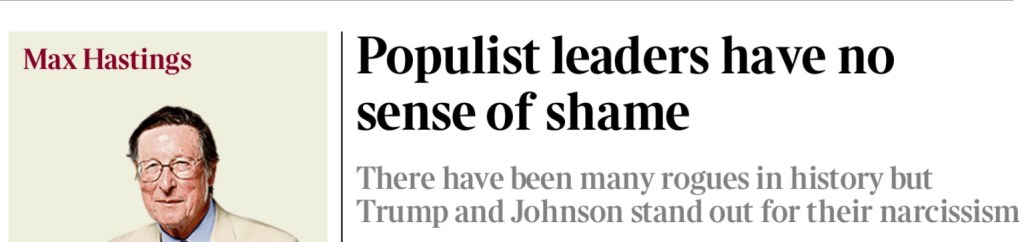
Give or take a few months I am the same age as Max Hastings whose excellent article in The Times today about the failings of Trump and Johnson I commend to you. I have seen many of the same things over sixty plus years as Sir Max has. In politics, along the way, there have been a few crooks and charlatans and a few with the morals of a polecat. But never can I recall such an absence of talent as today.
A fine article
Take Richard Nixon. He was an able man, streets ahead potentially of any current politician in the US. Unfortunately when he was made along with giving him the talent God made him a shit (as Denis Healey once said of David Owen). Trump is like Nixon – only without the ability.
Its not just about character. Johnson is less disqualified from being Prime Minister by his abhorrent character than he is by his incompetence. He actually gets nothing right and manages nothing well. If he was a brilliant leader but with personal flaws (Lloyd George or JFK) you’d shrug and say fair enough. But he isn’t.
In the land of the blind the one eyed man is King. Joe Biden and Keir Starmer are , I think, better than that. Certainly Starmer has the potential to be a good leader and seems a principled and decent man. Biden and Harris can clear the Augean stables – a task which will dominate the presidency. What a mess his predecessor leaves behind him.
My dream of a summit between Starmer and Kamala Harris in 2024 is on track! There’s talent enough there and an absence of the fatal flaws of Trump or Johnson. Come that blessed dawn we can draw a line under the Age of Incompetence and Venality in which we now live. Live the dream.
When democracy gives us a result we approve of we embrace it, when it doesn’t we worry about it. However at the heart of the debate is the detail not the principle. In 2016 democracy delivered Trump the White House and the British people Brexit. In both cases there were huge flaws in the processes and, to some extent, the principle of the votes.
Hillary Clinton won the Presidential ballot by two million votes. But the serendipity of the electoral system denied her the Presidency. In Britain the winning side in the referendum lied to the electorate and there were dirty tricks. And the people didn’t know what we were voting for because nobody knew what we were voting for. At the very least there should have been a confirmatory plebiscite once the terms were known and the irregularities of the vote had been investigated.
“Democracy” is not a simple concept except at the most abstract level – “Citizens should choose their Government “ – that sort of thing. But how they make that choice is what really matters.
Too many votes in Britain don’t count because of FPTP. Because of the Electoral College in America a Republican vote in California or a Democrat vote in Wyoming doesn’t count. It doesn’t have to be like this. The Electoral College is actually anti-democratic and in 21st Century America wholly unnecessary.
There are well-tried voting systems that if applied at a British General Election would give an outcome that more accurately reflect the electorate’s collective wishes. And simplistic Yes/No referendums on highly complex issues wouldn’t happen because they would be unnecessary if we had a Parliament which more accurately reflected the people in its composition.
When Alan Turing was pardoned a few years ago there was a sense that justice had been done. But there was also a sense that legal and intellectual logic had been broken. Turing had been convicted according to the laws and mores of his times. He was pardoned by those of ours.
What is done is done. We can look back on history and regret it, but we cannot disown it. Turing’s pardon gave us a warm feeling, perhaps. It also brought his case and those of hundreds like him to our attention – a good thing. Those who are ignorant of history are more likely to repeat its mistakes. The more we know the better we can have a chance to be.
Slavery and its principal facilitator – Empire – were grotesque and shameful. But the scale of what happened and the impact of it was permanent. The countries of the Caribbean are how they are today because of the slave trade and the colonial exploitation of natural and human resources . The southern United States were built on slavery and the racial demographics of modern day America were formed by it.
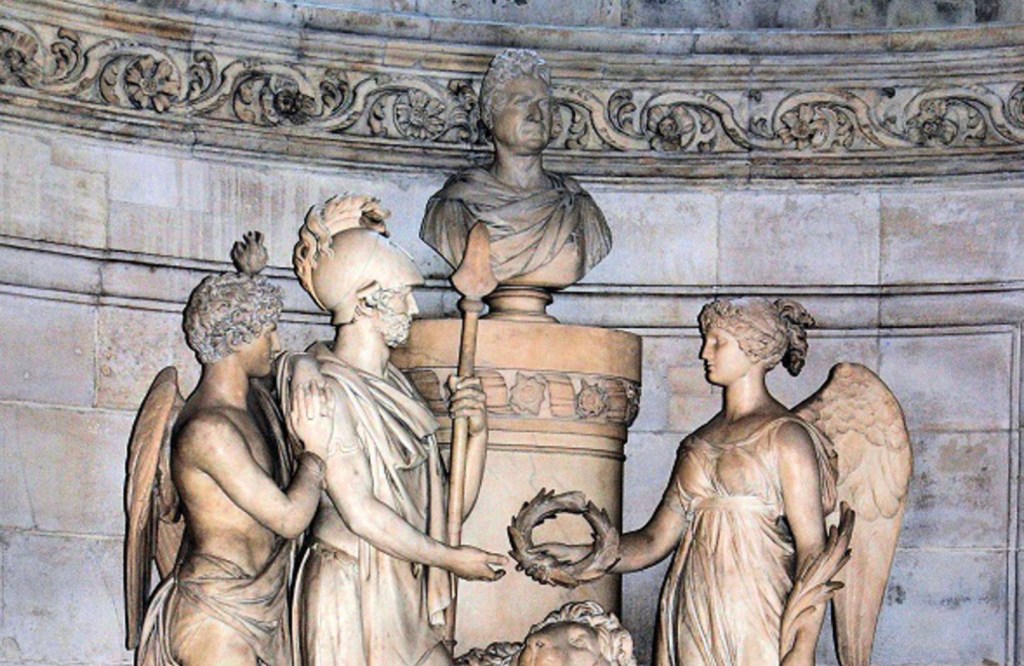
The memorial to Sir Thomas Picton in St Paul’s Cathedral – he was a hero of Waterloo, on which battlefield he died. He was also a brutal colonial governed and a slaver.
We need to balance the need to record and understand the past with a genuine need to condemn it if it offends modern day standards. But removing a statue or a memorial does not change the past. Indeed it may mean that we less understand what happened. Out of sight out of mind.
The memorials and statues should stay where they are. Alongside them should be placed clear statements which tell the stories warts and all. The inextricably linked subjects of Imperialism and Slavery need to be better understood – the creation of a “Museum of the British Empire” telling the complete story of imperialism and colonialism is long overdue. Hiding away events from the past so that we do not offend today’s sensitivities is adding delusion and denial to past offences. Let’s seek out and tell the truth.
Preposterous delusions in “The Times” today . “Mr Johnson has an opportunity to deepen the transatlantic alliance by working with Mr Biden” Real Politik will dictate that Britain will be way down President Biden’s list of priorities despite past sentimental attachments. The only “transatlantic alliance” that will matter will be America’s with Europe of which Britain will, to all intents and purposes, no longer be part.
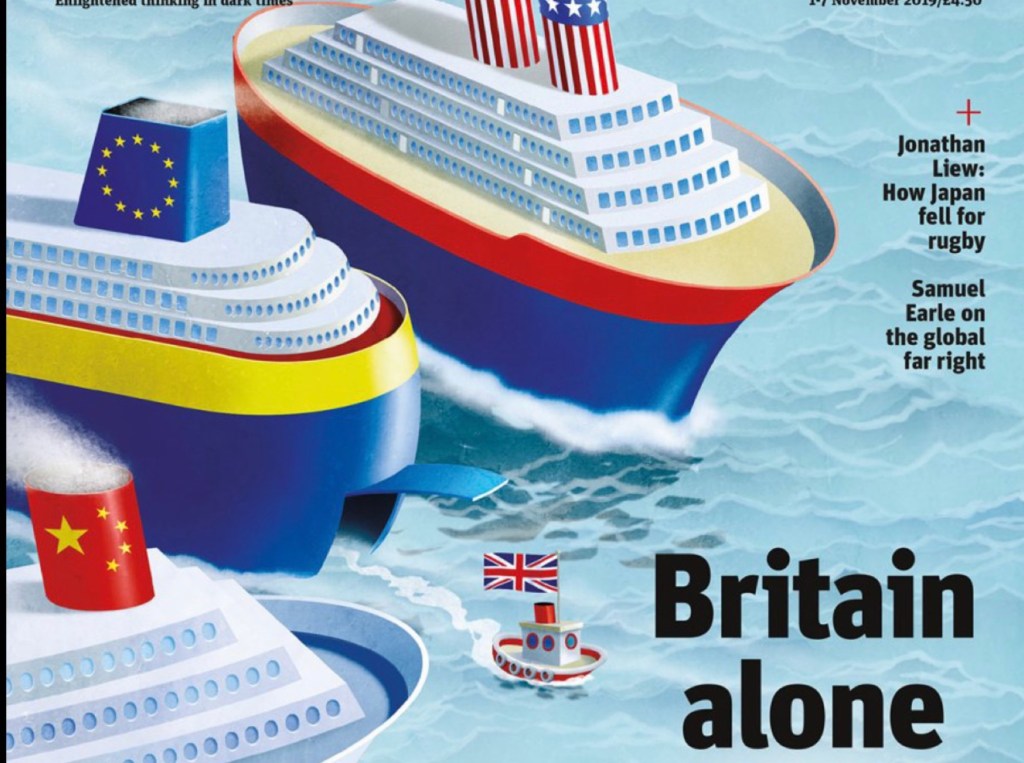
It’s now sixty years since Britain was told by an American Secretary of State that the “Special Relationship” was bunkum (I paraphrase) and that the only option for our future was as active participants in a uniting Europe. The developing idea that our genuine emotional and cultural ties with the United States could help us as a member of the EU be a bridge between Washington and Brussels had some validity, but that of course has been torpedoed by Brexit.
Biden will thankfully have a more rational approach to international relations that his nationalist predecessor. He will know that Europe, Canada, China, Mexico, Japan, India, Brazil, Israel, the Middle East etc. etc. are America’s priorities. Little England will be way down the list. When Angela Merkel is the first of Mr Biden’s meetings it will be to a backdrop which will include the European flag as well as that of Germany.
The whole Brexit disaster was based on the premise that a Britain disconnected from Europe could return to the Great Power status it once enjoyed. It was faux-patriotic bombast – actually laughable and quite sad. Even Donald Trump didn’t buy that nonsense and Joe Biden certainly won’t. Time to get real.
The United Kingdom does not matter much to the United States of America these days – indeed it has not for a very long time. President Biden will be polite and perhaps a bit sentimental. But at a personal level he probably cares more about Ireland than he does about the UK as befits a man from County Louth (albeit a while back!). I suspect that his views of Britain would be the same as those of Dean Acheson nearly sixty years ago:
“Britain’s attempt to play a separate power role – that is, a role apart from Europe, a role based on a ‘special relationship’ with the United States, a role based on being the head of a Commonwealth which has no political structure or unity or strength and enjoys a fragile and precarious economic relationship – this role is about played out.”
I would like to think that Biden won the Presidency because the American electorate rejected the petty nationalism of Trump – perhaps there was a bit of that. But in truth it was simpler. The demographics of the US are changing, and this was a watershed election. A very different America is emerging – one that will be characterised not by Biden’s presidency but by Kamala Harris’s which will surely follow it. Neither Biden nor his “president is waiting” alongside him will want much to do with a Britain breaking itself asunder and drifting offshore from the great economic, cultural and political entity that is Europe. As Acheson presciently put it there is no “Role apart from Europe” for Britain.
Lurching to irrelevance. Losing an Empire may be regarded as a misfortune; also losing Europe looks like carelessness.
The nationalism of Trump had resonance with the nationalism of Brexiting Britain. The first foolishness will now, and quickly, disappear. Britain alone among America’s allies has nationalist great power delusions. When Joe Biden has his first summit with Angela Merkel the European Flag will be as prominent as the German one – maybe more so. That’s the twenty-first century reality for us as well, if only we could see it, not anachronistic memories of Roosevelt and Churchill’s special relationship which was short, pragmatic and successful. Those days are long since gone.
America’s future looks bright now it is no longer polluted with Orange. The move from Vulgarity to Decency and from Disarray to Competence starts today. It would be excellent if these moves could be matched in Britain. But sadly, they won’t be for a very long time. As America returns to global respectability Britain lurches towards irrelevance Losing an Empire may be regarded as a misfortune; also losing Europe looks like carelessness.
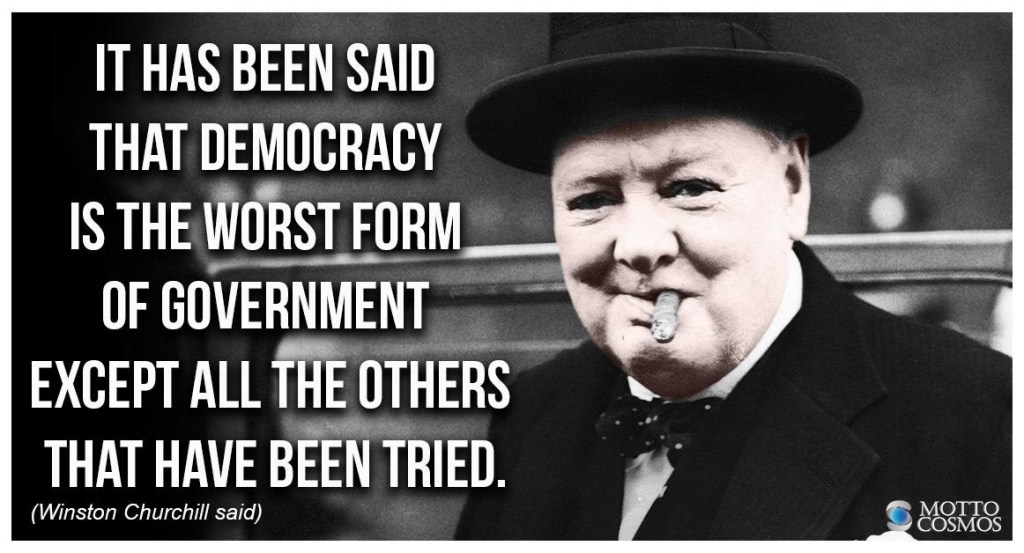
Churchill’s famous aphorism about democracy is worth keeping top of mind when we see that in practice it can and sometimes does take a nation towards disaster. Where they are is where they chose to be. And when any of us chooses to repeat mistakes, no matter how venal they turned out to be, we have nobody to blame but ourselves. Adolf Hitler won power in January 1933 with if not a totally clear electoral mandate certainly a democratic legitimacy.
In celebrating Joe Biden’s ultimate comfortable victory we should not take our eyes off the fact that it was actually much closer than it might seem. The Washington Post analysed the vote and found just three States Biden won narrowly made the difference:
Arizona: 10,457
Georgia: 14,028
Wisconsin: 20,565
Total: 45,050
If Trump had managed to get those 45,000 votes, he would have won 37 more electoral votes, making the electoral college a 269-to-269 tie!
So Donald Trump, a man who had proved himself to be totally unsuited to high office, won over 70 million votes in the 2020 US Presidential election and came agonisingly close to being re-elected.
That the election was nearly a repeat of 2016 tells us that each of the two Americas is not going to be told what to do by anybody in the other one. Many thought that Hillary Clinton was so flawed that it was she who was the main cause of the election of Donald Trump. We can now see that wasn’t the case. Then, as now, the tribe of which Trump is the personification polled strongly.
Trump came very close to re-election
The two American tribes are separate in virtually all the key demographics. They do not overlap at all – there is no common ground. Even their patriotisms are different – as well as that other American touchstone their religiosity. The one Tribe is evangelical, tub-thumping, flag-waving and raucous. The other tribe is traditional, cerebral and measured. Their homelands are utterly different, even though in some cases they may be physically close, and so are their attitudes.
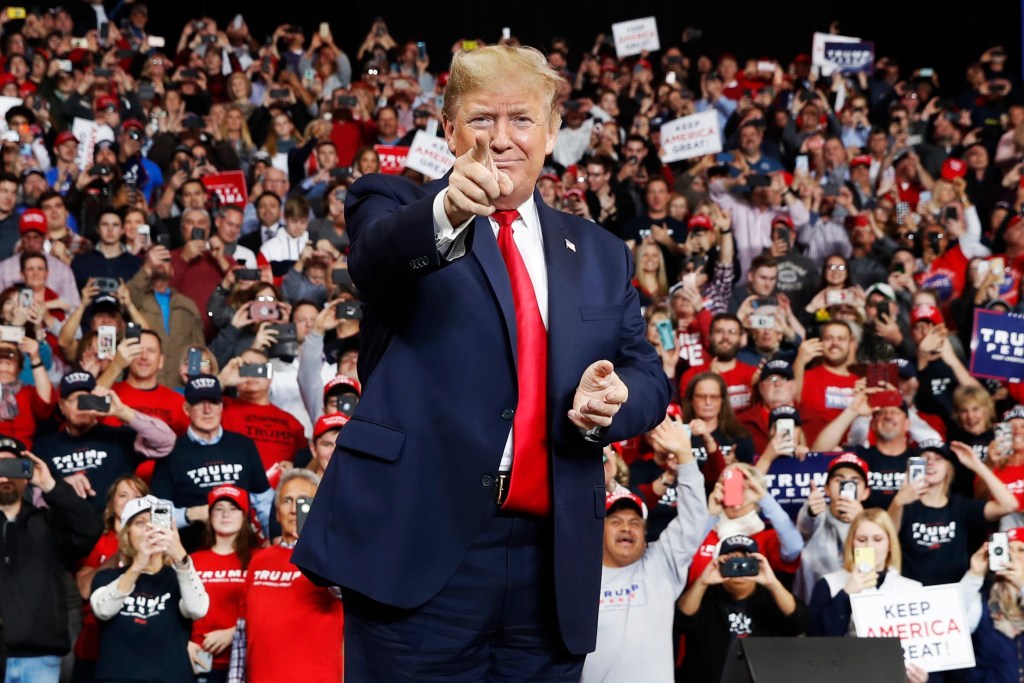
When Trump spoke to his tribe he did so in their language – he is the quintessential populist politician. He did not talk down to them or patronise them – that much of the time he talked arrant nonsense doesn’t matter. A Trump rally is not intellectually robust political argument. It’s rabble rousing. He keeps the message simple and instinctively knows who to blame, true or not – and it works. He never minds adopting the blame culture or the language of the trailer park.
Victory is everything in politics and that is why very few Republicans broke ranks and turned against Trump in 2020 as in 2016. The “Lincoln Project”, noble though it was, probably made very little difference. The rich families of Palm Beach benefited from the votes of the much poorer voters of West Palm Beach. Trump got many of the votes of poor white America despite his personally being of and for Wall Street and the millionaires.
Polls have indicated that the economy was the voters’ main preoccupation – “It’s the economy stupid” was on Bill Clinton’s study wall – it worked for him – it also almost worked for Trump. Changing the distribution of national wealth is a noble aspiration but to the poor white in the trailer park it is incomprehensible theorising and when Trump calls it “Socialist” he agrees. Many of those who could have benefited from the fairer tax and spend policies that Biden offered voted against him, and Wall Street rubbed its hands, prematurely, in glee.
Perceptions are reality because people believe them to be true. And if Trump voters perceived that Donald Trump was more in their interests than Joe Biden they voted accordingly. You could argue that after four years there was ample evidence to dissuade them but this would have required them to move tribes. So they didn’t do it.
In most walks of life competence is prized but in politics, certainly recently, electorates seem to prefer show and bluff and bluster. Trump and Johnson certainly both have plenty of that. Populist policies that don’t require us to think too much but to which our inner prejudices respond. Three of four word slogans which sell the policies to us – “Get Brexit Done”, “Make America Great Again” – help the selling of the President or the Prime Minister as a brand of choice. Job done, off to the pub.
But in a time of unprecedented crisis brought on by the pandemic bluff and bluster don’t work and we spot what we might have missed earlier – that our Government has no idea what it’s doing and even worse that it’s lying to us. The U-turn on lockdown was maybe the quickest of Johnson’s Strictly Come Twisting moves but it was far from the only one in this Year of Living Dangerously.
There is competence around – from Ireland to New Zealand and dozens of stops in between countries are managing things better than Britain and America. But the too little too late bias of Trump and Johnson, combined with denial and a disdain for experts , has been deadly. Thousands of people are dead and thousands of families bereaved due to sheer, culpable incompetence.
Back in 2014 Britain was tootling along quite happily under Cameron’s Coalition despite the political Right despising him and his chummy partnership with Nick Clegg. Then a golden opportunity to make mischief occurred – the European elections. And the standard bearer of the forces of right wing mischief, Nigel Farage, emerged from the swamp big time. UKIP mopped up many Tory voters, one or two Tory MPs and eventually slew the Old Etonian dragon – the rest, including the precipitate fall of Dave is history.
It may be happening again. It’s a different Old Etonian in Number 10 but the same smell of faux-libertarianism is in the air. The Tory Right, including the same “Usual Suspects” are jumping up and down again. And, right on cue, along comes Nigel Farage to cause mischief. Again. Shortly the coincidence of “Events” will be overwhelming – mismanagement of the pandemic at the same time as Britain struggles with the immediate impact of Brexit. In the New Year, even if a last-minute EU Deal is cobbled together the Faragists will be in the ascendency. If there’s a deal it will be a “sell out” – if there isn’t the chaos will be Johnson’s fault. His days are numbered. Donkeys led by donkeys.






 Paddy’s Blogs in a crazy world