To have investigated Russian involvement in the Referendum would have damaged Theresa May – so she didn’t do it

“It found that the intelligence agencies hadn’t even bothered to investigate what weapons Russia might have been deploying to try to disrupt Britain’s democratic processes, including the 2016 Brexit referendum.” “The Times” on the Russia Report.
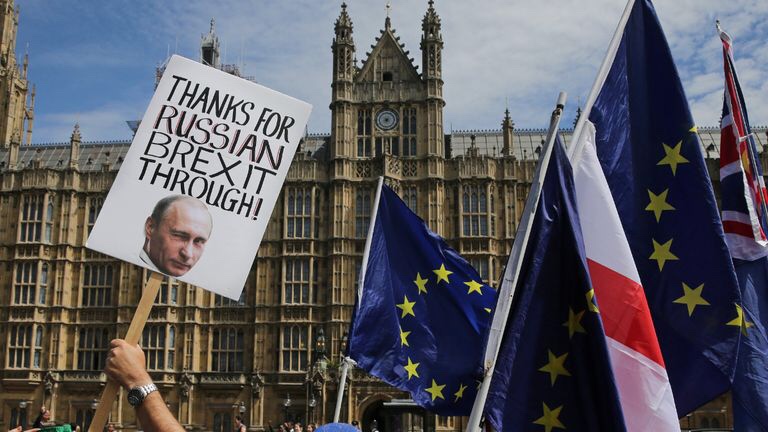
Russian involvement in the EU Referendum had long been suspected.

The “intelligence agencies” are an arm of government – they do what the Government of the day tells them to do. In a democracy it couldn’t be otherwise. So if these agencies didn’t investigate this matter it was because government hasn’t asked them and/or authorised them to do so. The buck doesn’t stop on the desks of the top spooks – it stops on the desk in Number 10.

This is a political failure of major proportions – the evidence of the “disruption” is clearly more than circumstantial. It should have been investigated. So you have to ask why it wasn’t and frankly you can come to only one conclusion – conclusive proof of considerable Russian involvement would have been damaging to those in power.

The months after the 2016 referendum were febrile times in British politics. The establishment had been defeated and could neither work out why nor agree what to do. The majority in the political parties in the House of Commons had aligned themselves with the Prime Minister and the Government in recommending a vote for “Remain” . They had been narrowly but clearly defeated. How had it happened ?

The new Prime Minister felt that politically she had no choice but to press ahead with Brexit. The strong rumours of misbehaviour in the “Leave” campaign were unhelpful to this. To have launched an enquiry by the security services into possible electoral malpractice by “Leave” could have thrown doubt on the referendum result. It would certainty have led to uncomfortable delays for Theresa May. She was in enough trouble anyway from her impatient Hard Eurosceptic Right – the so-called “European Research Group” (ERG).

Allegations of Russian involvement in the referendum were swilling around early in May’s premiership. Leading figures in “Leave” had Russian connections – some of them were Conservative MPs or supporters. And there was the undoubted fact that the Kremlin wanted to politically disrupt Europe – what better way was there to do this than by helping facilitate for a leading EU member to depart the Union?

In 2016/17 and thereafter the drivers of “Leave” began to become clear. The campaign had been dishonest and had used sophisticated, but questionable methods to reach voters – especially on social media. And the rumours of Russian involvement weren’t going away. It was then that Theresa May should have launched a comprehensive security breach investigation , putting Brexit on hold if necessary.

The Theresa May premiership was not about the PM being under pressure from the official Opposition. Jeremy Corbyn’s Labour was no threat – May wasn’t going to be brought down by hot air, and wasn’t. She comfortably won the 2017 election. And she wasn’t going to be brought down by Remainers either. No her only threat was the Hard Core Brexiteers (the ERG) in her own Party who did everything they could to frustrate May’s wish for a sensible “Withdrawal Agreement”. For May to have instigated a security services enquiry into aspects of the referendum would have been a red rag to the ERG bull and covered her in its excrement. So she didn’t do it.


Botham a political figure? Where’s the beef ?

Ian Botham got a knighthood for genuine cricketing and charitable achievements. I thought it a bit OTT, but 🤷‍♂️. The Life Peerage is not for achievement at all but for rather incoherently and without any expert knowledge supporting Brexit. Absolutely unbelievable and unprecedented.

Beefy the golfer

To be clear. Sir Ian was generously (some would say over-generously) rewarded with a knighthood for his cricket career and for his long walks which promoted charities and raised money for them. In recent times he has been a cricket commentator and since being sacked by Sky he has spent his time mostly in his house in Spain and played golf. He has also launched the “Botham” range of wines.

Sir Ian has arguably earned the privileges of wealth and fame. I have met him and heard him speak on cricket and he is entertaining and informed. Previous cricketing peers – Learie Constantine, Colin Cowdrey and Rachel Heyhoe-Flint – lived post player lives of distinction. Botham has added little if anything to the achievements for which his knighthood well rewarded him. That he takes a rich man’s view of Brexit is his right – many of his wealthy ex-patriate golf buddies no doubt agree with him.

Sir Ian is not a toady and is his own man – he always has been. But he is not a credible political figure – more a Right Wing Colonel Blimp with no gravitas on Brexit nor any other non cricketing subject. Where’s the Beef? In the past his friendship with the great West Indian Viv Richards made the young Ian Botham a doughty and respected opponent of racism and discrimination. That the older man aligns himself with the xenophobes of Brexit is sad. That he is ennobled for this is a scandal.

Britain leaving the European Union gives Scottish independence its crucial intellectual and emotional legitimacy.

Scotland wanted to stay in the European Union but unlike those of us in England who also wanted this the Scots can do something about it – and they will. Scotland is a country of authentic historic status but without being a nation state since 1707. But Boris Johnson’s recent claim that there is “no border” between England and Scotland is far from the truth. Devolution strengthened that very real border and Independence will finish the job.

There’s little pride in being British these days, and even less in being English. But north of the border things are much better. A devolved Government without an effective opposition is a bad thing – but it has allowed Nicola Sturgeon and her team to focus on 2020’s principal task, managing the COVID pandemic. People have stopped dying in Scotland and from the start the Scots have managed things infinitely better than the English.

Scotland is competently governed which in itself is a strong case for independence. Add in history and the case for reestablishing total Sovereignty becomes unarguable. In 2014 the economic case against independence was crucial and it is still strong. But as we saw during the EU Referendum Sovereignty has an emotional gut appeal. To argue, as the Brexiteers did, that in the EU Britain was not a sovereign nation was nonsense. But to argue that in the Union Scotland is not sovereign is a fact. Period.

The potential for Scotland as an independent nation in the EU is enormous. The Irish have prospered in a way that the Scots can match. The EU27 would love that and whilst the Spanish will have to be reassured that there is no precedent for Catalonia Scotland will be welcomed with open arms by all. Ireland has been a positive net recipient of EU funding and Scotland would be the same. Adopting the Euro and abandoning sterling reinforces the legitimacy of the break.

And if the Scots decide that the prospect of King Charles in a kilt is one they prefer to reject (and who could blame them ?) then the “Republic Of Scotland “ has a nice ring to it.

The Chinese will laugh at Boris Johnson’s willy waving.

“The official explantion for the U-turn is that Britain’s spooks can no longer vouch for the security of Huawei’s kit now that the US has banned the sale of American chips to the Chinese technology company, forcing it to use domestic components. But there’s little doubt that the real reason is political. It had become clear that opposition from Tory backbenchers had made Mr Johnson’s original approach unsustainable.”

“The Times” leading article today

The idea that there is the slightest likelihood that Britain’s Security services on their own could “vouch for the security of Huawei’s kit” is laughable. They can’t – and nor do they need to. This is all another example of this Government’s preposterous British exceptionalism.

China is very big. It’s very big because the West ensured that it would be. Corporations like Huawei were created by Western demand, western exports, western finance and, initially anyway, Western style management. British companies, British financiers, British diplomats drove and fuelled China’s transformation from a big but backward country into a big and innovative and highly sophisticated one. But not on our own. The world came beating on China’s door. And the Chinese opened it very wide.

The cause of China’s current preeminence is that it was a convenient place for the West to transfer its manufacturing to as well, of course, for it being a massive and lucrative market. But China is also a threat. There is a paradox here. China’s very existence relies on supply to and demand from the West. Most of this is fairly benign and some of it highly beneficial (the manufacture of drugs and medical equipment for example). But with the current leadership of the People’s Republic being so nationalist as well as imperialist the West needs to take care. There is a real and present security threat seen gruesomely in Hong Kong and potentially in Taiwan. It’s more than sabre rattling.

The threat to security does not come from Chinese companies but from the Chinese Government. That they use companies like Huawei is obviously true. But the solution for the West is at a higher level. And it can only be combated by joint action . There is already extensive monitoring of what the Chinese Government is doing using sophisticated intelligence as well as old fashioned Agents on the ground. This is a cooperative effort across Europe and with allies in North America and around the world. Any “vouching” of Huawei takes place in this context – if the company is some sort of security threat it is a threat to all.

Boris Johnson is acting as if Britain on its own matters to the Chinese. But it’s all willy waving. Sending a gunboat will no doubt be welcomed in Peking – if they don’t already have an agent on board the HMS Queen Elizabeth I’m sure they soon will, not to mention electronic surveillance. Really they know Britain is no sort of threat but they’ll keep tabs on the carrier just to be sure.

Nixon in China gave the green light to the beginnings of the growth of the PRC as an economic and commercial force. The financial power this growth has given the Chinese drives their political and military power and ambition as well. Huffing and Puffing over Huawei by Boris Johnson is as comical as it is impotent. The challenge of protecting Britain’s interests will not be met by Virtue Signalling like this. It’s a rather bigger task and one requiring extensive transnational cooperation with allies.

The changing world of Gin

“Long before it became fashionable, Queen Elizabeth the Queen Mother was a dedicated gin drinker.” So says “The Times” today in an article about the Royal Family launching its own brand of Gin.

My Grandma (b. 1887) was a prodigious gin drinker especially in the 1930s when she ran a hotel in Cornwall with a busy residents’ bar. Whether quaffing Gin would have been regarded as “fashionable” I don’t know but it was certainly popular. My Nan’s preference was “Gin and French” which had a healthy slug of Gordon’s topped up with Noilly Prat – a French Vermouth. A popular alternative was “Gin and It” which used Italian Vermouth.

Gin and French

The mixing of Gin and Vermouth reached its apogee in the United States with the invention in the interwar years of the “Martini” which certainly was “fashionable” . The barman’s challenge for a Dry Martini was to maximise the spirit and minimise the Vermouth. 🍸. The drink is essentially neat Gin with a bit of flavouring – a bit like “Pink Gin” , popular among Naval Officers.

In the 1950s the prewar Vermouth based cocktails were still popular alongside the ubiquitous Gin and Tonic or Gin and Bitter Lemon (the latter seems to have fallen out of fashion). Over these years, pre and post war, the gin brand was relatively unimportant. They were nearly all “London” gins – Gordon’s, Booth’s, Beefeater – and whilst there was some brand preference it was really what you put in the gin that mattered rather than the gin itself.

Designer gins

The development of designer gins is a modern phenomenon which has taken it out of the commodity product category. Gins can be like malt whisky with variations brought in by the blending process and the choice of botanicals etc. This has given the industry a massive boost – helped by improvements in tonics driven by the remarkable “Fever Tree” company. The added value that these initiatives have given the industry is considerable – who can blame “Royal Family Limited” from cashing in ?

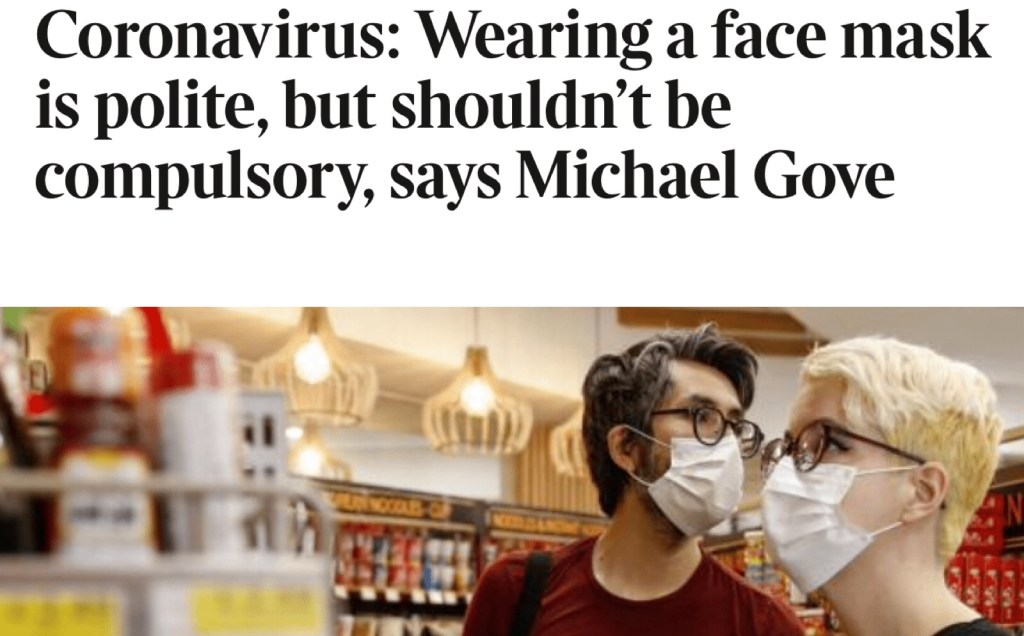
Michael Gove’s assertion that the wearing of face masks should be voluntary is nonsense

As societies progress over the years they generally get healthier, people live longer more fulfilling lives and their choices increase exponentially. But for these advances to happen we have needed to accept the curtailment of some of our freedoms.

Michael Gove reported in “The Times” today

In the 1950s my father could drive to the pub, quaff three or four pints, sit in his driver’s seat unprotected by a seat belt and so long as he infringed no road traffic rules he was within the law in doing so. When wearing a seat belt was made compulsory and the breathalyser was introduced a decade later Dad complained vociferously about the curtailment of his freedoms. Barbara Castle really got it in the neck from him and his golf club drinking buddies.

What I do in my own home is within certain limits up to me. But when I venture out into the community rules of behaviour apply. I can’t drink and drive – a couple of half pints aside maybe. And I have to belt up. These restraints on my behaviour are not just to to protect me, though they do, but to protect others. They are uncontroversial (though no doubt on the eccentric fringes of the libertarian Right there are anti breathalyser and anti seatbelt societies).

Which brings us to Michael Gove who would no doubt like to be seen as a libertarian. Freedom of choice as to whether to wear a face mask for example. Gove’s opposition to regulation is as idiotic and selfish as my father’s opposition to the breathalyser was fifty years ago. And as ignorant.

My wearing a mask 😷 doesn’t actually protect me but the collective wearing of masks does protect me and the community as a whole. For this to work there has to be compulsion. If I drink and drive I threaten myself and others. The same with not wearing a face mask. Gove, as ever, is playing politics and seeking the applause of the libertarian cohort in his Party and beyond. Let’s hope most people see it for the populist conceit it is.

Britain botched the handover of Hong Kong – a better outcome for its people was possible

“Thanks in part to (Lord) Chris Patten’s governorship of Hong Kong, Britain left Chinese shores on a moral high in 1997.”

The quote above is from an article about China by Matthew Parris in The Times.

I lived in Hong Kong for four years in the 1980s, have revisited it many times since and have many HK friends. These friends liked Patten but they all knew that he had received a hospital pass. The damage had long since been done. He made little difference as the “Last Governor “. His hands were tied by what went before. There was no “moral high” – the abandonment of Hong Kong’s people was an amoral act . Period.

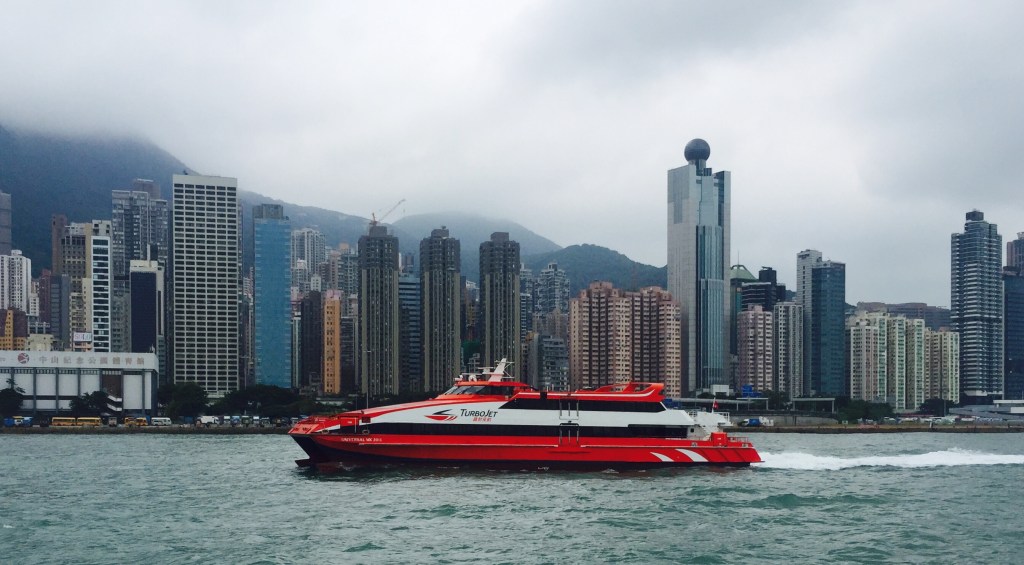
Hong Kong

Throughout its long history as a British colony Hong Kong was a benevolent (mostly) dictatorship. Democracy was absent and power was firmly in the hands of an appointed and unelected cabal – mostly British ex-patriates. Knowing that the New Territories would have to be handed to China in 1997 Britain could have changed the governance structure of the colony well in advance – in the 1960s for example. If Hong Kong had become largely self-governing by say) 1970 the negotiations with China that had to take place in the run up to 1997 would have been held in a very different context.

Hong Kong as a clone of Singapore was a very viable proposition. Sovereignty would be in Peking but Hong Kong would have been run by Hong Kong people. Not by the British colonialists but not by China’s authoritarian gerontocracy either.

When you are dealing with dictators it helps to carry a big stick. Militarily of course Britain could not compete with the PRC . But we were not without assets. Hong Kong Island and Kowloon were British in perpetuity under international law. This was a hand played badly in the negotiations and if the colony had been self-governing and effectively independent in the early 1980s the outcome would have been very different.

Sunak will take over – but it won’t be easy!

In the land of the blind the one eyed man is King. It is generally acknowledged that this is the least talented Cabinet in living memory. Rishi Sunak is the exception. Labour cannot attack him for what he is doing but they most certainly can for what he believes. From supporting Brexit in 2016 to his extreme free market personal ideology he was potentially the most economically Right Wing Chancellor of modern times. We are firmly in “Tax Payers Alliance” territory here.

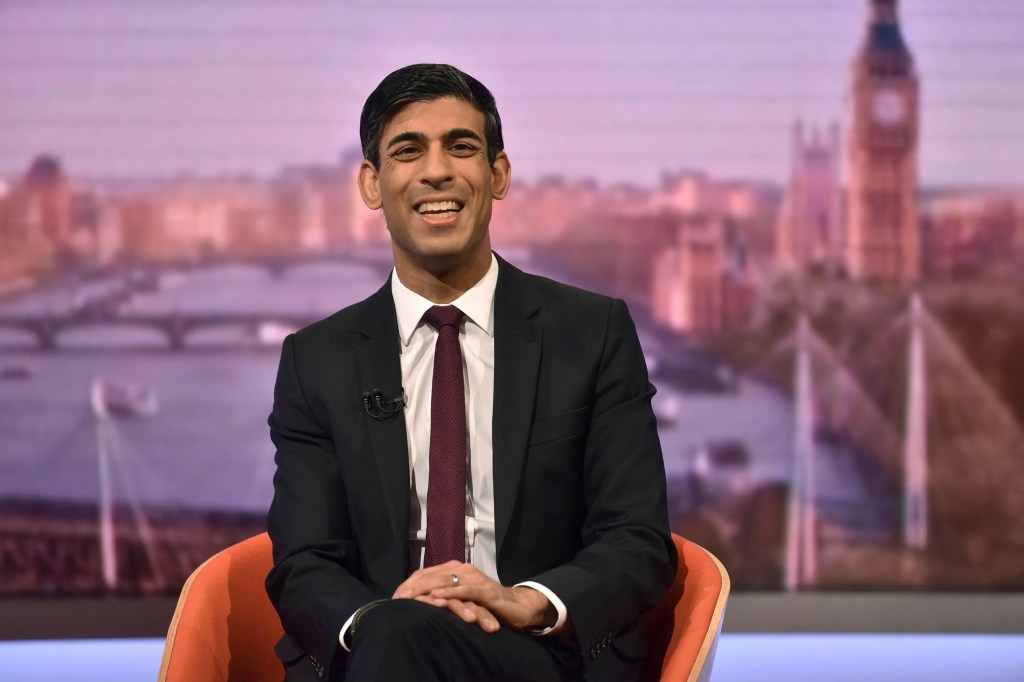
Rishi Sunak – Prime Minister in waiting

Mr Sunak’s brief political career to date has been mainly about establishing his credentials in the Conservative Party. He did this at a time when the Party handed itself over to its Hard Right – and as it happens that’s where Sunak sits. I would not accuse him of opportunism. I don’t think that he has spouted a libertarian, free-market hard neoliberal position to secure a personal political advantage. I think he really believes it. But as Harold Wilson said “Campaign from the Left, govern from the Centre”.

I remember when Ted Heath came to power in 1970 on a very pro Business and economically non-interventionist manifesto. (That was ten years before Sunak’s birth so he won’t remember it !). Within a year he was knocked off that free market pedestal by what Harold McMillan called “events”. Suddenly Ted, like Harold before him, had to “govern from the centre”.

In February this year (pre Covid) Hard Right Tory economic veteran, and uber-Eurosceptic John Redwood advised Chancellor Sunak that “We need a bigger and more prosperous private sector, which requires lower tax rates and a holiday from yet more prescriptive regulation.” I doubt that at the time Sunak would have disagreed. You don’t have a successful career in Goldman Sachs if you’re a wishy-washy interventionist “Tax the rich” liberal.

Then came Rishi’s “events” which changed him from being a dedicated follower of the Redwood faction into the most interventionist and free-spending Chancellor of the Exchequer of modern times. Not his fault, of course, but it must have hurt. This wasn’t “Government from the Centre”. It was Government from the Praesidium.

Before the referendum Sunak endeared himself to the hard core Eurosceptics by saying “It can’t be right that unelected officials in Brussels have more say over who can come into our country than you.” This may seem a curiously anti immigration position for a British Asian to take, but it went down well in Yorkshire where he is an MP. And Sunak’s fellow British Asian Home Secretary Priti Patel, could have used the same words – and probably did.

If, as seems increasingly likely, Rishi Sunak becomes Prime Minister within a few months he will have to manage not just the calamitous economic and business challenges of the Pandemic but of Brexit as well. The combination of these events, and of dealing with them, will bring unprecedented social consequences. It is possible that the worst effects of Brexit on trade (etc) can be ameliorated by a “deal” with the EU27. The earlier Sunak takes over from the inadequate Boris Johnson the better in this regard – especially if he rapidly dispenses with Johnson’s puppeteer Dominic Cummings. But even a deal-brokered Brexit will not be a walk in the park with an ailing economy totally reliant on Government support and spending.

So will Prime Minister Sunak be forced to “govern from the Centre” – when the current alternative is to govern from the hard-interventionist Left he’d probably settle for that. The supreme irony of where we are is that the most committed anti EU Conservatives (of which Sunak was one) took this position from a hard non-interventionist and free enterprise perspective. For this Parliament not only is that not going to happen but Britain will not enjoy the benefits of membership of the most successful single market and customs union in the world either.

Rishi Sunak may morph into a pragmatist and cleverly find an accommodation with the EU. The ideologues won’t like that – they’d probably quite welcome the riots in the streets which could be a consequence of Britain’s self-evident ungovernability. Especially if they are viewing them from their tax exile home or from their Chateaux in Provence.

Where Shell locates it’s corporate HQ is pragmatic and has nothing to do with Brexit

According to a piece in The Times today Royal Dutch Shell is considering moving it’s corporate HQ from The Hague to London and predictably the Brexiteers in The Times and also elsewhere are already beginning to celebrate this as a triumph. They shouldn’t. This decision, if taken, says virtually nothing about the management of the corporation and a lot about the respective tax regimes of Britain and The Netherlands. The tax benefits of the U.K. as they are at present, are made clear in the article. As is the perceived need to simplify the Capital Structure. These issues have nothing whatsoever to do with Brexit. It’s financially driven and pragmatic.

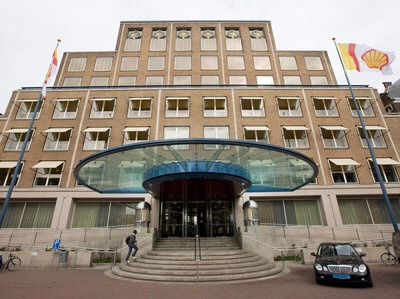
Shell’s Corporate HQ in The Hague – and home of many of the corporation’s key businesses.

Royal Dutch Shell’s (RDS) has over the past few decades become a much more centralised corporation than it was in the four decades during which I worked for it. The direction of the business comes primarily from London and The Hague – with Houston being a sort of third central office for some activities. RDS has always been Anglo Dutch and this is unlikely to change.

The Hague as well as being the location of the HQ is also the location of the executives at the top of various key business streams such as Oil and Gas exploration and production – the “Upstream”. All the technical, engineering and associated activities of the Upstream take place in The Netherlands. The same applies to Manufacturing (the Refining sector). In theory all these Holland based activities could relocate to London and there would be some cost reduction benefits – but it’s very unlikely to happen.

Shell Centre in London

Shell Centre in Waterloo is the location of the central offices of Shell’s other businesses including Marketing, Supply Trading, Legal, Finance etc. This duality of location is long established and it would be complex to unravel it. Certainly any move of the registered office HQ from The Hague to London would have few implications for the daily operation of the business. Very few employees would be in any way affected. The only visible change of a move of HQ would be that RDS AGMs would in future be in London rather than The Hague – which would please The City.

Better to teach the past than to try and sanitise it

Goodness me those people in the nineteenth century were racists weren’t they? Well yes when seen from today’s enlightened times they were. (I didn’t put quotes around “enlightened” – I genuinely believe that is a fair descriptor of how we approach race today). Some will say that to criticise Dickens, or Marx (or Enid Blyton of Agatha Christie for that matter) for their racist views or racist expressions is wrong because they were simply products of the mores of their times.

I cannot even write the original title of Agatha Christie’s “Ten Little…” book here because The Times automatic word checker would reject the whole post if I did. The use of the same word in Fawlty Towers has led to some rapid post hoc editing of the archive. Twenty-first century enlightened standards being applied retrospectively to the 1930s and the 1970s – let alone to the late 1800s.

The root cause of what some would see as a preposterous application of political correctness to the past is a contempt for the perceptiveness of the people today. It assumes that people aren’t smart enough to see what John Cleese and Connie Booth were doing when they put those words into the Major’s mouth. The Major was an old bigot not untypical of his age and times – I know this because there were a few similar in my own family. Surely most people can see and understand this – and learn from it?

When listening to David Starkey I wasn’t seeing archive footage of an old racist spouting offensive views. I was watching a old racist spout them today in real time. His pathetic little interviewer failed to challenge him which seemed to encourage the fool to be more outrageous. Why the hell he did it I’ve no idea – because he was allowed to I think.

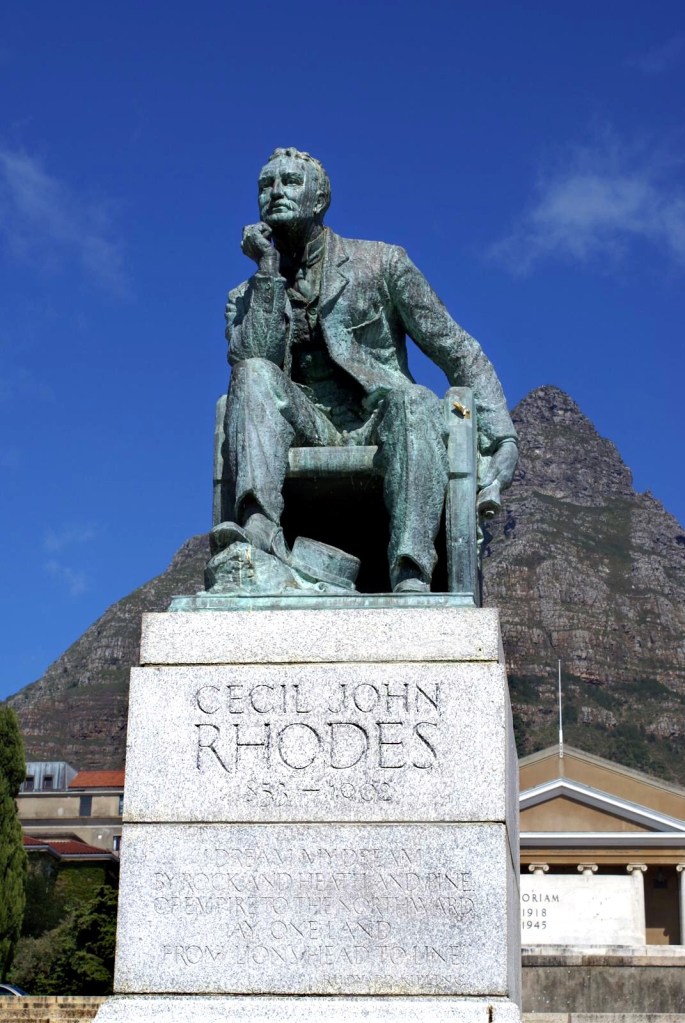
Cecil Rhodes statue in Cape Town

If we remove all the statues and edit all the books (and maybe throw some on the fire) how will we learn about the past? If you throw some slaver’s statue in the Harbour it doesn’t make what he did not to have happened. It just means that fewer people will know about it. Are we likely to be able to know more about Cecil Rhodes if his statue is hidden away out of view or if it’s somewhere we can see it – with a suitable plaque explaining who he was and what he did and the times in which he did it? Do we really need to be protected from the past? Or might it not be preferable that that past was better explained to us?