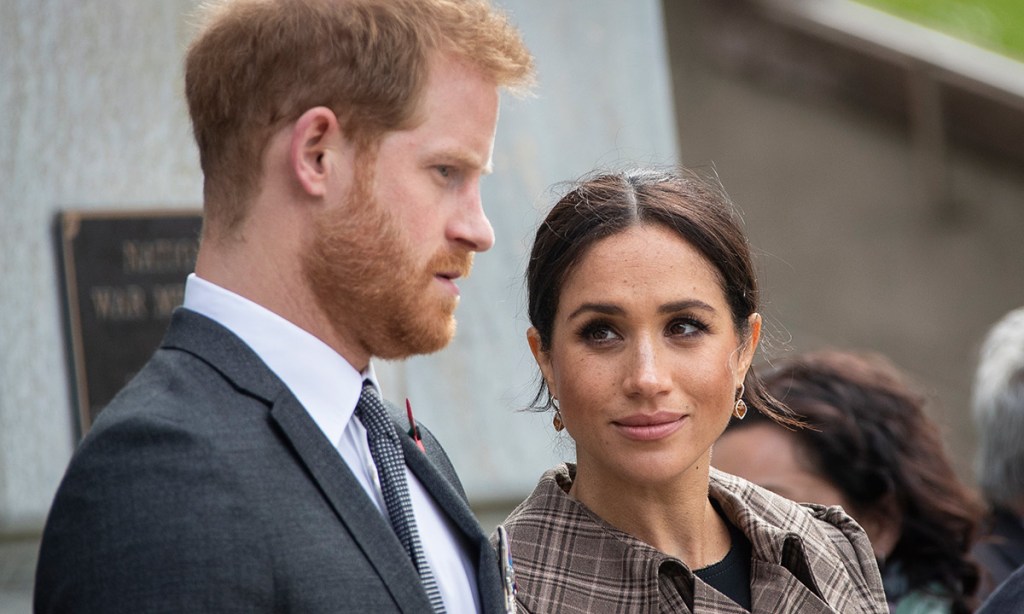
The phenomenon of being famous for being famous has always been with us. Harry’s Mum had it for a while but she actually did a few good works once she had kicked her arrogant, unkind and unfaithful spouse into touch. And she was liked. Her sons are decidedly ordinary but the older one probably has sufficient of a sense of duty to tackle the constitutional monarch sinecure – not a job requiring too much brainpower – unless we have the good sense as a nation to abandon the whole “Royals” charade in time. Unlikely.
The second son is an attention-seeking twerp. Life for the “spare” can be tricky – look at Margaret Rose or the dysfunctional Andrew. True Harry Windsor’s great Grandfather unexpectedly became King so you never know. But there are plenty of little Windsors ahead of Harry in the queue. He ain’t going to the Palace in charge and he knows it. So what to do?
Harry’s great, great Uncle was banished from Britain for marrying an American divorcee – Harry has banished himslef for the same “offence”. In retrospcct the ghastly Duke of Windsor didn’t matter a jot – his brooding life in Paris and the Riviera was wholly insignificant. This silly, dimwitted, deluded man with his ambitious Yankee spouse faded quickly from the public consciousness. And so it will be with Harry and Meghan. You can plunder the good fortune of Being famous for being famous for a while – but only for a while before the public moves on and you are forgotten.
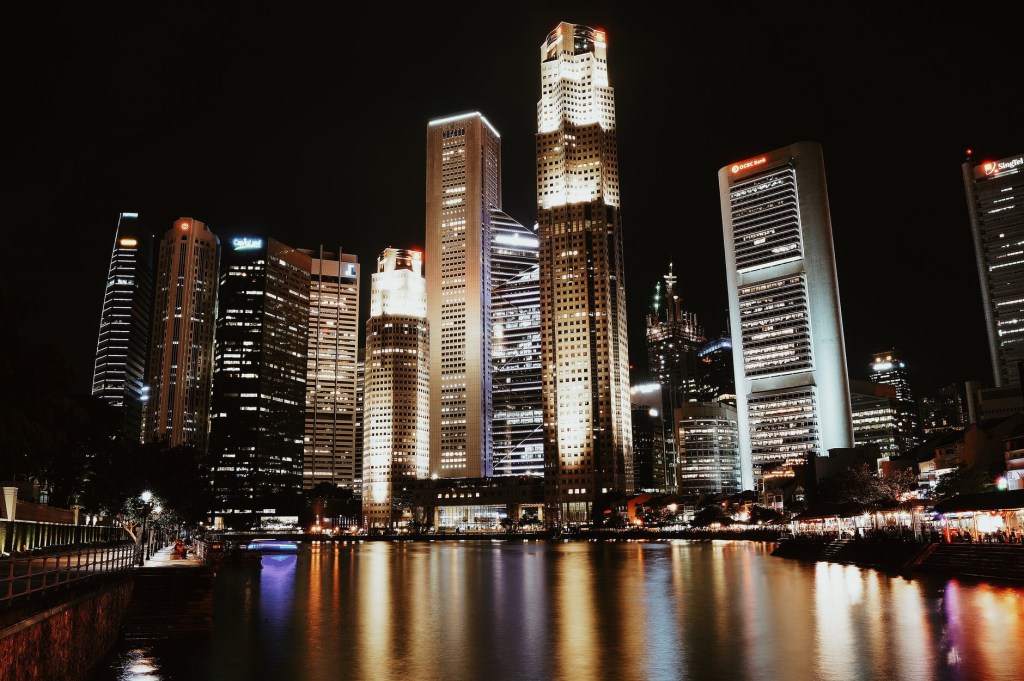
I was re-reading diaries I wrote when I lived in Hong Kong in the 1980s recently. My job took me around the region – what comes across frequently is a mention of ambition and a “Can Do” mindset. It had more to do with culture than government system. Hong Kong was a colony and undemocratic. But the government had the good sense to encourage freedom of enterprise and to provide infrastructure and public services which it did well. That was the model across the region. Prime Minister Lee’s regime in Singapore was hardly liberal but he shrewdly invested in what the tiny island needed to work and grow, including public services.
Modern Singapore
The mixed economies across the Far East worked. The governments did what they had to do and left it to free enterprise to do the rest. There was no ideology involved, just common sense. I visited Thailand recently for the first time for a while. Bangkok traffic used to be chaotic but now it is much less so thanks in to a new and expanding light rail system. Thailand has pretty unpleasant politics but its leaders have the “Can Do” mindset. It works.
All societies are stratified but nowhere in the Far East region is class and power as engrained as it is in Britain and America. One reason is education. Public education in Kong Hong or Singapore is not just free but consistently good. Equality of opportunity is not an ideological goal – it’s a practical reality.
In Britain we debate and dither. Our infrastructure is not fit for purpose, our education mindset elitist and we are culpably complacent about all this. If many of our ex colonies in Asia lived in the past as we do they’d be stuck in a rut bemoaning the evils of colonialism. Countries like India, Malaysia, Singapore don’t do that. That there were once mad dogs and Englishmen in charge doesn’t bother them today.
Across Europe there is inconsistency. Some countries are more vulnerable than others to the “threat” from the East. But nobody is as vulnerable as Little England or Trump’s America. Even China is not as nationalistic and introspective as we Anglo-Saxons and their natural pragmatism will probably prevail. Watch Hong Kong closely. If it stops being in the international news you will know that Beijing, having made its point, has decided to let its little jewel alone for a while. Don’t bet against it.
Old, fat, complacent and wallowing in nostalgia are not characteristics that encourage change and progress. There are always a hundred reasons not to do something. The young and ambitious nations of Asia don’t spend their days re-running newsreels of eighty year old military triumphs and singing patriotic songs. They look forward not backwards. Which means they will win.
Tax increases in Britain seem inevitable if we are to avoid going bust. There is no magic tax button to push. You either tax consumption or you tax income.
Within those broad descriptions a Capital Gain is unearned income. Taxing consumption is regressive , taxing income is progressive. So any government favouring redistribution will favour taxing income. For me there is no moral distinction between earned income and unearned income so making a tax level distinction as a sort of reward for work as opposed to good investment I object to. The tax system needs simplifying within the fairness criterion of the more you earn, however you earn it, the more you pay in tax.
There needs to be more subtlety to consumption taxes. Some purchases are essentials and in the main should be untaxed, or lightly taxed. Luxuries should attract higher rates of VAT/Sales Tax – as once they did of course. Yes there are challenges in defining what are necessities and what luxuries but common sense should cover the majority of cases. Fuel Duty is a consumption tax – it hasn’t changed for eight years. Despite my oily career and oil-funded retirement I believe it should be increased substantially. In Britain, a few exceptions aside, we do not charge for use of our motorways. The benefit of Fuel Duty is that the more you use our roads the more you pay. Seems fair !
Fuel Duty hasn’t changed since 2012
Increasing Fuel Duty is always politically dangerous – ask Tony Blair – and I very much doubt that our present Government has the balls to do it. But it makes sense – it encourages the purchase and use of more efficient and environmentally friendly vehicles and switching to public transport. I’m making my own small contribution to this at the moment leaving my car on the drive. Mind you this is a result of my epilepsy diagnosis and treatment! I won’t be able to drive again until April next year at the earliest. I haven’t missed it one bit!!
The concert as televised was visually beautiful and the social distanced orchestra intriguing, giving a rare opportunity to see individual players in the sections clearly. And they played all the right notes, as you’d expect from a fine orchestra under a top conductor. But I didn’t see the players smile much. At the end of a movement you usually see a bit of eye contact and facial communication between the musicians and with the conductor. There was none here.
Spaced out
Can you play normal music in an abnormal society? Well they did their best and the sound engineers in particular delivered sumptuous sound for the audience, all of us at home of course. But you sensed that the layout on the huge stage impaired the collectivity of the sections and of the orchestra as a whole. The musicians looked lonely. The horn section, always the most rumbustious in an orchestra, were separated and seemed almost to be stuck in a gallery!
As a concert regular all my adult life I know how important the relationship between musicians and with the audience is. As a patron of the RPO I feel I know the musicians personally from how they interact with one another. The first violins, for example, nearly always sit in the same seats and in pairs, sharing a music stand. There was, of course, none of that last night. Nor was there eye contact with each other, with the audience or with the conductor.
In short this was a performance by skilled individual musicians rather than a united band – it was almost as if they’d stayed at home and been brought together on Zoom. Precision there was and some individual moments of brilliance – the Cor Anglais and the Trumpet, for example. But there was no passion and, it seemed, not much enjoyment . It wasn’t any sort of ode to joy….
If your personal patriotism is about reverence for the past and its symbols rather than your country’s current behaviour then you can justifiably be accused of living in that past. This may suggest that how your country now is compares unfavourably, in your mind with how it once was. So you grasp at nostalgic memory, whether it is yours or part of your personal inherited belief system. Intellectually you may know that the past is a foreign country where they did things differently but if that past is a comfort zone, whereas the present makes you uneasy, you’ll go there.
The Past and it’s symbols
Some take the “My country right or wrong” approach and are resolutely loyal no matter what. Even glaring national failures like Suez had their “patriotic” defenders. But most of us acknowledge mistakes, though how we define them differs greatly.
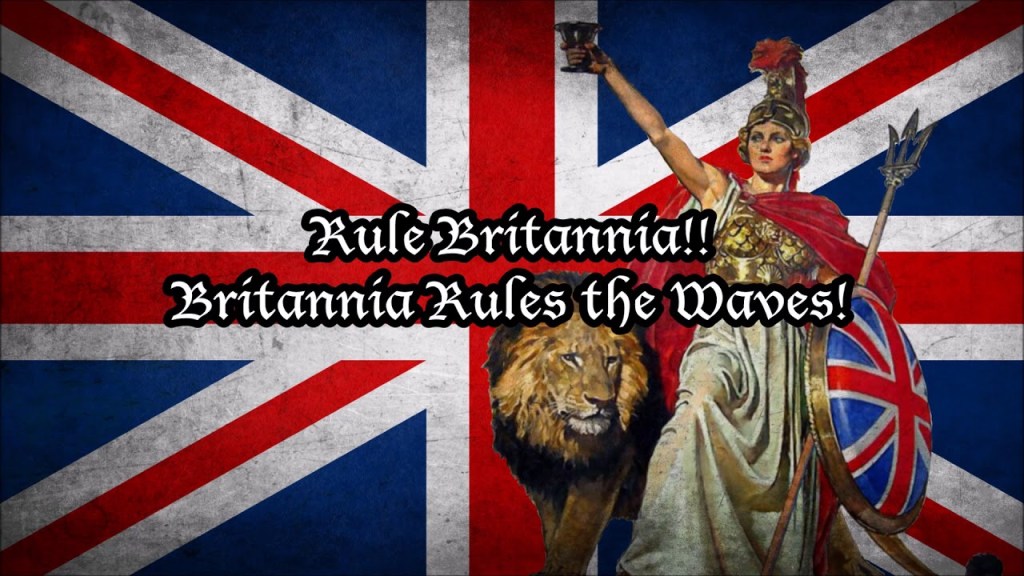
The songs sung at the Last Night of the Proms are patriotic symbols of the past with little or no relevance for the present. Even the most jingoistic flag-waver can’t argue that “Britain rules the Waves” or that Britain is uniquely “Mother of the Free” . Nor that we have cloned a new Jerusalem in our “green and pleasant land”. That land wasn’t green and pleasant when Blake wrote the words as a critique of the emerging industrial revolution. It’s even less so now.
So the Proms songs about which there has been so much hoo-ha are moments of time travel to a distant age – interesting as long-since outdated symbols, particularly of Empire, but no sort of relevant reference for modern Britain. Worse than that if we cling on to them we implicitly approve what they stood for. If we sing without irony “Wider still and wider shall thy bounds be set” we celebrate imperial expansion – not that different, in practice, from the Third Reich’s search for “Lebensraum”.
The debate about the Empire, rather trivial and binary though it has been, has revealed for some just how important our imperial past is. It’s binary in that some celebrate it as a good thing – hence the defence of “Land of Hope and Glory” and “ Rule Britannia. Whether these defenders really think that these songs are any sort of descriptor of 21st Century Britain I dread to think. I suspect not and that it is more nostalgia for a lost age of perceived greatness.
My own view is that the debate, ludicrous though at times it has been, may have stimulated some to look more deeply at the 19th Century when the Queen was “Empress of India”. This to me was anything but a glorious past. The assumption that Britain rightfully and justly governed the sub-continent (and the rest of the pink coloured areas in your school atlas) needs greater challenge and wider understanding. Google “Amritsar” for starters.
The reality is that now, a few odd islands and a lump of rock aside, we have “lost” our empire. The writing was on the wall with India in 1948 and gradually the rest has drifted away. But when Argentina invaded the Falklands in 1982 (islands which I suspect few of us had even heard of ) we all went into full “Land of Hope and Glory” mode. Patriotism didn’t come more British than that. It was an absurd and deadly adventure to kick the invaders out but when the triumphant fleet returned John Bull had rarely been happier.
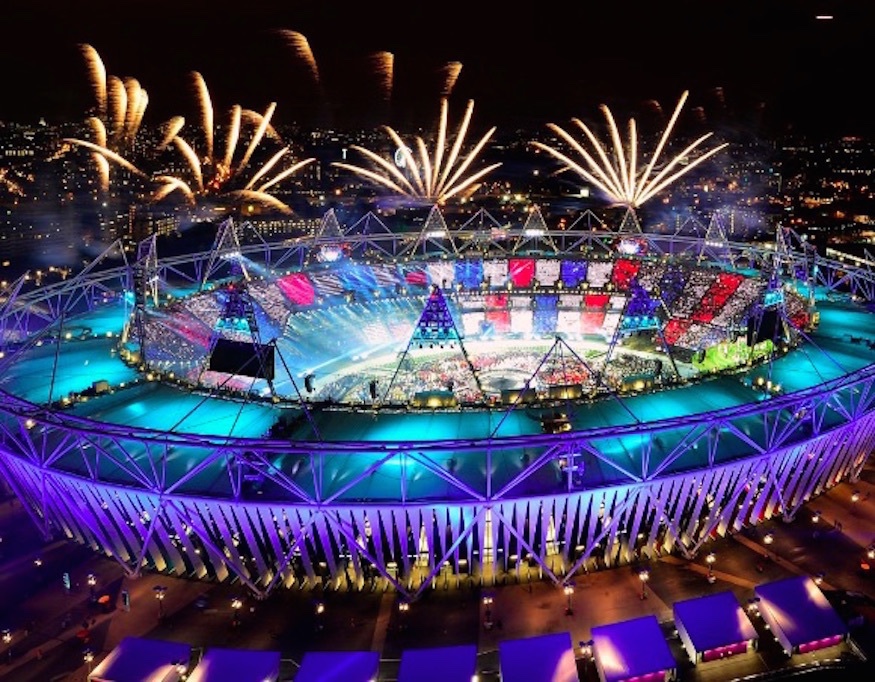
So what could we patriotic about today, or is it only the past? For me (I was heavily involved) the London Olympics in 2012 made me proud. There was no uber-jingoistic patriotism – the opening ceremony was confident and ironic not nationalistic. I loved it. We do The Arts and Sport well and can be genuinely world-beating. At our best we can be open and welcoming, but increasingly this is a rarity. But am I “patriotic” about modern day Britain. Absolutely not. The absurdity of Brexit and the gormless flag-waving many of its supporters indulge in is abhorrent. Xenophobia is much more than an undercurrent in British society, it’s pretty much the norm. And so it’s the past and the symbols we cling onto.
London 2012 – something to be patriotic about.
The furore over the Last Night of the Proms was a wallow in nostalgia with the self-appointed patriots ruling the roost. Not for me. But if you give me something to be genuinely patriotic about I’ll happily go along with it. If we’d led the world in coping with COVID- 19 that would be something to celebrate. But we’ve been culpably bad. If we’d treated the displaced person boat people washing up on our shores in a compassionate way I’d be the first to congratulate. But we’ve been shamefully vicious to them in thought, word and deed.
When Samuel Johnson famously said “Patriotism is the last refuge of a scoundrel” he wasn’t knocking patriotism as such but false patriotism. I agree. I define false patriotism as that which relies on the past and it’s symbols and falsifies the past in the process. I would be patriotically proud of things that make Britain better today and for the future. You can keep “Glory” but I’d be happy with a “Land of Hope”. That’s in very short supply in 2020.
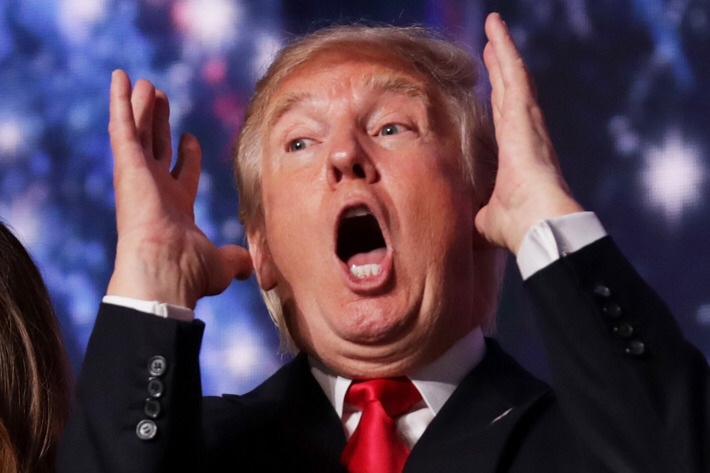
It would be naive to claim that image management does not matter more than substance in American politics (and British for that matter). Ever since 1960 (brilliantly described in “The Making of the President”) candidates have been primarily brands. But in Trump you have a brand that is an anti-hero – that’s a first. Voters choose him not despite his venality but because of it. The Obama brand was the precise opposite. He was not universally liked but to many he was a hero – a Kennedy figure where Trump is Nixon but without Dicky’s cleverness, vision and intellect.
Trump the anti-hero
Is Trump an aberration or can we expect more charismatic populists in America politics? Well not necessarily. Lyndon Johnson had none of his murdered predecessor’s charm but he won in 1964 because he was (then) respected if not greatly liked. Four years later the fatal misjudgments of Vietnam drove him from the race and with Kennedy Mark 2 tragically joining his brother in Arlington Cemetery the public chose Tricky Dicky because he actually seemed more experienced and authoritative than the alternative – which he was.
Post Obama the Democrats have struggled to find anyone of similar electable charisma. Hillary carried too much negative baggage and in 2020 they struggled to find what they needed – a youngish, appealing, decent counterweight to Trump. And so it is a choice between an old populist they know and an even older bland old man who in normal times would be at best an older statesman in a rocking chair.
Sometimes our brand choices are the lesser of two evils. If a flight route we want to travel on is either British Airways and Ryanair you grit your teeth and make a choice. We now know that Donald Trump is certifiable – the evidence is in plain view every day. If he was an anti-hero four year’s ago now he is a demented anti-hero – like a character in a Joseph Heller novel or in “MASH”. In 2016 his populist charisma struck a chord with sufficient Americans to win. In the interim he has been impeached by the House of Representatives and demonstrates every day his unsuitability for high office. And yet the core brand elements that won him the presidency are intact.
Trump would have fitted well into the mad world of “MASH”
In an age of suspicion of the establishment the candidates distanced from the political norms can win. That was the key to Leave’s win in the EU Referendum and to Boris Johnson’s General Election win in 2019. Add in a heavy dose of xenophobia and patriotic symbolism and you may have enough. Can you win an election with extreme nationalism grafted on to your flag-waving populism? Yes you can – especially if you demean foreigners at the same time. Stress that COVID-19 is a Chinese virus and you shift the blame from your incompetence to someone else. When Brexit becomes the disaster it inevitably will be it will be the EU’s fault. Obviously.
I think Joe Biden will struggle (I hope to God I’m wrong). His brand identity is weak. The people that would vote for any Democrat will vote for him, but that’s not enough. Republicans, despite the admirable “Lincoln Project”, will vote pretty much en masse for Trump. Independents are the key. To be against Trump is not enough. To win the floating vote you’ve got to be pro Biden. That’s proving to be difficult.
Indeed. Part of Britain’s collective delusion about its place in the world is that we would wish to, or have the capability to, launch significant unilateral military action against anybody – let alone a major power with significant armed forces.
In 1982 a distant corner of the remnants of the British Empire was invaded by a hostile power. Honourably we did not abandon the couple of thousand British subjects who eccentrically chose to live there any more than we would have done had the invasion been of the Isle of Mull. But we couldn’t do it again.
For medium sized western powers the only Defence option is collective. That’s what the tentative moves towards a European Army are about. As Europe moves to ever closer union the logic of including united armed forces in that move is inescapable and, actually, fairly uncontentious. NATO is dominated by the United States – the sole Western state that could engage the “Russian, Chinese or Iranian armies”. But its construct, a post war invention, is archaic. A European Defence Force (EDF) is a much more logical option.
The prospect of an EDF which is part of a military alliance with the United States is entirely logical. Yes it would resemble NATO but it would have a major difference. The accountability of the EDF via political masters in the European Parliament would be clear. The collective accountability of NATO frankly doesn’t exist. There are national accountabilities via individual country Parliaments but that is far too loose and ineffective.
And what of Britain? Well Britannia rules very little these days and would struggle to defend what it has. Whether we have aircraft carriers or submarines or cruise missiles or Trident, or even tanks, if we were attacked anywhere by a major hostile power we could not defend ourselves without help. To pool our military resources as part of NATO makes sense and we should abandon the delusion that we should spend huge amounts of money independent of the NATO alliance. The only case for Trident is if the NATO members collectively decide that they need it and will collectively pay for it.
When Empires fall it is uncomfortable and the celebration of perceived past glories becomes common. To say that as a land we have lost “Hope” and that the celebration of past “Glory” is all we have is perhaps unduly pessimistic – but not by much. In a sane world we would be prime movers in building European unity including a European Defence Force to which we could make a major contribution. The size of our Armed Forces is still significant even though it lacks critical mass for major independent action. As I have said we could not, on our own, defend or recover The Falklands these days.
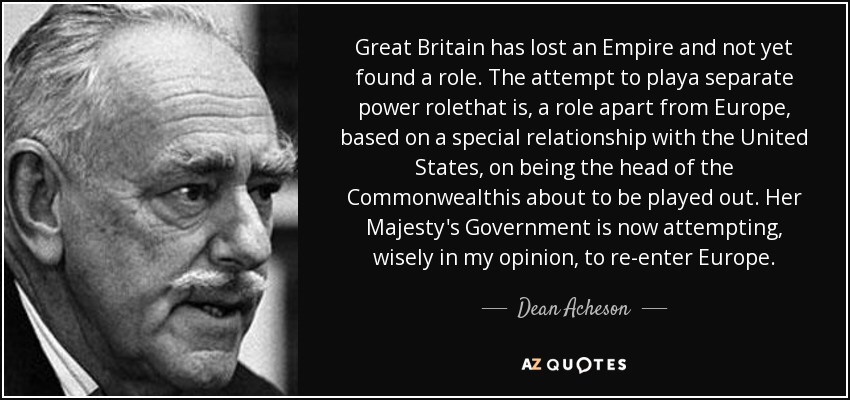
Its now nearly sixty years since we were told that we had “lost an Empire but not yet found a role”. No amount of jingoistic flag-waving will take away from the truth of that. One of the militarily great powers is our ally – albeit under the Madness of King Donald a shaky one. The remainder are threats. A uniting Europe is potentially more than just a political and economic entity. It has the capability to be strong militarily and this will surely happen. We should get back inside the tent.
The State Pension is means tested. I pay income tax at the marginal rate on mine effectively returning 40% of the pension from whence it came. I do this willingly. I acknowledge that although I am entitled to the Pension I have other income sources and rely on the state less than some others. As for its quantum in Britain we have a slightly different model than some other European countries. The state pays my baby boomer generation less but I have more from my workplace pension which was final salary based, inflation-proofed and secure. I also pay tax on this of course.
Pensioners get a raw deal…
The problem for many is that both the state and workplace pensions are inadequately inflation proofed. Even with the triple lock the state pension loses its purchasing power every year. Similarly workplace pensions linked to an inflation index such as RPI or CPI decline in useful value every year. The reason for this rarely-acknowledged fact is that Pensioner inflation always exceeds that of the price indices. Indices are based on baskets of goods and services for the population at large, but what pensioners need to spend their money on is different.
If you search for it you can find an official index of Pensioner inflation, though it’s a bit hidden away! Odd that ! The money we pensioners spend on utilities is higher than that of the wider population. Similarly falling interest rates benefit us little as many of us no longer have mortgages. Poorer pensioners especially are disadvantaged with state pension increases not matching the inflation they actually experience.
Pensioner inflation generally exceeds the Price Indices.
The myth of gold-plated baby boomer pensions needs to be busted. And it’s also time we started comparing our total pensions receipts (state plus workplace) internationally and not just our lower state pension. The subject of pensions has always generated more heat than light. Time we started more fact based analysis and commentary.
There has not been a Promenade Concerts season in 2020 and will not be. Whilst the return of live symphony concerts next month is to be welcomed they are emphatically not Proms. You simply cannot have a Promenade Concert without promenaders. It’s a non sequitur.
The relationship between audience and performer, be it in sport or in the Arts, is what makes a live event. The virus affected cricket and football this year has been strange and unreal. The players and others involved have done well and the sport has been as normal as possible – but it has been soulless and cynical. The latter because we know that the only driver has been financial.
To hold a symphony concert with players scraping and plucking and blowing within a few feet of one another in a time of social distancing seems perverse and it is clear that the restrictions will mean there can be no sort of normality. We will see how the orchestras cope – presumably there will be screens? You can hardly play the trombone in a mask.
To even think about holding a “Last Night. Of the Proms” is absurd. Audience participation, especially after the interval, is the key to this event. Without it it it’s not just not worth the bother. It’s also grotesquely disrespectful. The Last Night is a spectacular celebration, very silly and eccentric of course but a bit of a bonkers tradition. To think of putting it on in a year when there is nothing to celebrate defies belief. More than 60,000 British families are still in mourning. The Land we live in is more one of dread than of “Glory” and any “Hope” we may have is dashed almost every day.
No glory and not a lot of hope in 2020
The issue of the “patriotic” songs is a separate one. Certainly to have them this gruesome year would be an affront and is unthinkable. For the future a review is called for. As a nation there are signs that the iniquities of Empire are at last beginning to be understood and that we never did create a “green and pleasant land”. That our lonely future can be celebrated as any sort of Jerusalem looks preposterous. You don’t remove Britain’s image as an inward-looking laughing stock by waving flags and pretending that Britannia Rules. But then perhaps delusion is all we’ll have left.
“Johnson the loner will govern as he pleases” says Paul Goodman in The Times today. Mr Goodman and his friends at ConserativeHome have long supported Boris Johnson and wanted him as the Party’s leader. This has never been because Johnson has shared their Hard Right Eurosceptic libertarian philosophy, but because they saw him as a vote winner. His ambition was such that he would do what he was told and if it was Lord Ashcroft and his ConHome website that was doing the telling all the better.
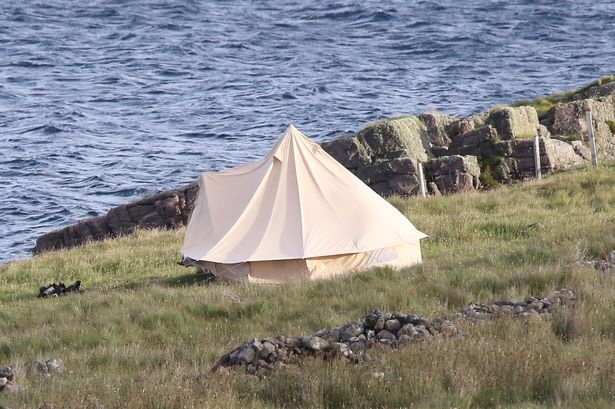
The Prime Minister’s tent (allegedly)
There is no vestige of a political philosophy in Boris Johnson. The terms “Thatcherite” or “Blairite” did actually mean something. What is a “Johnsonite” – there is no such thing ? Like Groucho Marx he has principles, but if you don’t like them he has others.
Tim Montgomerie, a ConHome founder, has said:
“Many [Conservative] MPs are furious at the slump in the opinion polls; at the ways in which their multiple calls for Cummings to go were ignored; and at a succession of unforced policy errors. They no longer believe in the Prime Minister in the way they did.”
It’snot just the Conservative Party realising that Boris Johnson is not up to the job – his defenders in the media and elsewhere are few and Montgomerie is far from the only once supporter who has reneged.
Pragmatic leaders who campaign from the political edge but once in power segue to the centre have been common. Indeed most modern Prime Ministers are in this mould (Thatcher the exception). Johnson campaigned on a single issue – to Get Brexit Done. A weary electorate gave him what he wanted. He has been unlucky that his first year in office has given him a management challenge far beyond his competence to handle. But it was his choice to keep the manipulative and scheming unelected ideologue Dominic Cummings in his job – as Tim Montgomerie pointed out this has been a major cause of policy errors, and still is.
Johnson isn’t an ideologue – he has never had a coherent and consistent political philosophy. His vacillations and U-turns are not a surprise. If you spend some of your youth trashing restaurants your innate respect for common-sense and propriety is unlikely to be substantial.
In times of extreme stress good leaders act decisively and communicate persuasively. I don’t just mean Churchill (though of course he was the great model). The challenges of 2020 are not those of 1940 (though the death toll is greater) but more those of 2008 post Lehman Brothers. Then competence was needed and Gordon Brown exercised it. Brown eschewed faux-charisma and went for hard work and transnational cooperation which he led. It worked and it is his legacy that it did. Oh for that level of competence today – you won’t get it from the man in the tent.






 Paddy’s Blogs in a crazy world