
My Question: “Is there a rational explanation as to why citizens of the former Communist GDR are now embracing the Hard Right AfD ?”
ChatGPT (AI) answer
Yes. There is a quite rational, historically grounded explanation—although it is important not to reduce AfD voters to either “Nazis” or “victims of economic deprivation.” The eastern German story is more complicated.
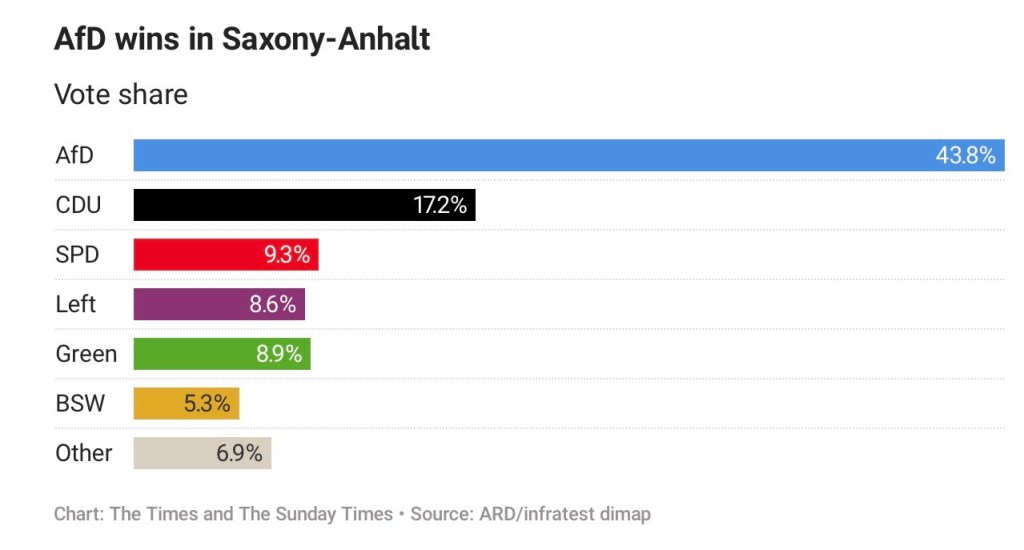
And the timing is striking: yesterday, 6 September 2026, the AfD won 43.8% in Saxony-Anhalt, its strongest state-election result ever.
The apparent paradox is: How can people who lived under a communist dictatorship end up voting for a party on the hard right? The answer is that the AfD is not offering a return to communism’s opposite in every dimension. It is exploiting several long-standing East German experiences that don’t map neatly onto the conventional left–right spectrum.
1. Reunification was experienced by many as something that happened to them
This is probably the most important piece.
For many West Germans, reunification was essentially a national triumph. For many East Germans, it was also an abrupt institutional, economic and social takeover.
The West German constitution, currency, legal system, political parties, companies and administrative structures were essentially extended eastwards. Millions of East German jobs disappeared as inefficient state industries were rapidly dismantled or privatised. Western Germans disproportionately occupied senior positions in the new institutions.
So there developed a feeling that:
We lost our country, our careers and our social status—and then we were told that the West had generously rescued us.
That produces a very different psychological relationship with the Federal Republic.
Research on eastern Germany repeatedly finds unusually strong feelings of social marginalisation and under-representation, even after substantial economic convergence.
And there’s an important distinction here: you don’t have to believe the GDR was good to resent what happened after it disappeared.
Someone can simultaneously think:
- “The GDR was an authoritarian dictatorship.”
- “Communism failed.”
- “Reunification was necessary.”
- “But the way reunification happened was humiliating and unfair.”
Those aren’t contradictory propositions.
2. The East has a particularly strong anti-establishment political culture
There’s an interesting historical irony here.
East Germans have had very little reason to develop the same unquestioning institutional trust that developed in West Germany after 1949.
They experienced one political system collapse in 1989–90. Then they were incorporated into another political system whose institutions were largely unfamiliar and whose elites were predominantly western.
Consequently, distrust of established institutions is unusually pronounced.
And that makes the AfD’s basic pitch—
“The political establishment doesn’t represent you; the system is rigged against ordinary people; let’s tear it up”
—particularly potent.
The German Federal Agency for Civic Education has documented substantially lower levels of trust in political institutions in eastern Germany and notes that the AfD replaced Die Linke as the principal protest party in much of the East.
That’s an important point: some AfD votes aren’t really votes for the AfD’s entire ideological programme. They’re votes against the establishment.
Of course, that distinction can disappear once a protest movement becomes powerful.
3. Economic deprivation matters—but not quite in the way people sometimes assume
The East is no longer simply “poor Germany.” Enormous economic progress has occurred since reunification.
But relative disadvantage and perceptions of disadvantage matter politically.
Eastern Germany still has lower wages and wealth, fewer major corporate headquarters, an older population, demographic decline and some areas with substantially weaker economic prospects. Reuters noted in 2024 that median wages were about €3,013 in the East versus €3,655 in the West, while unemployment remained higher.
More interestingly, research from the ifo Institute found that increasing economic deprivation produces a stronger increase in far-right voting in eastern Germany than in western Germany.
But this doesn’t mean:
poor → AfD
It’s more like:
economic insecurity + perceived disrespect + demographic decline + political alienation → receptiveness to populism.
That’s much closer to what the evidence suggests.
4. There’s also a profound status issue
This is arguably even more important than income.
Imagine being 55 in 1990.
You had spent your entire adult life in the GDR. Perhaps you had a respected position in a factory, railway, school, local administration or technical profession.
Suddenly, the entire institutional world that had validated your status disappears.
Your qualifications may no longer count in quite the same way. Your workplace disappears. Your children move west. Western managers arrive. You are repeatedly told that the West has the more advanced culture, economy and political system.
You aren’t necessarily poor.
But you can feel that your biography has been devalued.
This is one reason why the politics of recognition is so powerful in eastern Germany.
The message isn’t simply:
“We’ll make you richer.”
It’s:
“We know why you’re angry. They look down on you. We don’t.”
That is extremely powerful political messaging.
5. The AfD has cleverly turned East German identity into a political identity
This is particularly visible now.
The AfD has increasingly presented itself as the party of the “real” East German—ordinary, socially conservative, sceptical of Berlin elites and hostile to what it portrays as western liberal cultural norms.
Its campaign in 2026 has even incorporated East German cultural symbols such as the Simson moped, deliberately invoking regional nostalgia and identity.
That’s clever because it allows someone to say:
“I’m not voting for extremism. I’m voting for us.”
And that is psychologically quite different.
6. The East is also somewhat more socially conservative
This is where the explanation gets uncomfortable.
It isn’t all grievance.
Research comparing eastern and western Germans has found somewhat stronger nativist and populist attitudes in the East, particularly among older generations who were politically socialised during the GDR period. Nativism is also more strongly associated with AfD voting in the East.
There are several possible reasons.
The GDR was officially internationalist, but it wasn’t a liberal multicultural democracy. Everyday social life was comparatively homogeneous, and immigration was limited and highly controlled.
After 1990, Germany entered an increasingly globalised, multicultural and socially liberal world.
For some people, that represents progress.
For others, it represents another enormous cultural transformation imposed from above.
The AfD tells the latter group:
“You aren’t backward. Your instincts are legitimate.”
Again, that’s an extraordinarily effective political proposition.
7. And there is a fascinating Russia dimension
This is another legacy of the GDR.
Older East Germans spent their lives in a society whose geopolitical orientation was towards the Soviet Union. Many had direct experiences of Russians—through Soviet military bases, education, work, friendships and cultural exchange.
That doesn’t mean they are pro-Putin.
But Russia is psychologically less alien to many eastern Germans than it is to many western Germans.
That difference has become politically significant since Ukraine.
The AfD’s opposition to sanctions, hostility toward German military support for Ukraine and advocacy of renewed relations with Moscow therefore resonate particularly strongly in parts of the East. Reuters reported this week that memories of the Soviet presence remain politically significant in Saxony-Anhalt.
But here’s the really interesting paradox
There is actually a continuity between some East German political behaviour before and after 1990.
During the GDR, people couldn’t meaningfully change the government through competitive elections.
So political culture developed around:
“The rulers are illegitimate; we have to find ways around them.”
After 1990, that instinct didn’t necessarily disappear.
It could manifest as:
“Berlin doesn’t listen to us.”
And then:
“Vote for the party that Berlin is terrified of.”
That’s one reason the AfD can function simultaneously as an ideological party and as a giant middle finger to the political establishment.
But I wouldn’t say “former Communists became fascists”
That explanation is too simplistic.
In fact, one of the most revealing facts about eastern German politics is that the same underlying electorate has historically been capable of voting for both the radical left and the radical right.
The successor to the East German communist party, Die Linke, was for years extraordinarily strong in the East.
Then the AfD began taking some of that protest vote.
And more recently, Sahra Wagenknecht’s BSW has attracted voters combining left-wing economics with socially conservative and anti-war positions.
That suggests something important:
The underlying political axis isn’t necessarily “left versus right.”
It’s often:
establishment vs. anti-establishment
combined with
social liberalism vs. social conservatism
and
globalisation vs. local/national identity.
The AfD happens to occupy the most electorally successful corner of that space.
And there’s one final irony
The AfD’s success isn’t really evidence that East Germans have forgotten what authoritarianism looks like.
It may partly demonstrate something else:
having experienced one authoritarian system does not automatically immunise a population against another form of authoritarian politics.
People don’t vote according to a historical lesson book.
They vote according to how they perceive their present circumstances, identity, status and future.
And if someone feels that:
- their region was humiliated by reunification,
- their children had to leave,
- their community is declining,
- Berlin doesn’t understand them,
- mainstream parties don’t listen,
- immigration is changing their country,
- their cultural values are being dismissed,
- and their economic future looks uncertain,
then an AfD message of “They abandoned you; we will put you first” can make considerable emotional and political sense—even if an outside observer finds the resulting choice deeply disturbing.
That’s probably the most rational way of understanding the phenomenon without either excusing the AfD’s extremism or caricaturing its voters.
And yesterday’s extraordinary 43.8% AfD result in Saxony-Anhalt suggests that this isn’t merely an interesting historical residue anymore; it has become one of the central political cleavages in contemporary Germany.

