

A majority Government in The Netherlands requires 76 or more seats in the Tweede Kamer (lower House). This means that there will always be a coalition between two or (usually) more parties. The seeking of coalition partners generally rests initially with the largest Party by seats. At present the PVV (Partij voor de Vrijheid) (despite losing seats) or D66 will emerge as the largest Party. .
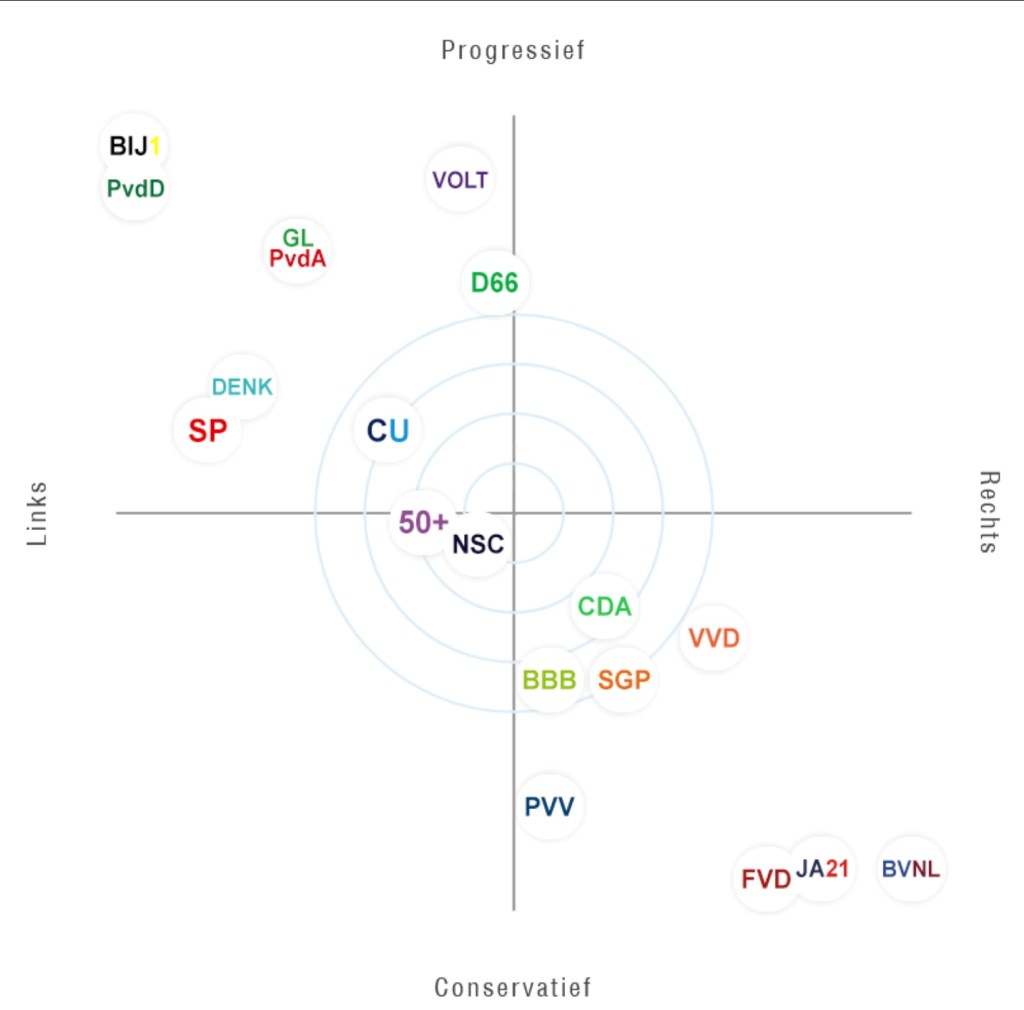
The main parties (the top seven in the table above) have distinctive political positions which can be described in British political party terms as follows:
PVV The party, led by Geert Wilders, is anti immigration and, particularly, anti Muslim. The parallel with Reform is strong as it is with Trump’s Republicans in the US. Its economic policies are more centrist. “On certain themes such as healthcare, social services, LGBT rights and elderly care the PVV can be seen as left-leaning and social democratic”. (As Wikipedia puts it). 26 Seats.
D66 rose to prominence when I lived in The Netherlands in the early 1980s. Its philosophy is profoundly centrist in terms of policy and it attracts support in particular from university educated voters. It has been a regular coalition partner more often with Leftist parties though on occasion with the soft Right. Its current position is its best ever and its leader Rob Jetton may become the Party’s first ever Minister President (Prime Minister). In British terms D66 is close to the LibDems. 26 Seats.
VVD was The Netherlands’ main secular conservative Party until the rise of the PVV. The comparison is with moderate One Nation Conservatives in the UK. Pro free enterprise but unlike its British equivalent it has never drifted towards Euroscepticism. It boasts that it is centre Right mainly to distinguish itself from the PVV. Mark Rutte, who led the party from 2006 to 2023, became Minister President after the 2010 election serving in the position until 2023. The decline in numbers of centrist Conservatives in Britain means that the old VVD/Tory synergies are much less valid than before. 22 Seats.
PvdA is a traditional Social Democratic Party with policy and structural similarities to the Labour Party in Britain and Germany’s SPD. It has been frequently in Government and there have been many PvdA Minister Presidents. In recent times it has been in close electoral alliance with the Green Party (Groene Links) and it is expected that the two parties will merge in 2026. 20 Seats.
CDA is a Conservative party whose core electorate are church members, both Catholics and Protestants. It was frequently in Government in the past but fell to only five seats in the 2023 election. Part of this electoral decline can be attributed to the secularisation of Dutch society. There is no direct comparison in Britain but the CDA has obvious links with the CDU/CSU In Germany. Polls suggest that the CDA has made a recovery in recent times and it will be a player in the negotiations for a new Coalition. 18 Seats
JA21 was a breakaway from the FVD (see below) and is a Hard Right nativist party seeing itself comprising “moderates” fleeing FVD’s radicalisation. Its mission was to capture disillusioned FVD voters seeking “credible” right-wing politics. 9 Seats.
FVD (Forum voor Democratie) was established as a Party for those who saw Geert Wikders and his PVV as too liberal (!). It is anti immigration and nativist.(FVD) and in the election positioned itself as a hard-right, anti-globalist alternative emphasizing repatriation leaving the European Union, scrapping climate policies, and drastic government shrinkage. 7 Seats
Where now ?
Every shade of opinion will be represented in the Dutch Parliament, as it usually is. There will likely be a small but vocal group of strongly socialist MPs from the Socialist Party who will have three seats. but their influence will be limited by their modest seat count and the broader centrist/progressive lean of the leading Centre/Left parties like D66 and PvdA..
The Hard Right (PVV+JA21+FVD) will have no more than 42 seats and none of the traditional parties would enter a Coalition with them. So the next Dutch Government is likely to be a Centre/Left combination of D66 and PvdA with VVD and CDA to keep them honest ! Not a bad outcome !
 Paddy’s Blogs in a crazy world
This election shows the racist far right have limited appeal to the majority of moderate voters. Lets hope that replicates in the UK.
LikeLike