Inflation proof pensions are hardly a revolutionary idea. Most Defined Benefit Scheme workplace pensions give annual increases linked to an inflation index – usually CPI or RPI. The problem is that these general indices do not in any way reflect Pensioner inflation – nor does the annual increase in earnings nor 2.5%. The triple lock is a lottery and one that guarantees that in real terms Pensioners will get poorer every year.
Pensioner inflation is different from overall inflation because Pensioner lifestyles and spending patterns are different. Many older pensioners do not have a mortgage and so the housing cost element of CPI is inappropriate. The basket of goods/services in the CPI is also very different from the real basket of pensioners. Utilities costs (electricity and gas) form a considerably higher percentage of a pensioners expenditure than that of a working family.
To maintain the value of the State pension (and workplace pensions for that matter) a new approach is nodded. Annual increments need to be linked to a Pensioner expenditure Index which accurately mirrors what pensioners actually spend their pensions on. Such an index does actually exist but nobody talks about it. They should. The Triple Lock is characterised as being generous to pensioners. It is nothing of the sort.
It is not just in Britain that motorway service areas are the preferred location for the oil companies. The economics are attractive in many countries despite the exceptionally high initial outlay. Here’s how it works.
Motorways are publicly owned and to help defray construction and operating costs the elements on offer on site are put out to tender. This includes such things as fast food and fuel (petrol/diesel). It is highly competitive and the right to have your brand on site will cost millions of pounds in upfront and annual costs.
The reason that despite the cost oil companies like motorway service areas is that there is no competition. This is supply/demand economics at its most raw. Price theory predicates that the price of a commodity like petrol is at the intersection of the supply and the demand curves.
In a normal town there will be a number of petrol stations competing on price. The supply is high which puts pressure on the price. It’s also open – prices are clearly displayed on the sign outside the station. Of course other factors play a part – the shop on the site will bring customers in and location is crucial. The busier the road the better. There can also be brand preference and loyalty schemes. But in the main demand is price determined and the customer exercises choice.
At a motorway service area there is no choice – they are virtually all single brand outlets. There is no price competition and there are no price controls. Companies have paid a lot to be there and they want to recover those costs so they put the pump price as high as they can. The customer is captive and takes it or leaves it. On a long journey it is likely that he or she will have to take it. The alternative is to leave the motorway and search for a station with lower prices – not many drivers do that.
British motorways are mostly free to use but the driver and passengers will pay in other ways. Your Costa Coffee will cost you more than on the high street, and so will your BP petrol. With today’s more fuel efficient vehicles a tank of petrol will take you a long way. You may be able to avoid expensive motorway petrol entirely and it makes sense to do so. But most of us will have to pay the motorway petrol cost surcharge sometimes I’m afraid !
“Don’t call them bovver boys, what you mean is racists” – Sara Tor in The Times
At the heart of these people (if they can be seen to have one) is stupidity. Blind ignorance leads to many things of which racism can be one. Not all dim people become racists but it’s fair to say that all racists are stupid. What about Nick Griffin an openly racist activist who was educated at Cambridge University ? What about the aristocratic Army Officer Oswald Mosley – an antisemite fascist racist much of his life. Good questions !
The racist thugs have their heroes – check social media if you doubt that. Nigel Farage for one. The Dulwich College educated and minor city slicker Farage was a fascist at his school. Well we all do silly things in our teens. But in Farage’s case the proto-fascist child was father of the Hard Right, xenophobic man. His very apparent respectability gives our fat ageing street urchin “protestors” encouragement. Farage’s opinions are not that much different from the yobs – just somewhat more elegantly expressed.
Mosley led marches through the East End Of London where the ancestors of todays “protestors” cheered. Enoch Powell received much support from the Alf Garnett cohort. They knew the buttons to press. At the high point of his political activism Nick Griffin garnered dozens of council seats for the British National Party and was elected as a Member of the European Parliament. It’s successor Farage’s UKIP, the most successful overtly nationalist political party ever, changed Britains direction, possibly for ever.
In the European Parliament elections of 2014 Farage roused the rabble. Britain’s UKIP representatives in that parliament became political outliers in Brussels who the elected MEPs from 27 nations looked at with puzzlement bordering on contempt. When these rancid Kippers turned their backs on their fellow MEPs in an act of vulgar defiance any reputation Britain may have once had as a credible participant in the governance of a uniting Europe disappeared.
The distinction between a racist and a xenophobe is a fine one. And the distinction between a xenophobe and the Brexiteer peddlers of the mythical benefits of “Sovereignty “ is a fine one as well. They are still at it of course – even a man as educated and urbane as Chancellor of the Exchequer Rishi Sunak is drivelling on about Britain becoming “Independent again” on 1st January 2021. As if the independence our recent ancestors fought for and won in WW2 was a chimera.
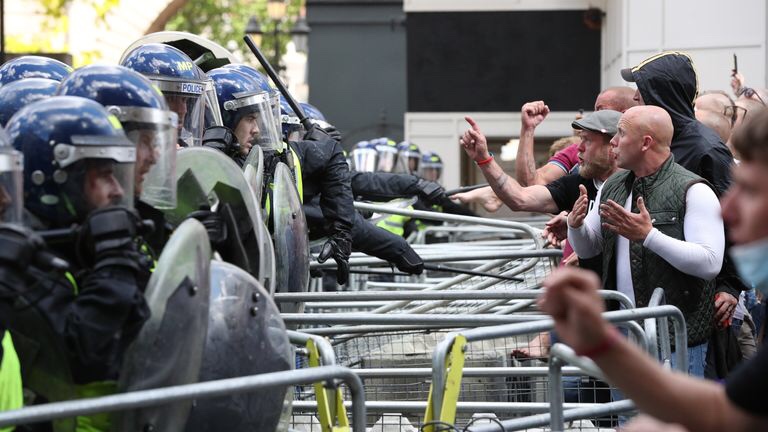
So we may all distance ourselves from the fat men with tattoos who desecrated our capital City at the weekend. But we should all look carefully at the political climate which gave them cover for their actions. The political line from Mosely to Powell to Farage is clear. To extend it to Johnson is not too much of a stretch. If you call people of colour “picaninnies” you signal your opinions fairly clearly.
When I worked in Scenario Planning in Shell more years ago than I care to remember one of the key variables was the price of Crude Oil. Indeed in many ways the alternative scenarios could be characterised as “High” or “Low” oil price scenarios. The point of course was that predicting future prices was a mug’s game. It still is. Single line forecasts are always wrong.
Scenarios make uncertainty explicit. If you describe two scenarios in which in one case the oil price in ten years time is $50 a barrel and in the other its $100 you are not forecasting. You are challenging your management team to test its strategies against both cases. If (say) an investment looks robust in both cases you will likely proceed. If it looks dodgy under both scenarios you won’t.
Investors seek a degree of predictability in their investments. The likes of BP and Shell historically have offered that. A Pension Fund putting a substantial slug of its assets into equities wants the dividends to be secure and in the past they always were. When Shell cut its dividend recently it was a shock to the system. In a short space of time it went from the rather negative policy of buying its own shares (“buybacks”) with excess earnings to not having enough earnings even to pay shareholders’ dividends. That seemed very much like panic.
The Oil industry has grown on the premise that the world increasingly needed its products. Demand only went in one direction. There is a direct link to supply – the higher the demand the higher the price and the more the marginal fields became profitable. But now economies under pressure could be stagnant at a time when previous investment in renewables is making a significant contribution to power generation. More wind, less gas. All of this can be modelled in scenarios. Price, demand and supply and the relationship between them and the extent to which they drive the potential substitution of one energy source by another lie at the heart of Scenario Planning.
If I was an investor I would not ask BP or Shell what their oil price forecast was. I would ask them what their strategy was under alternative and sharply contrasting price scenarios. I would ask them, for example, if they had plans to invest in renewable energy and whether those plans were firm under different future oil price scenarios. The planners in Shell were often told that our balls were made of crystal. It was true. But we found a way not to fail in our forecasts by saying – but what if ?”. It sounds like this technique is needed more than ever today.
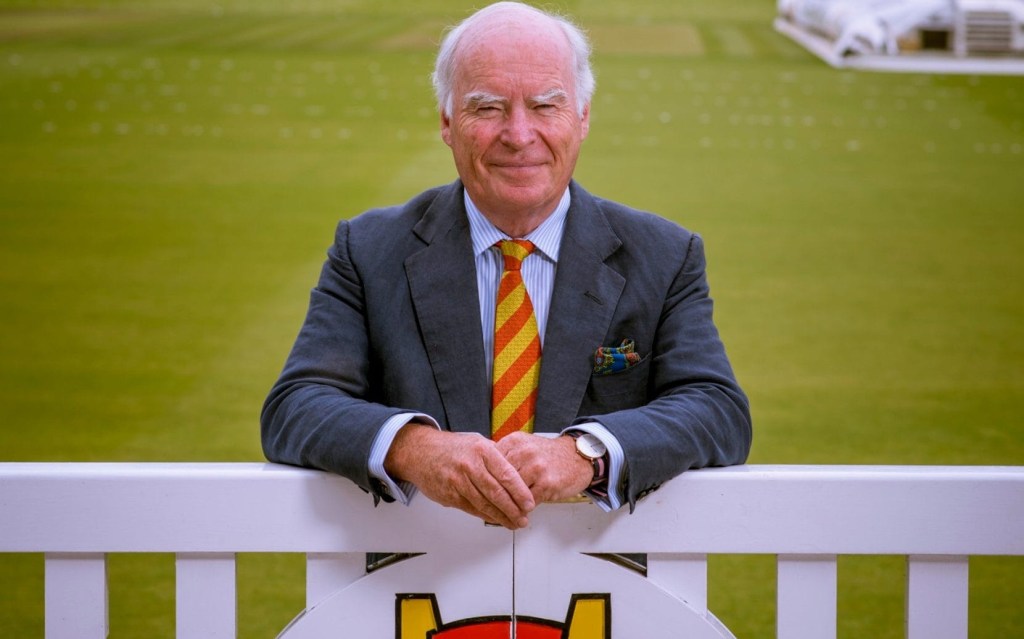
Gerald Corbett – Chairman of the Marylebone Cricket Club
Many club members, like me, have been arguing for a decade or more that it is the club’s management structure that is at fault , something that transcends personalities. MCC is, of course, a private members’ club and as such it can pretty much do what it likes within the laws of the land. And it does. The geriatric chummocracy is not new – it once governed world cricket but since those heady days it has been reduced to a more modest role. We should be grateful for small mercies.
Gerald Corbett is an amiable and pragmatic man whose arrival as Chairman many of us welcomed. If you think it’s a chummocracy now look at what went before! But Gerald has changed much less than we hoped and the secrecy which bedevilled the club’s governance throughout its long history remains. Last week a live “Webinar’ for members was held to which I and many others tuned in. But the transmission failed and we had to be content with watching a recording later. It was shambolic. We have not been told what went wrong other than that it was a “technical” problem. Which I think we could see for ourselves. But why did it happen, and isn’t a proper apology due?
On Gerald Corbett’s watch a running sore which he inherited has festered and is worse than it was. That is the relationship with the freeholder of the strip of land along the Wellington road which is on the Lord’s estate but in which MCC only has a leasehold interest. The resolution of this anomalous absurdity was certainly possible to the Club’s substantial financial advantage. But manoeuvring behind the scenes by the leadership, including Gerald, has meant that this is further away than ever. The Club’s current financial problems (well recorded previously in this newspaper) are such that the imperative to do a deal is stronger than ever but there are few signs that it will happen.
MCC is nominally governed by a Committee many (but not all) of whose members are chosen by ballot by the membership as a whole. In the past the chums then in charge attempted to get their preferred men in place by “starring” candidates they approved of on the ballot paper. This was fortunately stopped under Gerald’s chairmanship but not before the late Mark Williams, a distinguished and challenging (to the system) man in the world of cricket through his direction of the “Lord’s Taverners” , was voted off the committee because he wasn’t “starred” !
So it is the structure that is at fault and many of us have our own ideas as to how it could be improved. A much smaller, more professionally skilled management team would be my preference with a much less hands-on and less quasi-executive Chairman. The Club has an able Secretary/CEO in the young(ish) and impressive Guy Lavender – he needs better support and more personal authority to do his job. And above all the leadership needs to focus on what is by far its primary role – the management of the Lord’s estate containing one of World cricket’s most “iconic” grounds. And for heaven’s sake solve the Wellington road issue once and for all.
So though I understand what motivates those calling for Gerald Corbett’s defenestration, and sympathise to an extent with them, I think the solution is more radical. MCC is more than a business – though not as much more as it rather pompously sometimes thinks it is! And it needs to be run more as a business with the far greater openness to its stakeholders (not least its members) that modern businesses have to have. It needs to select people of ability to govern it rather than place trust in the randomness of Committee elections which often sees famous cricketers chosen ahead of people of proven business experience.
Lord’s is one of my favourite places and I consider myself fortunate to be able to enjoy it comfortably on Major match days. I’ll pay my substantial membership fee this year despite circumstances meaning that I will see no cricket 😥. But I don’t want to be taken for granted. I want to feel comfortable that the governance of the club and the processes and people that are in place are appropriate. There’s work to do.
When in Cambridge in 1961 I saw a current British Prime Minister portrayed on stage for the first time in “Beyond the Fringe” I’m not sure that I was aware of the significance of the moment. Later I bought the early copies of “Private Eye” in the streets of the City. And before I left school Ned Sherrin and David Frost had launched the groundbreaking “That Was The Week That Was”. What was happening was Satire.
Beyond the Fringe
The world is absurd, and people lie and cheat. Politicians parody themselves daily and people have prejudices out of ignorance or venality. What satire did was to hold a mirror up to all this – sometimes the mirror enlarged and sometimes it distorted but it always reflected and allowed the viewer or the reader to judge.
Peter Cook, Dudley Moore, Jonathan Miller, Alan Bennett, David Frost, Barry Humphries, Richard Ingrams and many more launched a wave of mockery believing, as Readers Digest used to say, that “Laughter was the Best Medicine”. Britain wasn’t alone in using satire – in the US “Roman and Martin’s Laugh In” and humorists like Bob Newhart also broke new ground. But in satire we Brits did lead the way and fiercely intelligent performers and writers like John Cleese and Cook and Moore were social commentators as much as they were comedians. Later “Spitting Image” portrayed Margaret Thatcher and her cabinet of “vegetables” with cutting wit.
“Fawlty Towers” was in this long satirical tradition. Basil was a monster and, yes, the brilliant writing of Cleese and Connie Booth also enlarged and distorted his character. He was genuinely comic and horrific simultaneously. The characters around him from Sybil to Manuel and the Major were caricatures in the same way that he was. Polly was us, the sane, capable normal person trying to do her job in the Fawlty madhouse – Basil’s surname was carefully chosen !
1970s Britain (I was there) defied satire at times. Edward Heath was easy to parody – a strange and decent man struggling to make sense of a world collapsing around him. The economy was stuffed, the nation was divided and over powerful institutions like the Mining Union challenged “The Grocer” as Private Eye called him. Around Heath’s England were relics who grumped and mumbled about the modern world and in parts of the country it was these old fools who still held sway. The Major is a satirical creation but a perceptive one. When he utters the offensive remarks that he does in “The Germans” he was actually not intending to be insulting – and that is the point!
The Major’s racism (as we would now see it) was far from exceptional amongst people of a certain age and class in the times in which Fawlty Towers was set. Cleese and Booth knew this – the words they placed in the Major’s mouth were deliberately chosen to ridicule the underlying attitudes and ignorance of people like him. In the golf club in a leafy south London suburb of which my father was a member there were many Majors. It was nasty, but was it dangerous? I would say that the xenophobia and borderline racism of modern times – from UKIP to the bigots elsewhere on the Right – have been far more dangerous than the Majors of the 1970s ever were.
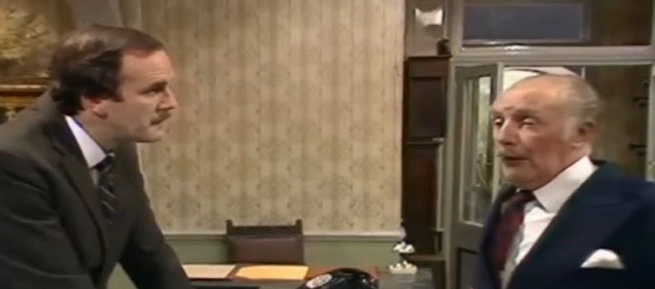
The Major
Once we stop laughing at ourselves we begin to lose our souls. Harold Macmillan came to see himself portrayed in “Beyond the Fringe” and Peter Cook departed from the script to give him a Glasgow Kiss welcome. He was not amused but alongside him the aristocratic Lady Dorothy laughed her head off. From the 1960s onwards we as a nation have been able to laugh at ourselves. This means that we can separate satirical comment (as in Fawlty Towers) from genuine offensiveness. When we listen to The Major we don’t think we are listening to a real person who wants us to believe his bigotry – he’s not Nigel Farage. The Major is a warning from the past that prejudice pollutes and that we should see it for what it is and call it out when we do.
I have spent some time in the last couple of years in Germany and have seen what the Germans have done to record their past. The Historical Museum in Berlin displays the Nazi era in graphic detail. There are other museums in the City which focus on specific aspects of those terrible times. They are all realistic and informative.
Imperialism and colonisation were arguably the most significant global forces of the second millennium. And yet there are few if any places you can go to learn about them certainly in Britain. Slavery was a driver of Britain’s Imperialism but there is no museum you can visit to learn about this.
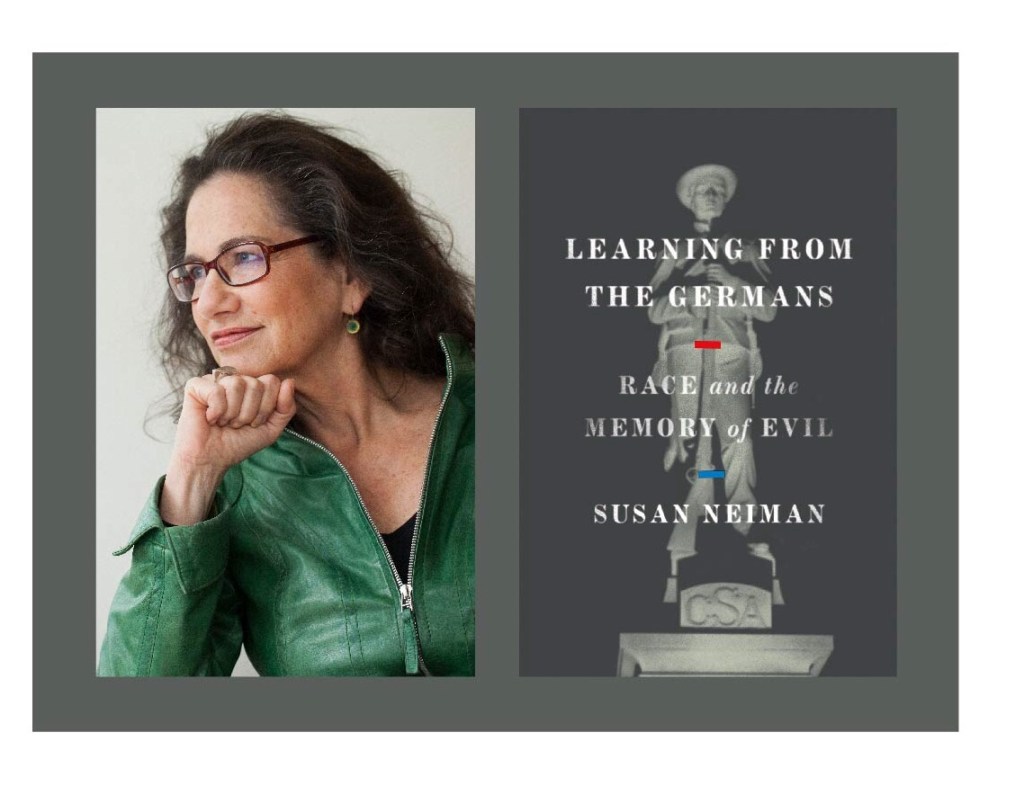
Susan Neiman, a professor of history in a Berlin university, published a book last year called “Learning from the Germans”. The key proposition was that the southern United States should address their racist past by establishing museums (etc) which inform about it. A start has been made on this in Mississippi.
Britain should found a substantial “Museum of Empire” in which our imperial past is accurately recorded. There are distinguished historians who think that some of that history was commendable – fine , let them have their say. If there was some “good” let’s put it alongside the bad and the ugly.
A couple of years ago I met an old Canadian business friend of mine for the first time for a while. He had been the Finance Director in Canada of the Corporation for which we both worked but like me he was now retired. We swapped notes about what we were doing and about the state of the World – as you do. I made some mildly disparaging remark about Donald Trump who was a year or so into his presidency and was already showing signs of his inappropriateness for high office – “Yes” said my friend “but look at Wall Street”.
Wall Street reaches record highs
On rational, moral or national reputation grounds there is no case for Trump. He’s a grotesque political aberration of unimaginable ineptitude and dysfunctionality. But even today he’s at 40% in the opinion polls when you’d think he should be in single figures. And the Republican Party, with one or two honourable exceptions, still supports him. Why?
The first reason that the idea of Trump’s re-election is not the zero chance option it should be is the continued support of poor whites. This is not a Liberal cohort and they are Trumpite to a man or woman. Every race inspired riot enhances Trump’s support in this group of disadvantaged Americans. The second reason that Trump is not out of it is the Fat Cat vote.
Those at the top of the tree financially got there in part on the back of a booming Wall Street. When your personal wealth grows with little effort on your path you vote for the ideology that does it – if the standard bearer of that ideology is Donald Trump so be it.
Strong stock markets with healthy dividend-paying shares are not just good for the Fat Cats of course. My Pension Fund still invests heavily in the equity asset class, and there are plenty of investment funds important to ordinary citizens like me predicated on Wall Street or FTSE Blue Chips. If Wall Street stays strong up to November and Trump can get across the message that this is good for all Americans don’t write him off.
I think that there are overlapping and complementary privileges at work in Britain. White privilege is one but not necessarily the most important. I don’t wish here to try and rank the privileges but let me try and address them. Let’s start with Wealth. The chancellor of the Exchequer Rishi Sunak was educated at Winchester College – a fine Independent school, but an expensive one. His parents were sufficiently wealthy to buy him that privilege and he has subsequently had the personal ability to build on it. But he had a head start denied not just to the vast majority on British Asians, it is denied to the vast majority of Britons of all races.
Rishi Sunak
Sunak’s privilege of wealth has allowed him to trump his disadvantage of race. I do not, of course, mean that his race was in any way inherently a real barrier to progress. The reverse seems to apply – British Asian children seem to outperform others at school though whether this is nature or nurture I’m not sure (I suspect the latter). But as Priti Patel has made clear people of colour like her (and Sunak) will face prejudice and discrimination at times. And not all will be able to ease their way around this disadvantage as they have.
Seven percent of children have the exceptional advantage of attending an independent school like Mr Sunak but wealth can buy educational advantage within the state system. Schools vary considerable in quality and there is a clear correlation between the wealth of a location and the quality of the schools. This is the so-called “postcode lottery” though it is less chance than this suggests. If you can afford a house in a more expensive area the schools there will be better. Again wealth buys advantage
Closely linked to wealth is, of course, Class. Again in Sunak’s case his father’s profession as a doctor placed the family firmly in middle class territory. And his education both at school and university will have reinforced that. He also sounds like what he is – a wealthy privileged Brit of colour. I doubt that any doors have ever been closed to him because of his race – as it should be, but all too often isn’t.
The advantages of class and wealth are endemic in British society – there is far too little equality of opportunity. Middle Class parents can buy their children privilege but they can also create a context within which education is valued. If at home there is a bias towards learning – books on shelves and diversity of entertainment choices – then this is an environment helpful to a child’s development – and to the passing of exams !
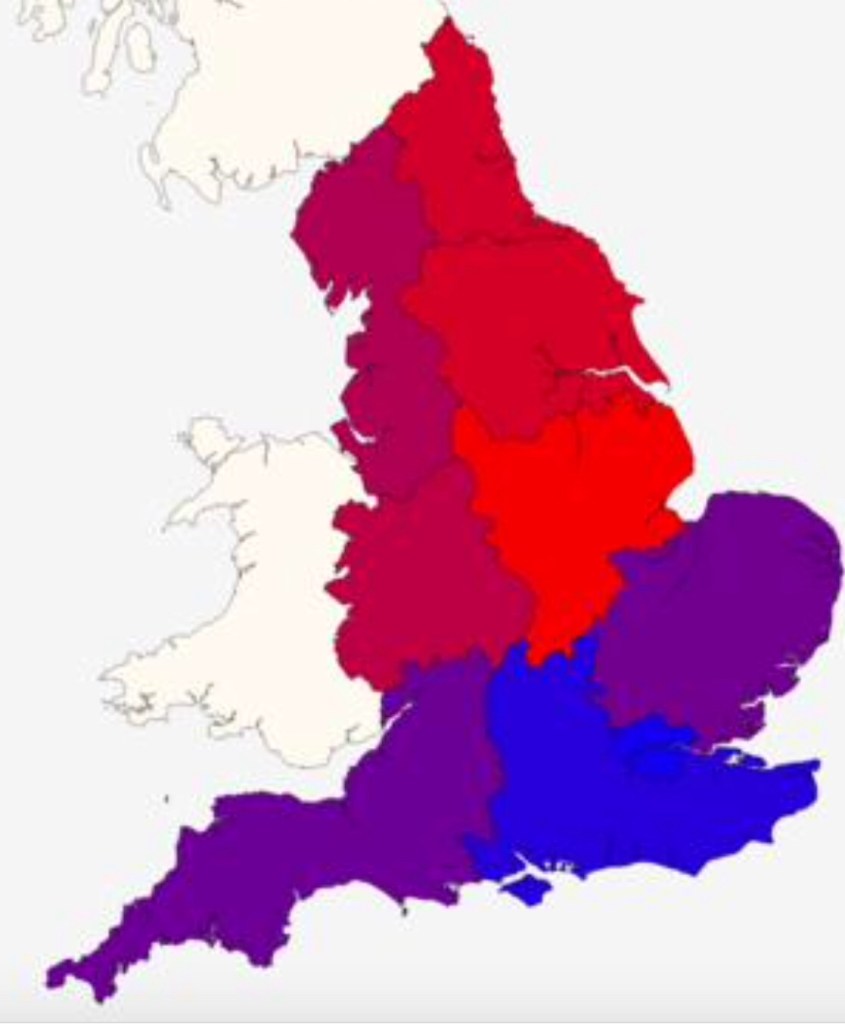
The evidence of a north/south divide cannot be ignored either. In the map below the percentage of children achieving five or more A to C passes in their GCSE exams is shown. The redder the area the fewer the passes, the bluer the more.
Five or more A-C passes at GCSE
If the discriminators of wealth, class and location can be added to that of race so can Gender. As the Trades Union Unison puts it “Some employers have outdated ideas about what work is appropriate for women, what work is appropriate for men, and how that work should be rewarded.” Look at the Board Rooms of our public limited corporations if you doubt that – and where there are exceptions check whether the presence of some female non executive Directors isn’t tokenism!
The fact that there are a raft of discriminations in British society does not, of course, minimise the significance of racial discrimination. Yes, Black Lives Matter. Yes we need more colour blind selection. As I have written before I believe the instances of racial discrimination in Britain are much greater than the establishment admits to. But our society is inherently discriminatory on many fronts – the goal of genuine equality of opportunity is a long way from being achieved.
I was born in 1946 so have spent my whole life, a few postings overseas excepted, in modern Britain. As a child in a leafy south London suburb casual racism was rife. My father’s golf club did not allow Jews to be members and the offensive insult “Jew Boy” was far from uncommon. Whilst I did not see the slogan “If you want a nigger for a neighbour vote Labour” the sentiment was rife in this overwhelmingly Tory borough. There was an underlying xenophobia in the 1950s which denigrated anyone who was not a WASP (English, White, AngloSaxon, Protestant).
I escaped West Kent when I went to University but many of my contemporaries stayed behind. They were the hard core of the “Leave” vote in the 2016 referendum and supporters of Nigel Farage (who grew up just down the road from where I was born). Not all were racists but they were not far away from deserving this descriptor. Remember I’m talking about fairly privileged middle class people here. Well, if narrowly, educated. Financially comfortable these particular xenophobes.
If the post war products of leafy suburbia could grow up with prejudice in an overwhelmingly white, “Christian” and middle class environment then what about the people of the West Midlands and the Northern Cities? When they were born their homes were in singularly WASP areas. But gradually newcomers from South Asia fundamentally changed these towns. Liberals like me might welcome the rise of multiculturalism – but bigots like Farage condemned it. UKIP was predicated on a discriminating and racist ideology.
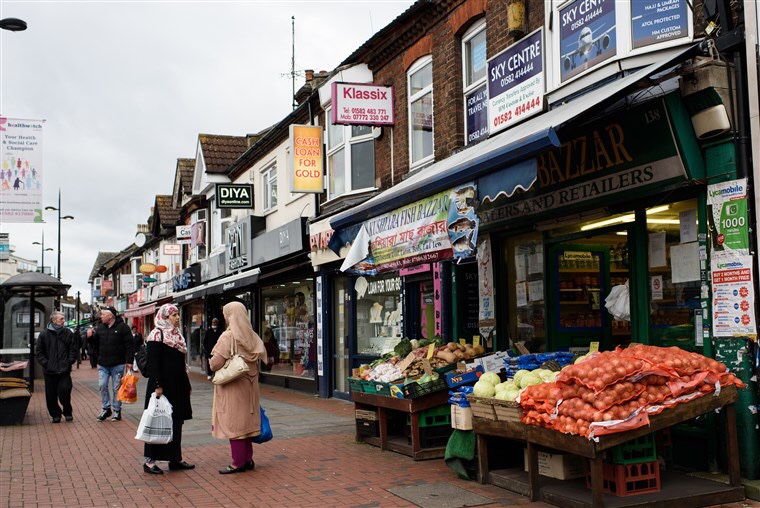
When the number of people attending Mosques in an area far exceeds those attending Churches it is symbolic of immense social change. The south Asian heritage communities may be overwhelmingly law abiding and hard working but it only takes a few vile sex offenders of Pakistani heritage to give the potential to people like Farage to condemn them all.
There is a strong undercurrent of racism across Britain. This is partly out of ignorance – in the leafy suburbs. But it is partly out of familiarity breeding contempt – in the Northern and Midlands Cities. There is no melting pot – the multiculturalism is also separatism. If your basic instinct is to reject the unfamiliar and the different it’s a small step to extend that to residents from Europe who (shock horror) might speak a different language to you. The politicians, including the Home Secretary, who boast about removing freedom of movement know this very well.
Not all pro Brexit voters are racists, but all racists voted for Brexit. If you doubt the underlying prejudice and bigotry rife in Britain then study of the reasons for the Referendum outcome is a good place to start.








 Paddy’s Blogs in a crazy world