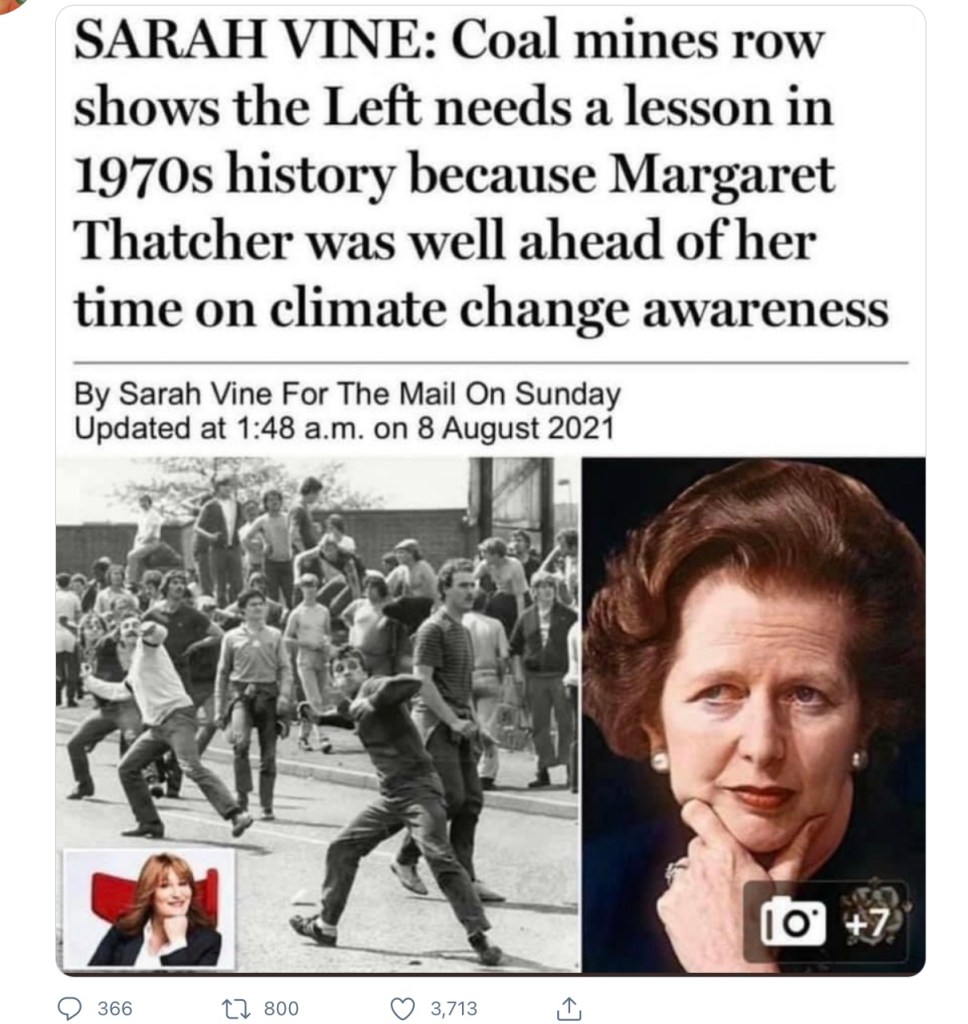
There is something quintessentially typical about this piece by Sarah Vine. Does she really think that there is even the slightest rationale for claiming that Mrs Thatcher’s “Climate Change awareness” was in any way behind her taking on the National Union of Mineworkers? I call the piece “typical” because it is a classic example of a supporter of the political Right inventing “facts” and peddling them in high circulation online outlets.

Vine conflates two things that at the time were unconnected. Margaret Thatcher’s genuine (if short-lived) concern about the dangers of climate change, on the one hand, and her determination to defeat the NUM on the other. To anyone with the smallest knowledge about, or recollection of, the 1980s this conflation is Fake News.

As I made clear in my piece on Boris Johnson’s claim that Thatcher was motivated by environmental considerations in respect of the mining sector is bunkum. Later in the decade she did have a short-lived Green period and it is fair to praise her insight on this. But it certainly was not in any way a factor in her handling of the Miners’ strike and her determination to go ahead with a swingeing pit closure programme.

But Sarah Vine isn’t interested in the truth which she could easily have checked – the story is hardly a secret. I was close to the issue when I worked in Scotland during the Miners’ strike. This is a personal story and for me a memorable one. Vine berates the “Left” in her piece but she is wrong to do so. Many on the Left, whilst horrified by Thatcher, were less than enthusiastic supporters of Arthur Scargill.

I don’t think anyone on the Left “needs a lesson on 1970s history”, but Sarah Vine certainly does. When Edward Heath’s Conservatives came to power in 1970 Britain’s Energy industry was relatively stable. Coal to Fuel Oil conversion was well underway in the industrial sector but for power generation this was more problematic. Coal was institutionalised as the primary energy source and most power stations were strongly linked to coal mines. When the price of oil tripled the development of the then alternatives to coal (oil and gas) pretty much ceased for a time. This strengthened the hand of the already strong Miners’ Union.

Edward Heath unwisely and incompetently took on the NUM. He fought a battle at the wrong time and in the wrong way. In 1974 he fought and lost two elections on the issue of “Who governs Britain”. The Callaghan government of 1976-79 received a hospital pass from Heath (after a brief spell of comparative peace under the wiley Harold Wilson). Callaghan tried but failed to do a deal with an intransigent Trades Union movement. The Unions, not Margaret Thatcher, brought him down.

So the Conservatives were as responsible as Labour for the troubled 1970s decade. From Harold Wilson’s first administration in 1964 onwards successive British governments of both Parties failed to curb Union power. Energy lay at the heart of this. Power generation was insufficiently diversified and the only alternative to British coal was imported coal.

Thatcher won the post Falklands 1983 General Election and in her manifesto she had said this:

In the next Parliament, the interests of the whole country require Britain’s massive coal industry, on which we depend for the overwhelming bulk of our electricity generation, to return to economic viability.”

To some extent this was code and there was no overt promise of confrontation with the miners. But “economic viability” could only come from reducing costs. In effect by closing loss-making mines and switching gradually to other energy sources (Natural Gas and Nuclear)

So Margaret Thatcher took on Arthur Scargill and won. But the damage to the social order was enormous. Politics descended into street fighting and the scars of that terrible time still remain.
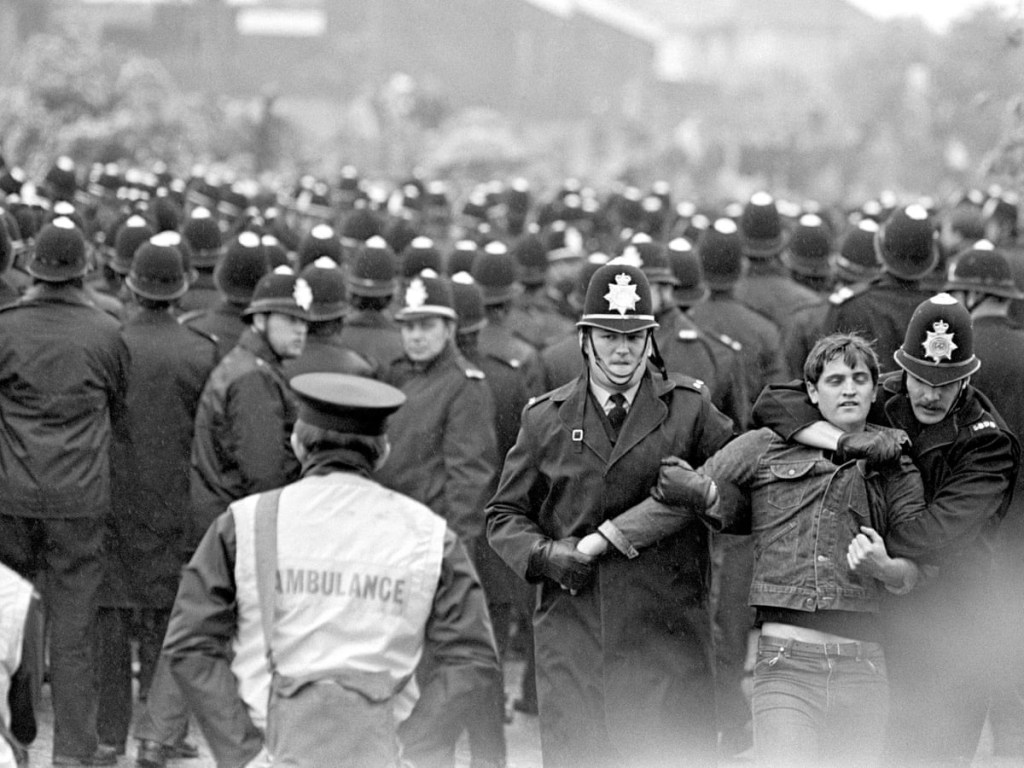
The battle of Orgreave in 1984

Thatcher was re-elected in 1987 and the working class vote facilitated this. Notwithstanding the bitter class divisions of the Miners’ strike Thatcher received support across the board.

Millions of working class people, previously solid Labour, voted for Margaret Thatcher’s Conservatives in the 1980s. Sound familiar ? Then as now extremism of the Left was a turn off for the majority of voters. Voter motivations can be complex but it is fair to hazard a guess that nobody who voted for Thatcher did so because she was “ahead of her time on climate change awareness”.

The Conservative manifesto in 1987 said “The world’s resources of fossil fuels will come under increasing strain during the 21st century; so may the global environment if the build-up of carbon dioxide the so-called “greenhouse effect” significantly raises temperatures and changes climates.” This was, of course, well after the end of the Miners’ strike. The Tory solution was a commitment to Nuclear Power, though, to be fair, Renewables do get a passing reference.
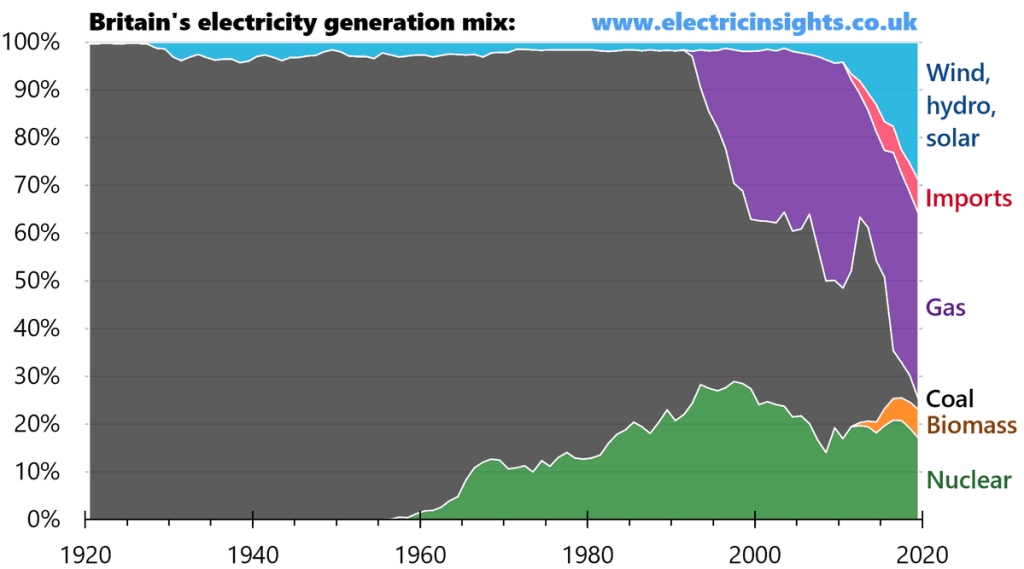
Boris Johnson was being disingenuous in his assertion, joke or not, that Thatcher “gave the UK a head start in its efforts to reduce its carbon emissions by closing so many coal mines across the country”. In defending the Prime Minister Sarah Vine misses a trick. The key contributor to the decline of Coal was the rise of the use of Gas in power stations (see above) and this started towards the end of the Thatcher years. Gas firing is still threatening to the environment but far less polluting than Coal. North Sea gas as part of the energy mix was driven mainly by its increasing availability and the Thatcher governments helped facilitate this. But again the driver was not the Environment but economics.
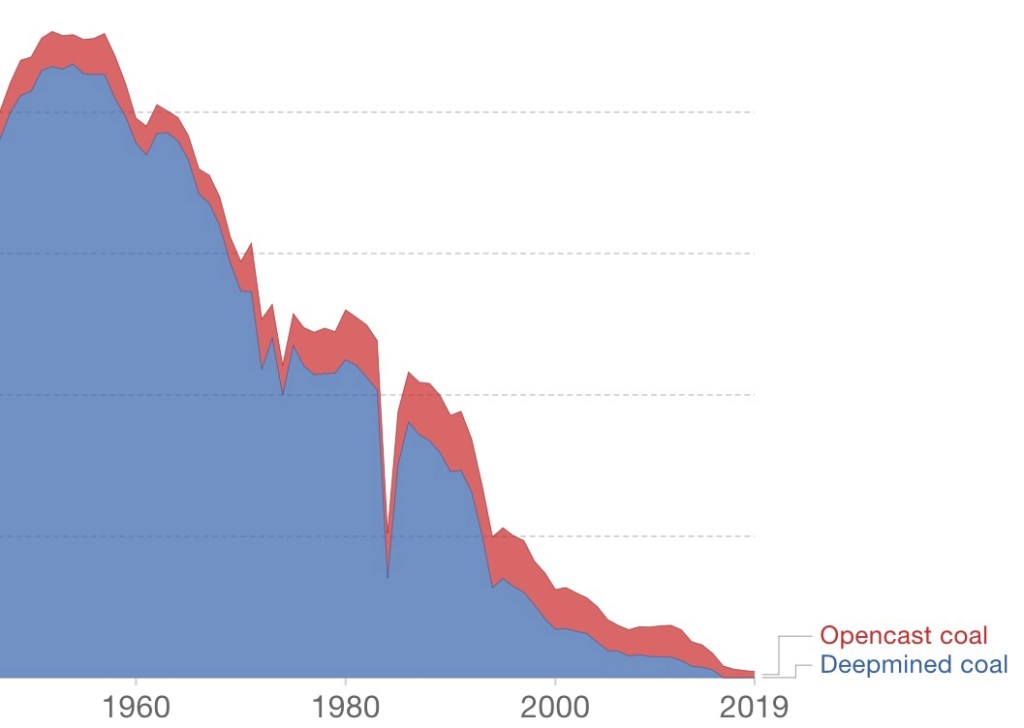
U.K. Coal production

The reduction in U.K. coal production started long before Thatcher took on the miners and continued in the decades that followed irrespective of whether it was a Conservative or a Labour government. Thatcher’s failure was not to manage the ongoing and inevitable decline in U.K. Coal production sensitively. I have argued that switching away from coal in the long term was desirable but that the confrontational way that it was done was deplorable.
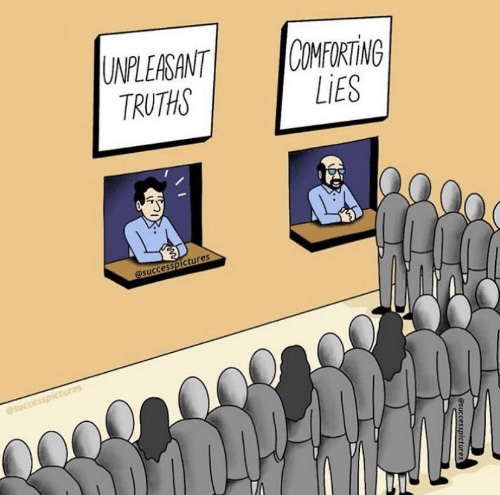
We are venturing into the unknown again with COVID

Venturing into the unknown is a driver of uncertainty. When we stick with the familiar by definition we know what to expect. I’ve been surprised that the uniqueness of COVID hasn’t had more prominence in the media. More civilians have died of the virus in Britain than from any other cause in living memory. And we are a very long way indeed from being free of the plague.

Denial is a common response to threat and to fear. A minority response maybe, but far from uncommon. Commentators with national platforms became instant COVID experts overnight spouting denial and/or conspiracy theories, or some did. The human instinct to believe what we want to believe was all around. Ignorance of the subject was not a restraint – we have been very selective in what we choose to believe and to say.

The thing about experts is that they don’t always agree with one another. If you look around you can find an “expert” who will give you comforting reassurance (or fear-inducing concern !) on almost anything. Add in the fact that in Britain and the United States at the beginning of the pandemic there were heads of Government who were culpably wrong in everything they initially said and criminally neglectful in delaying action.

Will vaccination really mean we avoid an autumn/winter upturn in COVID fatalities ?

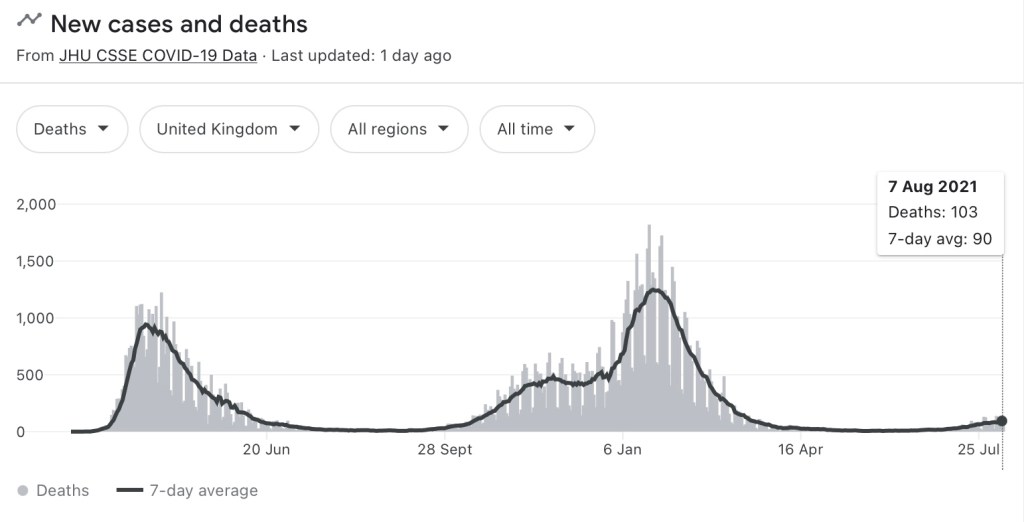
Truth has many faces and most of us are not scientists so we cannot validate what we are told by those who are. My personal response has been caution, it still is. To effectively quarantine myself has not been that difficult – there has been no pressure of any sort on me to return to “normality” ! I’m conscious both that I’m privileged and that I’m in danger of being complacent. Look at the above graph which is self-explanatory. Will vaccination really mean we avoid an autumn/winter upturn in COVID fatalities ?

We are, I think, venturing into the unknown again. There is clearly a correlation between ambient temperature and COVID deaths – has that cause and effect been broken? I can be accused of pessimism and of course I hope that my fears are unfounded. The truth is that eighteen months into the pandemic we just don’t know.

The Taliban has won in Afghanistan and the “international community” is impotent in the face of this truth

“The international community has a vital role to play in demonstrating our confidence in the Afghan people”. General Sir Nick Carter in “The Times” today.

This sort of empty, platitudinous rhetoric bedevils western perceptions of countries like Afghanistan. The underlying premise is that western States and, by unavoidable implication, their military forces have a role to play to prop up governments we approve of or to bring down those we don’t. The premise is false for both moral and practical reasons.

The idea that the United States, with or without Britain, has the right or even the capability to interfere in the internal affairs of other countries is, or should be, have become outdated by experience. Civil wars are endemic to the human condition and from Korea, via Vietnam to Afghanistan western interference on one side or the other only makes things worse.

What about diplomacy or international institutions like the United Nations? They don’t work in such circumstances either. Neither War War nor Jaw Jaw achieves anything. Ever. The sad reality is that the League of Nations failed to stop the Second World War and that post war the UN has often accelerated conflict rather than put a break on it. Indeed the UN was the prime mover in supporting South Korea against the North in 1950.

We can boast about our concern for the “Afghan people” but in reality these words are empty. It may sound harsh and uncaring but the Afghans have to be left to resolve things for themselves. President Biden was right to withdraw American troops and if he’s sensible he’ll think twice about deploying them as policemen anywhere again.

We the people have a voice, if we are prepared to use it. Strip away the faux-patriotic flag-waving bombast and there is nothing much left. 179 British servicemen died in Iraq and more than 450 in Afghanistan. And sad though it is they all died in vain. Surely we have had enough of body bags being flown home from faraway countries of which we know nothing?

The Taliban has won in Afghanistan and though we may deplore it we cannot deny it or ameliorate it. The “international community” is impotent in the face of this truth.

Closing the mines – a good thing, appallingly handled

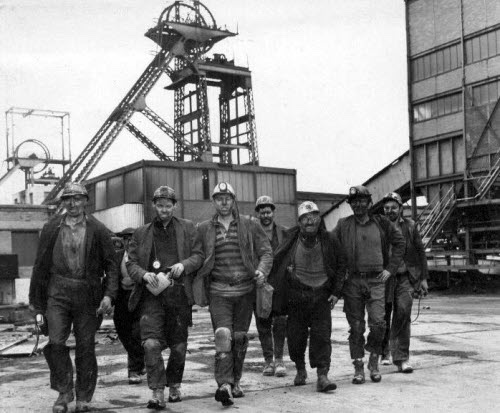
In a civilised society men working in deep mines in dangerous and unhealthy conditions hacking at a seam of coal is unacceptable. Taking the coal produced and burning it in a boiler to generate electricity whilst polluting the atmosphere and damaging the climate is unacceptable as well. But let’s be clear. Prime Minister Thatcher’s attack on the traditional mining industry had nothing to do with Health and Safety and even less with concerns about the Environment. It was all about political power.

In 1974 Edward Heath took on the miners and failed. Later in the decade James Callaghan failed as well. They both asked the nation “Who governs Britain?” They were told “Not you”. Thatcher was not going to make the same mistake.

The decline and fall of deep mining and then of coal-fired power stations was indisputably a good thing. The way it was done was scandalous. There was no coherent strategy to the pit closure programme. Mining towns lost their raison d’être, their employment and their self-respect. As the pits closed nothing opened to replace them. It was largely left to the market, and the market failed.

It may be that working with the National Union of Mineworkers to implement a strategy to run down coal mining was never going to be possible. That there was no room for compromise and that Binary Britain had its origins among the coalfields. But working at a higher level with the TUC to co-jointly put in place a strategy could have been possible. Who knows?

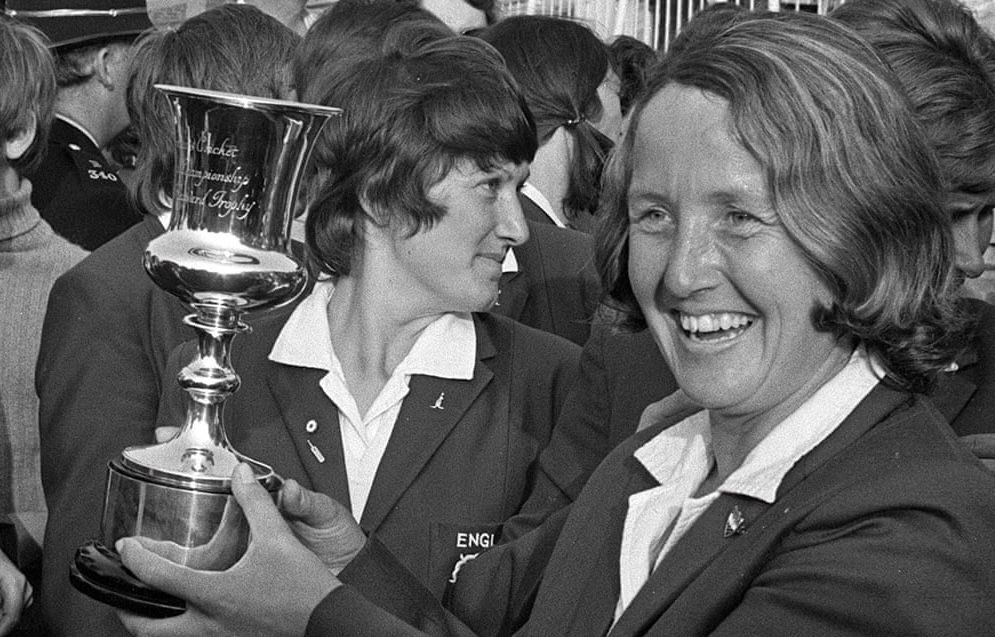
Rachel Heyhoe-Flint was an apologist for Apartheid – the Gate at Lord’s may become an activists’ target

It was in 1963 that CLR James, adapting Kipling, asked the question “What do they know of cricket who only cricket know?” That quote illustrated perfectly the dilemma faced by cricket lovers about South Africa. Not for the first time the Marylebone Cricket Club is putting cricket sentiment before principle in its decision to erect a gate in Rachel Heyhoe-Flint’s memory. The decision is an affront and in this age of cancel culture it may become a target for Black Lives Matter activists.

Heyhoe-Flint: “Who are we… to tell the South Africans How to Run Their Country?

In 1960, with Apartheid firmly in place, Rachel Heyhoe had been a member of an English women’s team touring the country. In her autobiography she revealed that the tourists had been warned “…to make absolutely no comment on the ‘racial issues’ (sic) in the country)”. Black spectators were banned at the matches and the coaching the English women did was only for the whites. The British Women’s Cricket Association (WCA), in which Rachel played a significant role for many years said that the 1960 tour “engendered goodwill”.

Rachel obeyed the rules in 1960 but by 1978 when her memoir was published, she revealed her true feelings “[I] retained the view that it was their country, and hardly the place of any English people to criticise”. This was a naïve even offensive remark, not least because it was made ten years after the D’Oliveira Affair and seven after South Africa had been banned from all international sport.

Rachel’s position on Sport and Apartheid was made crystal clear in her 1978 autobiography “[if] the British Government consider it their duty to register their disapproval of South African policies I suggest they cut off every contact with them, including banking and trading links. For, as things stand, sport is merely being used as a political lever. Who are we, in any case, to tell the South Africans how to run their country”?

Rafaelle Nicholson, a historian of Women’s cricket, has written that “in the build up to the D’Oliveira Affair, it was the women’s cricket community who continued to wholeheartedly to embrace South Africa.” The WCA was in the forefront of this, and Rachel Heyhoe played a significant part as player and later administrator. In 1968 once MCC reluctantly cancelled the men’s tour to South Africa over D’Oliveira the WCA followed suit cancelling their own planned cricketing stopover.

Nicholson writes further “Several members of the [WCA] Executive Committee had wanted to go ahead with the stopover… but had been outvoted. Presumably, this included England Captain Heyhoe-Flint, who told The Times that she was “very disappointed”. Nicholson calls her chapter on Women’s cricket and Apartheid “Who are we… to tell the South Africans How to Run Their Country”. She quotes Rachel Heyhoe-Flint verbatim.

Rachel’s position on South Africa, including her participation with many luminaries of the world of cricket to try and ensure that the 1970 men’s tour took place, was unequivocal. Her position in 1969 was an establishment one and many joined her in the “1970 Cricket Fund” which was set up to pay for security to allow the games to go ahead. Those in cricket opposed to the tour, most notably Mike Brearley and the Rev. David Sheppard, were in a minority. So Rachel was far from alone in supporting the 1970 tour.

The politics of all the “1970 Cricket Fund” supporters was probably “Reactionary Right” and these supporters included the Monday Club. The official TCCB position on Apartheid was that they “disliked it” but that “they could not change the law in South Africa [and that] playing against South Africa would be the best means of changing Apartheid”. This was certainly Rachel Heyhoe’s view. She said in the Preface to her autobiography that she had a “deep-seated interest in politics – I could dream that I might one day become minister of sport” so we are not dealing with someone politically unaware.

The 1960s and 1970s saw a binary divide between those who wanted to build bridges with and those who wanted to boycott South Africa. That Rachel was in the bridge-building category is not in itself to be condemned. So were many others including future MCC Presidents M.J.C Allom, Colin Cowdrey, Tony Lewis, and many other members of the cricket establishment. The Women’s Cricket Association was particularly pro South Africa ties and Rachel was often their go-to spokesperson.

By the early 1980s the issue had not gone away – a planned England Women tour to the Caribbean was cancelled because three of the England party had played on private cricket tours in South Africa. Rachel declared her position once again unequivocally and said “…perhaps the time has come for a stand to be taken against the removal of our freedom and rights”. The Times reported on 19th February 1983:

Rachael Heyhoe-Flint, England’s best-known woman cricketer, said yesterday that she was “completely shattered” by the decision to cancel the tour “We heard through the Jamaican High Commission in London some 10 days ago that there could be a problem, but we never thought it could come to this,” she said. “The big irony is that the five people referred to went to South Africa four years ago on what was a completely unofficial visit and that subsequently the West Indies have played in England and have not raised any objection against the players who had been in South Africa.” John Carlisle, the Hard Right Conservative MP and a member of the MCC, said: “This cancellation illustrates the total chaos that now surrounds cricket and the extent to which political interference rears its head at every turn.”


The “freedom and rights” issue was, of course, to stay in play as the rebel tours began in 1982. This is a large and contentious subject and perhaps Mike Gatting’s statement that “I know very little about Apartheid [but] I do believe that there shouldn’t be any politics in sport” encapsulates the naivety or more likely hypocrisy often involved.

With hindsight Rachel can perhaps be seen as only being naïve but I think that would be a cop out. She was unquestionably in her statements and actions close to being an apologist for Apartheid. She could hardly claim like Gatting to “know very little of Apartheid” having toured South Africa as a player and visited as an administrator. She said, again in her 1978 autobiography, “And if we are honest, can’t we other examples of oppression, perhaps just as odious, in the recent histories of counties such as Chile and Russia?” This takes us into some very dark areas indeed. She implicitly acknowledges that Apartheid is “Oppression” but defends not doing anything about it by saying that there is oppression elsewhere. For someone with a declared “Deep-seated interest in politics” this is not surely ignorance or naivety but a declaration of her true feelings. There is a token criticism of Apartheid in her statement “…South Africa, apartheid apart, is such a wonderful country for a visitor”. But the idea that you could praise a country by avoiding any comment on its institutionalised racism, and with Nelson Mandela locked up on Robben Island, does rather stretch credulity!

President Biden is right to quit Afghanistan

“We must not turn our backs on the Afghans” says William Hague in The Times today. Can he really not see that in the post-war era Western interventions in the internal affairs of independent countries have been an unmitigated disaster? With one or two exceptions American and often British military action in pursuit of some specious high-sounding goal like “freedom” have resulted in outcomes which were worse than the start point.

In my lifetime Korea, Vietnam, Suez, Iraq, Afghanistan and countless other adventures have been long on pompous rhetoric but short on effectiveness – often tragically so. America has in theory the military strength to be the policeman of the Western conscience but, as we saw in Asia and the Middle East more than once, not the strategic nous to know how to win.

The Taliban is like the Vietcong a flexible pragmatic force which can disappear into the hills whenever it needs to, regroup and fight another day. In Iraq the sheer power of America backed by Britain’s largely token forces overthrew Saddam alright. Leaving still unresolved chaos behind, tens of thousands dead and continuing instability. Not to mention hundreds of bereaved American and British families.

President Biden is right to recognise that the American dream of honourable defence of liberty, articulated so eloquently in John Kennedy’s inaugural address in 1960, has proved to be bunkum. And the British Government should get real as well and realise that our obligations extend no further than the defence of our own borders. No more body bags returning from far away countries of which we know nothing please.

So long as there is no public incitement of illegal acts, we have to tolerate fools like Katie Hopkins

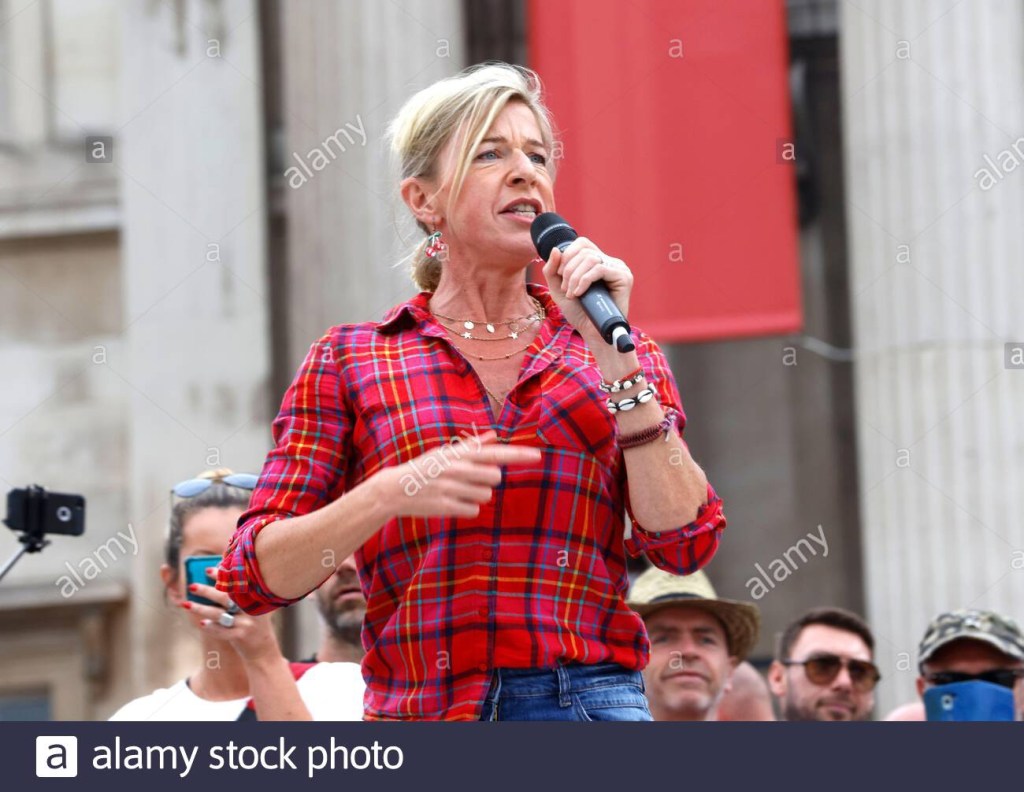
Katie Hopkins

If we believe in Freedom of Speech, and so long as there is no public incitement of illegal acts, we have to tolerate these fools. It’s not illegal to be Katie Hopkins or David Icke.

I’m not going here to try and analyse or even condemn stupidity. I regret it, but struggle to find what to do. We live in an age of Fake News and have a head of Government who makes it up as he goes along. We recently had a President of the United States who added incomprehensible ranting to his manifest stupidity. What to do in both cases?

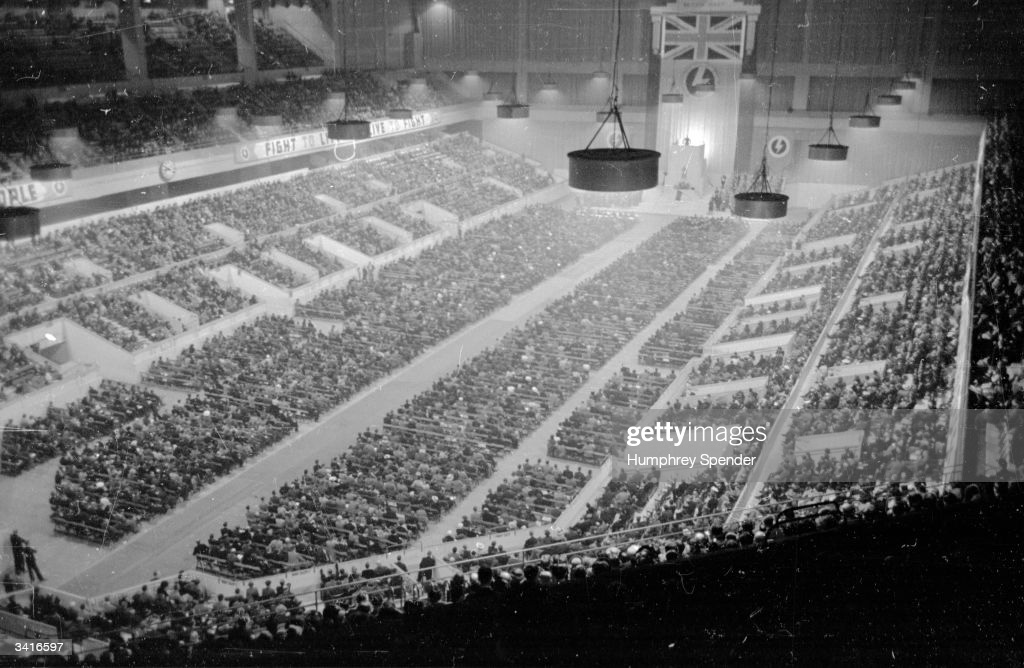
Mosley at Earl’s Court

In 1939 Oswald Mosley held a massive rally at Earl’s Court spouting his usual vile but not illegal (just) vitriol. It was largely unreported in the media (Newspapers and Radio). There’s a clue here. Publicity seekers who get no publicity might just eventually give up. I couldn’t avoid La Hopkins if I tried. But if the media had said “Let’s show a few doctors talking about saving lives” rather than showing Katie Nobrain might that have worked ? Just a thought.

If to show proof of vaccination is desirable to help us manage the virus then let’s get off our high horses and accept the minuscule loss of freedom involved.

Interesting that Hugo Rifkind mentions France at the beginning of his piece on “Freedom” in The Times today saying that the French are different. Those twenty miles of the Channel really do keep us apart from the rest of the world eh? Except of course they don’t. No outpouring of good old English exceptionalism can obscure the truth that what is “freedom” one side of the Channel is also freedom the other side. Freedom is not a British value – it’s universal.

Rifkind demolishes the anti-vax brigade comprehensively and rightly in his article. But then he fails to point out that those who object to carrying and showing proof of their vaccination status are just as bad as the anti-vaccers. That isn’t defence of freedom one tiny bit, it’s insular and selfish arrogance.

The NHS letter showing your vaccination record is clear and uncontroversial. I’ve posted mine on social media to explain why it is a wholly benign document. To suggest that there is any loss of freedom if someone entitled to asks me to show it is perverse.

There is such a thing as society and we are all more than just being entire in ourselves and our families. We have a duty of care that goes beyond the walls of our home. Every day I leave my home, as well as when I’m in it, I must obey society’s laws. Society would descend into anarchy if there were no restraints on our freedom to act.

The virus is a deadly and unprecedented threat to us all and we all know families that have been devastated by the loss of someone dear to it. It is the duty of Government to protect us. If the judgment is that to have and show proof of vaccination is desirable to help do this let’s get off our high horses and accept the minuscule loss of freedom involved.

Something to celebrate – Britain has the most varied wine choice in the world

This is fascinating and checks with my own memories. We Brits were a beer and spirits (mostly beer) nation in my early childhood. My parents went to the pub and drank beer. My Nan drank Gin and French (and anything else actually) but we rarely had wine.

Then in the late 1950s Mum and Dad started to holiday abroad and wine started to appear at home, mostly for high days and holidays. Brands like Nicholas and Chianti in straw clad bottles appeared in the off licence and, roughly from when I got married in 1969, the beginnings of a wine culture started.

In the 1970s wine was still elitist, expensive and snobbish. But gradually the choice widened and imports exploded. The supermarkets stocked wine on their shelves and value brands from around the world became available. For wine consumption to today equal that of beer is remarkable, and slightly worrying – a litre of wine has rather more alcohol than a litre of beer!

Britain has the most varied wine choice in the world. Other big wine consuming nations like America, France, Italy or Australia have their own indigenous winemakers and consumers tend to stick to these. In the U.K., whilst we do now make now some good local wine, 98% is imported and the wine world beats a path to our door. In my wine rack you can find bottles of wines from ten different countries quite often (they only stay briefly in the rack).

Wine with the groceries in M&S

Wine today is far less snobbish and much better value. It’s also far better to drink! The norm now is to drink wine young – even some Bordeaux reds are now drunk only a year or two old and far better for it. Supermarkets, and not just the posher ones, have excellent wine choices and value for money. The tend towards screw top closures is a positive one, though I now have a battery operated corkscrew for the traditionally cork sealed bottles!

People will die unless somebody stops our reckless Prime Minister in his tracks

Is COVID Johnson’s Falklands moment ?

In The Times today Matthew Parris compares Johnson’s COVID gamble with Margaret Thatcher’s Falklands. It’s an interesting analogy, though I think a false one. Parris exaggerates the risk of failure in the South Atlantic in 1982. The United States played a crucial often covert role in supporting Britain. Had the Task Force got into serious trouble the US would have upped her involvement to a more military one. It may have been the beginning of the end for the Old Alliance in the 1980s but it was still there, just.

Today Britain is friendless, an extraordinary state of affairs when looked at historically. In 1956 at Suez we at least had the French and the Israelis – but the Americans thought we were mad, said so, and the game was immediately up.

The Britain without allies after Suez is strongly analogous to the Britain without friends today. Try and find nations that support us, let alone want to copy us, on COVID and you’ll look in vain. In 1956 we hung out the flags and the media was mostly behind Eden. So it is today for Johnson with the dash for “freedom” – for now. The support for Britain’s dishonest attempt to unravel the Northern Ireland protocol is also totally absent beyond the Orangemen. Crucially President Biden, like his predecessor over Suez, thinks Britain is wrong.

Having rejected a formal partnership and economic ties with Europe the “Belarus” option is in play. That country is the only other European nation other than Britain to go it alone. We are increasingly like the fans of Millwall FC seeming to delight in the fact that everyone hates us.

Britain Contra Mundum is then far from new. Suez, The Falklands, Iraq and other adventures had little or no support from allies and friends. But COVID is different, it’s a global enemy demanding global solutions. Not a time for English exceptionalism you’d think. But that’s what we’ve got. Similarly we are actually putting at risk the Good Friday Agreement with our volte face in Northern Ireland. The similarities between these two acts of stupidity and treachery are that people will die unless somebody stops our reckless Prime Minister in his tracks.