Coherent critique” – you have to be joking ! It was an offensive ramble by a man for whom diplomacy means screaming abuse. He involved himself in his rant in matters about which he has no right to comment (the governance of London for example) and in matters like climate change about which he has neither the knowledge nor the intellect to speak.
His whole life and persona is a historical aberration. Near 80 years without a scintilla of moral underpinning and full of excess. Once seen as a New York liberal (really!) he has morphed into a clueless parody of a real politician. And yet we do have to take him seriously – there’s a nuclear button on his desk.
Students of American history will describe how the Presidents can be ranked from “Great” through”Good” to “Bad” – but never before has their been downright “Ugly” nor a felon in the White House.
Trump should not have been lavishly welcomed to Britain, and our Prime Minister should not have kowtowed to him. But the moment when the King visibly sniggered at one of Trump’s inanities in his speech was to be treasured. Charles can spot a fraudulent fool when he meets one – he’s had a few in his own family.
Having lived in the Middle East for six years and travelled widely in the Region I think that the routine description of Israel being the only democracy there is overdone. Yes Israelis vote and (say) Emiratis do not. But, frankly, I’d rather live in Dubai than Tel Aviv!
The progress made by Israel over nearly eighty years to expand their borders lies four square behind Netanyahu’s ambition to create Greater Israel. This is pure Lebensraum. Along the way some Arab states made grievous errors with military assaults on the fledgling Israeli state. And Arab terrorist movements like Hamas and Hezbollah have done the same. But over the years, and especially recently, Israel’s response has been disproportionate.
No Palestine in Netanyahu’s “New Middle East”
The Iran/Iraq war, Saddam Hussein’s Iraq, the Human Rights abusing states like Saudi Arabia and Bahrain and many other instances of institutionalised terror show that it is wrong to characterise the region in a binary way – “Arabs good, Israelis bad” (and vice versa) is unhelpful. But when push comes to shove the Arabs (and the Persians) will oppose Israel (sometimes collectively).
In this continued tinder box situation Israel’s expansionism feeds the fire. They may by force acquire Gaza and settle there, as they have done elsewhere. But does anyone seriously think that will contribute positively to the resolution of conflict? Rather the reverse surely ?
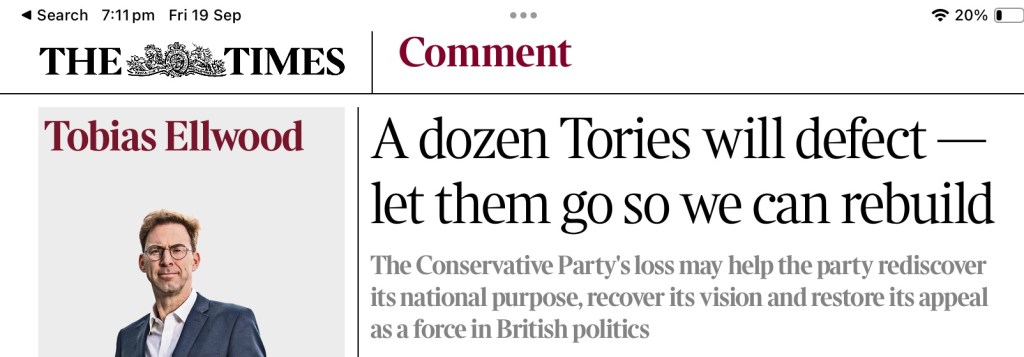
Tobias Elwood in The Times today has contributed a very good piece, and I say that as someone who has never voted Conservative in my life! I particularly like the call for consensus. Margaret Thatcher was the first mould-breaking party leader of my lifetime. Attlee created the Welfare State but it was World War 2 that spurred that. Attlee’s reforms were largely unchanged by governments of either Party. Until Thatcher came along. She did some good, some bad and some downright ugly things. But Major, Blair and Brown restored the centrist norm and a fair degree of consensus.
So what’s gone wrong – in one word it was Brexit. Cameron was a consensus politician – he even formed the first peacetime coalition of modern times. The Referendum screwed him, and then the country. We haven’t been polite to one another since !
The decline of the Tories was directly attributable to the “Leavers” in the Party and then to the grotesque Hard Brexit which, astonishingly, leaves us as the only country in Europe with no formal economic, commercial or social alliances. Except for Belarus. Strange company.
The Conservatives have morphed into “National Conservatives” , and they’re not very good at it. Reform has seen the nationalist drift on the Right and captured it. There’s probably only room for one “Hard Right” Party and Mr Farage’s “fruitcakes, loonies and closet racists, mostly”. have taken over.
There are some decent One Nation Conservatives still around but they are leaderless, unrepresentated in Parliament, and rare as red squirrels.
“Yet in Britain we still have — and must hang on to — vital attributes of which America seems to have lost sight: courts that are not politicised, media that entertains more than one point of view, public servants who are impartial, electoral boundaries that are not gerrymandered, politicians who consider their opponents wrong but not criminal, and voters whose readiness to switch between parties shows they are searching more for competence than ideology.” William Hague. The Times.
Indeed, Hague is right. We are divided from America by a common language and a whole lot more. That common language can sometimes fool us into believing we are culturally the same. Far from it. It certainly helps the British traveller in the States – I can engage with a bauxite miner in Nevada (which I once did) rather more easily than I can with one in Brazil ! But it’s not just casual acquaintances. I worked with Shell colleagues in Houston who were superficially like me. But deep down they were utterly different. Verbally we could communicate well (with a little effort on my part). But culturally we were polls apart.
The arrival of Trump has widened the gap. We have had our Bozo politicians (Liz Truss anyone?). But we survive. Trump is, of course, an aberration, especially in his ghastly second term. We’ve not had anything like him. Dei gratia. It’s when politics become a cult that you have to worry. In Britain it happened to an extent with Margaret Thatcher, but we found a way to get rid of her when she went mentally AWOL. Can the US do the same with Trump ? We’ll see.
As English becomes the Lingua Franca of Europe it makes communication differences with we monolingual Brits irrelevant. The educated young Dutchman or Dane is as comfortable in English as he is in his mother tongue. And believe me we have more in common with most Europeans than we do with most Americans.
We made the wrong choice in 2016. Our future is indisputably in Europe not as some distant territory of the United States (which is how Trump sees us). We need to put that right.
Do I still like to be in America? Not under Trump I don’t.
Gangster in chief Al Capone eventually went to jail for tax evasion not murder. They got him in the end. The analogy is far from precise but I have a feeling that “they” (whoever “they” is ) might get Keir Starmer for the Mandelson error not for failed governance.
Now let be clear Starmer’s mistakes are individually not particularly venal, but collectively the perception is that they add up to a Prime Minister not on top of his job. And these perceptions become reality because, rightly or wrongly, people perceive them to be true.
The Mandelson scandal (and scandal it is) revealed a culpable lack of judgment on Starmer’s part. When I heard of the appointment I immediately could see a very deep elephant trap opening up, and unavoidable. Mandy has previous (ask Tony Blair) and this and his linkage to Jeffrey Epstein, greatest villain of our times, should instantly have precluded his appointment.
That Mandelson qua ability could do the job is probably true, but not the point. We’re back to perceptions again. When Emily Maitlis did her forensic demolition of Prince Andrew the dodgy links to Epstein were enough to destroy him. Andrew was too thick to see this. Mandelson is far from thick which is why he should have turned Starmer’s job offer down. Did his ego override his judgement? It certainly looks that way. Both Starmer’s offer and Mandelson’s acceptance exhibited dreadful judgment.
Politics is always the Art of the Possible. Starmer is on very shaky ground at the moment. Many in his own party are uncomfortable with what they see as the Prime Minister reacting to the apparent rise of Reform by aping them. If the Labour Party is a “Moral crusade or it is nothing” I’m afraid that Starmer’s lurch to the Right means it is nothing.
The appalling record of failure of Cameron, May, Johnson, Truss and (to a lesser extent) Sunak should have shown Starmer what to do and, more importantly, what not to do. We cried out for honesty and competence to replace 14 years of mendacity and screwing things up. Starmer is more honest than this bunch of shifty folk but in truth he doesn’t seem to get things right any better.
What next ? I don’t know. Even competent European leaders like Emanuel Macron are struggling, America is in thrall to someone who I can only call an idiot. As in the 1920s and 1930s Italy and Germany the Hard Right is seeking and winning public appeal. Batten down the hatches, there’s a rough ride ahead.
I still support Keir Starmer, but it’s hard going. The problem he has is, ironically, not being political enough rather than being too political! He hasn’t created a distinctive political persona and told us what he believes. He talks slogans but they are a veneer covering very little – at least very little that’s observable.
Starmerstilllow on the political learning curve
Harold Wilson said “Campaign from the Left, govern from the Centre” – and he did. So did Blair. Quite where Starmer is I’ve no idea. Some of his policies seem more Thatcherite than Blairite. Others are reactive , responding only to what Harold Macmillan called “Events”. Behind the scenes my guess is that there are some good things going on. But they get little prominence in the media because Starmer doesn’t sell them.
People can be divided broadly into “Persuaders” and “Reactors”. The former sell us what they’re doing. The latter only respond , and it’s often too late, unconvincing and nakedly opportunistic. Starmer is a Reactor, and people have rumbled that.
Starmer is a genuinely cerebral Prime Minister – a rare thing. The last was Gordon Brown whose intellectual brilliance was seen at its best when he showed internationally respected leadership during the global financial crisis during his premiership. Starmer is as bright as Brown, but with nothing like Brown’s political depth of experience. In truth Starmer isn’t a conventional politician at all.
Starmer first entered Parliament in 2015 at the age of 52. Whilst he had dabbled with politics, and was clearly a Labour supporter, his first highly successful career as a Lawyer precluded political activism. Moving quite late in the day into politics can be seen as a second career and he started close to the bottom of the Learning curve. And it shows.
The best politicians are grounded in grass roots activism. Starmer had no such grounding, The best Prime Ministers are grounded in previous performances in Parliament, often spread over many years. Again Starmer had done none of that. To be Shadow Brexit Secretary to Jeremy Corbyn, having previously been Shadow Minister for Immigration, were poisoned chalices. Significantly he could be consistent in neither job with his previously expressed personal views. As the Daily Mail later (accurately for once) put it:
“In his Labour leadership campaign he produced a 10-point manifesto including ‘defending freedom of movement’ and softer treatment of illegal immigrants. But after winning the leadership he began his long journey towards a harder line on immigration, sparking fury among his former allies on the left.”
Of course Starmer is not the first Labour Prime Minister to renege on his views from his past. Clement Attlee is perhaps the only one who didn’t! But where skilled communications helped Wilson and Blair get away with it brilliantly Starmer lacks that quality. He’s at best a dull public speaker sounding more like a summariser in a complex civil legal case than an impassioned advocate defending, or prosecuting in a criminal trial at the Old Bailey. The former worked, no doubt, in the rather cold world of the Crown Prosecution Service. But persuasive politicians need more passion.
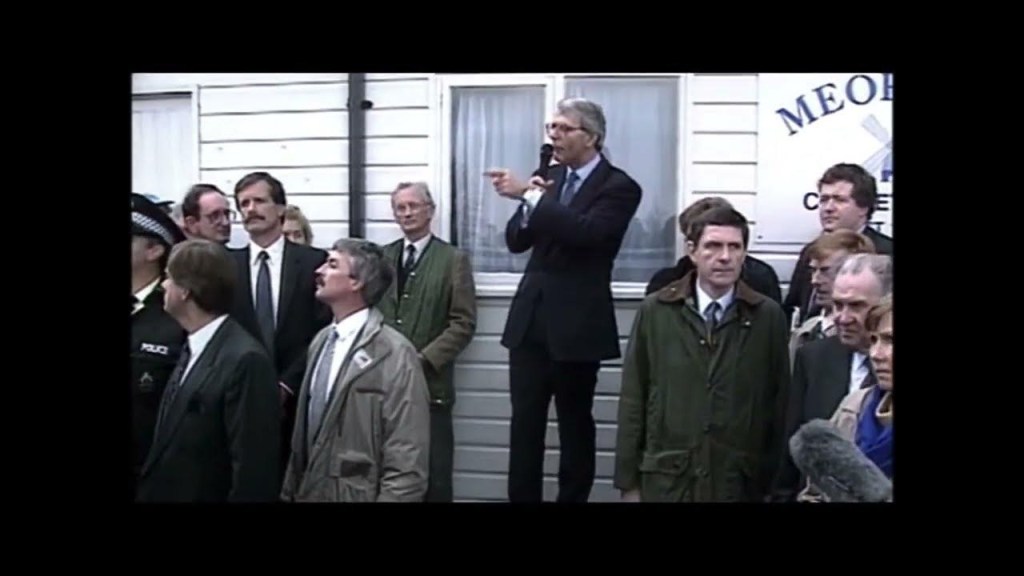
Major on his soapbox
Starmer needs to find his inner John Major, if he has one. Major seemed grey and dull – a huge contrast with Margaret Thatcher his predecessor as Prime Minister. But in 1992 he climbed onto a soapbox and won a General Election he was more than likely to lose. It was clever, courageous and effective. Starmer could learn from this.
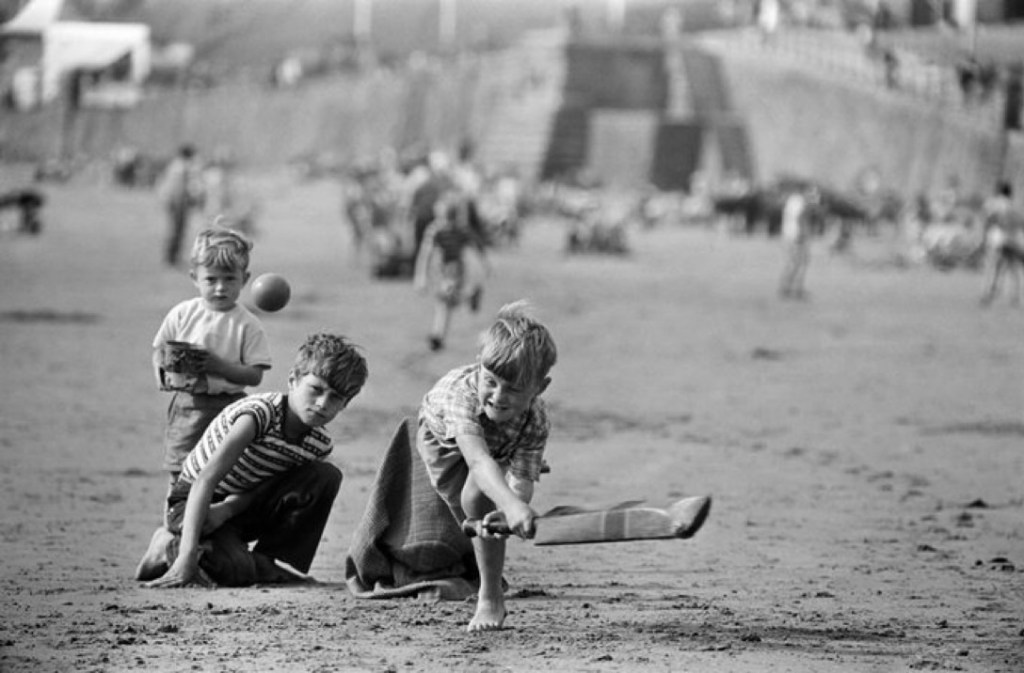
Every cricket lover has been there. All you need is a bat and a ball and something for a wicket. And someone to play with. I was Colin Cowdrey, my mate Sam was Brian Statham and Roger was Ted Dexter. It wasn’t a beach but the grass by our house at boarding school. The rules we made up as we went along but the game involved bowling, batting and fielding.
And there you have the game. French cricket, Beach cricket, Cricket as fun, cricket at the highest competitive level, cricket in the back garden with your Nan or your Aunty Minnie (a mean leg spinner in my case). It’s just another “bat and ball game” as MCC Chairman Mark Nicholas called “The Hundred” – except that Mark was wrong. It isn’t.
Yes the game is infinitely variable and always has been. And yes “The Hundred” is unquestionably authentic cricket – and the bowlers are better than Aunty Minnie. But neither her leg breaks, nor my school knockabouts threatened the professional game. The Hundred is killing it. It’s like squirrels. I like the grey ones but they are ousting the red ones. The species is under threat, as is traditional cricket.
First Class cricket versus T20
This August there were no Test matches, we used to have a couple in that month. It meant that our Test series against India had to be squeezed into five weeks. Little or no recovery time between matches. And it’s going to get worse. The “shorter form” of the game whether it’s over 100 or 120 balls is swamping First Class and “List A”.
The shorter form is lively entertainment. The England and Wales Cricket Board (ECB) introduced Twenty20 (T20) cricket in 2003 as a professional inter-county format to address declining attendance at domestic matches, reduced sponsorship revenue, and what they saw as the need to appeal to younger audiences alienated by longer formats (like Test cricket, First Class cricket and the traditional 50 over one-day game).
The format was a new, fast-paced one innings competition limited to 20 overs per innings, designed to last about three hours and deliver exciting, accessible entertainment comparable to other popular team sports. The key word here is “entertainment” of an easily digestible type. Fast food not a banquet. As we know the creation of the Indian Premier League (IPL) took T20 into the stratosphere. Whereas the main short form sport in England is football there was no such thing in India. T20 and the IPL filled the gap.
The IPL became a huge financial bonanza. And money talks – for cricket Boards, advertisers and sponsors and, above all match hosts and players. So a format which had a pragmatic goal financially to augment the income streams of County cricket morphed into a money making bonanza across India. The ECB made nothing out of this – they hadn’t copyrighted the format.
From India “franchise” cricket spread like wildfire around the world. The grey squirrels won. The red ones entered intensive care. Kindly caring traditionalists tried to protect the species – especially in England where we’re a sucker for furry creatures . But the writing was on the wall.
The commercial and entertainment benefits of T20 cricket are clear. And whilst the traditional game will survive for the foreseeable future it is being marginalised and starved of funds everywhere except in Australia, India and – of course – England. But even here (for example) the MCC’s main concern from next season will be their financial interest in one of the “Hundred” franchises.
“Patriotism” is actually a tricky word to define. The reliable OED says “quality of being patriotic; devotion to and vigorous support for one’s country”. The interesting thing here is that the dictionary is saying that a Patriot is proactive (devotion… vigorous) suggesting that it is not really normal – it requires some sort of extra effort. This rings true to me.
I’m happy to be British (most of the time!) but I’m not proud. I didn’t achieve Britishness by dint of my efforts, there was nothing I could do about it. Nor do I take any narrow pride from British history – like most nations that’s a mix of the good, the bad and the ugly (very ugly indeed sometimes). Nor really from our character. I think we can be very funny at times and our sense of humour pleases me. But we can also be insular and pompous and borderline xenophobic.
But what about the English as compared with the British? It’s confusing. Flanders and Swann only exaggerated slightly in their “A Song of Patriotic Prejudice: “The English, the English, the English are best I wouldn′t give tuppence for all of the rest!”
In this good example of British humour the song whilst promoting the English calls the Irish, Welsh and Scots “stinkers” and otherwise insults them. It’s a joke , of course, but there is more than a hint of assumed superiority which comes from England always having been the dominant nation in the UK. “United” in name only some might say.
World Cup Final, Wembley 1966
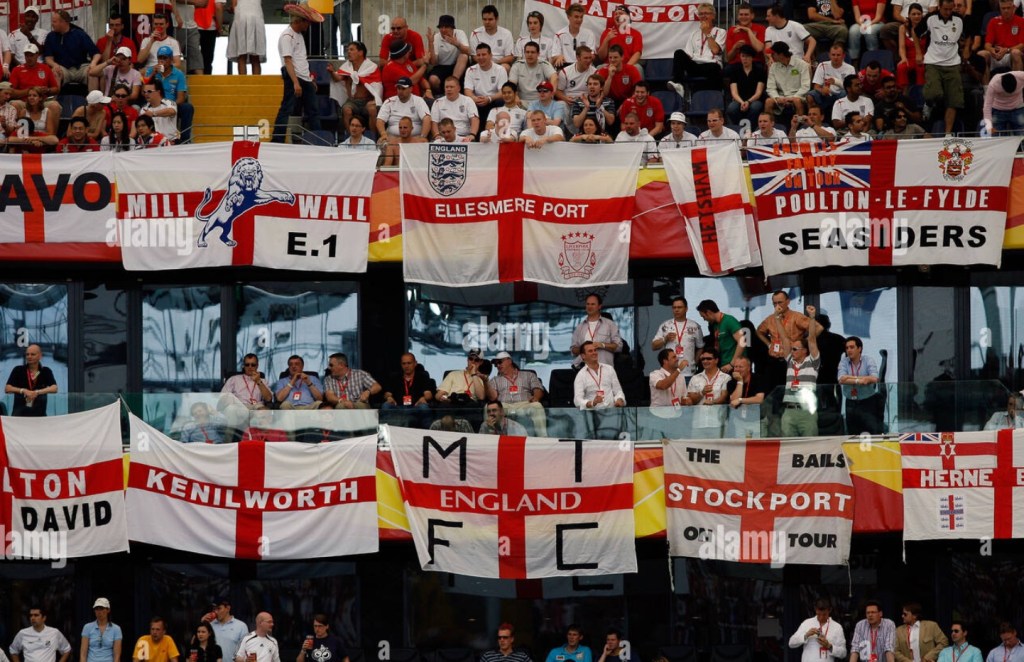
The distinction between being “English” and “British”, especially in sport, is today far more nuanced than in the past. At Wembley in 1966 (above) it was the Union Flag which was displayed. The cross of St George was nowhere. Forty years later this was the crowd at the finals:
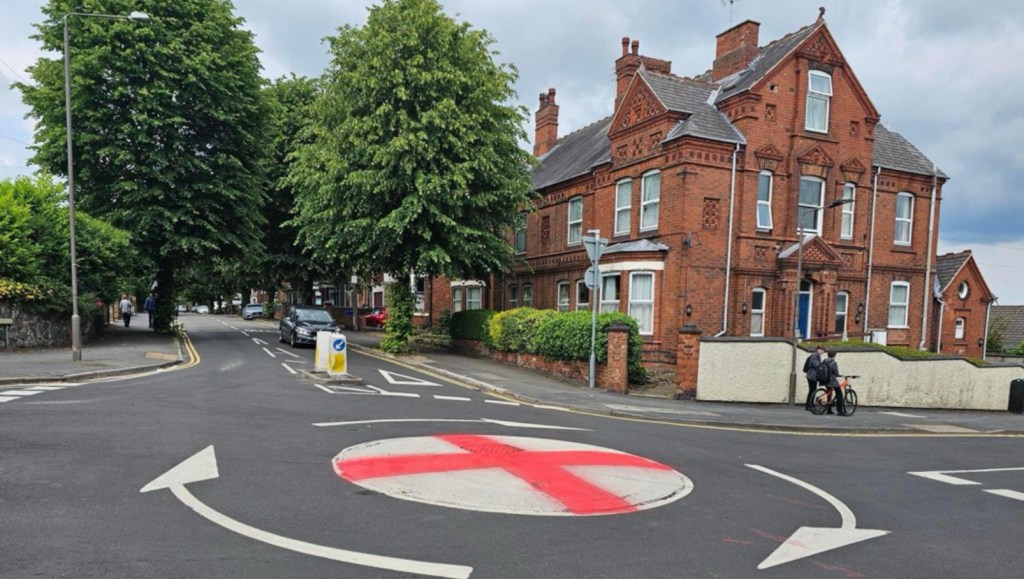
Which brings us to the current controversy over the painting of the English flag gratuitously and illegally in public. As here in Derbyshire:
Ilkeston roundabout
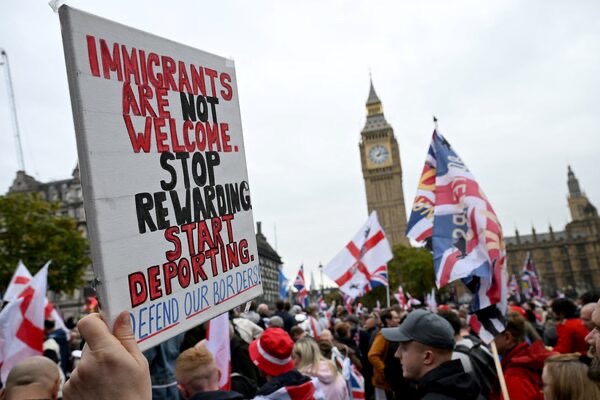
Those that did this did so, or so they claim, to demonstrate their “patriotism”. But in reality this sudden rush to display the flag of England (or in some cases Britain) is driven by more divisive motives. It is an overt protest against immigration sponsored by the Far Right. The undertone is xenophobic and racist. “We are in a dangerous moment,” says Lewis Nielsen, an anti-fascist officer at Stand Up to Racism. In the context of increased far-right protests and encouraging political rhetoric, he says, “the ‘Operation Raise the Colours’ [as it is called] was never about flags, it’s about giving confidence to racists and fascists to target refugees and migrants”.
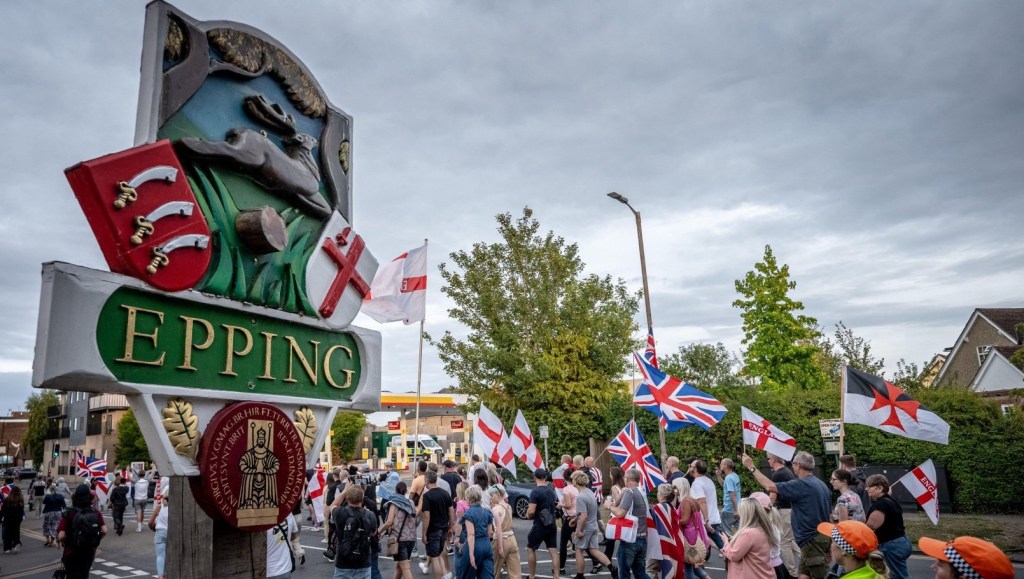
The London Borough of Epping has seen major protests as seen here reported in The Guardian.
The extreme faux-patriot might be thought to believe “My country, right or wrong…” but that, as Chesterton put it “is a thing that no patriot would think of saying. It is like saying, “My mother, drunk or sober.” In fact the Epping protesters, and their fellow travellers, would agree. On immigration policy they believe their country is profoundly wrong.
So what then is “Patriotism” ? Does it mean what any individual, group or political party wants it to mean? In other words it’s not an absolute but very flexible in its definition. The Prime Minister wants to be associated with what we might term “Good Patriotism” :
Asked if the PM was supportive of people who flew English flags, a spokesman said: “Absolutely, patriotism, putting up English flags. We put up English flags all around Downing Street every time the English football team – women’s and men’s – are out trying to win games for us.”
Few would argue against patriotically displaying an English flag to show support for an England sports team. But that’s emphatically not what they are doing in Epping (etc.) ! Here the flag has been hijacked by the Right to become a symbol of xenophobia. I doubt that the PM is “supportive” of people who do this. At least I hope not!
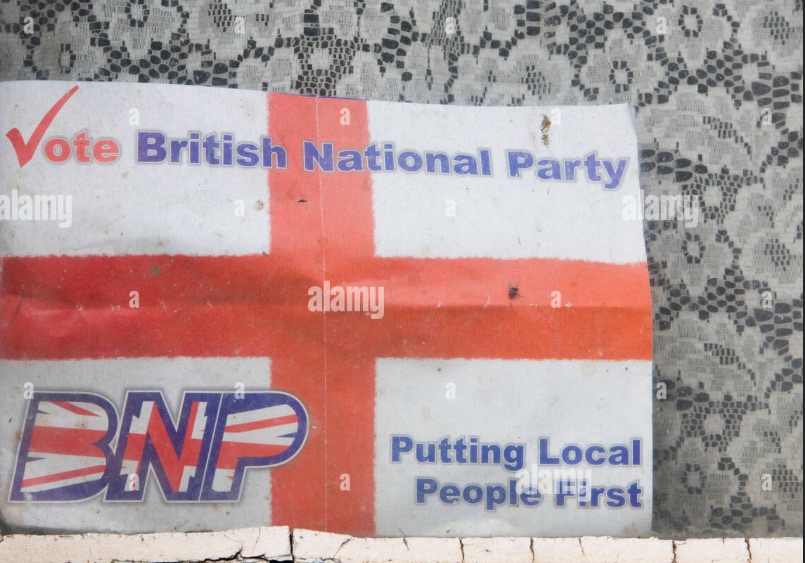
The core of the issue is, then, the contrast between what I’ve called “Good Patriotism” and the pretence that Nationalism is analogous with Patriotism. This assertion goes back decades with the overtly racist “British National Party” using the English and British flags in it’s literature (etc) :
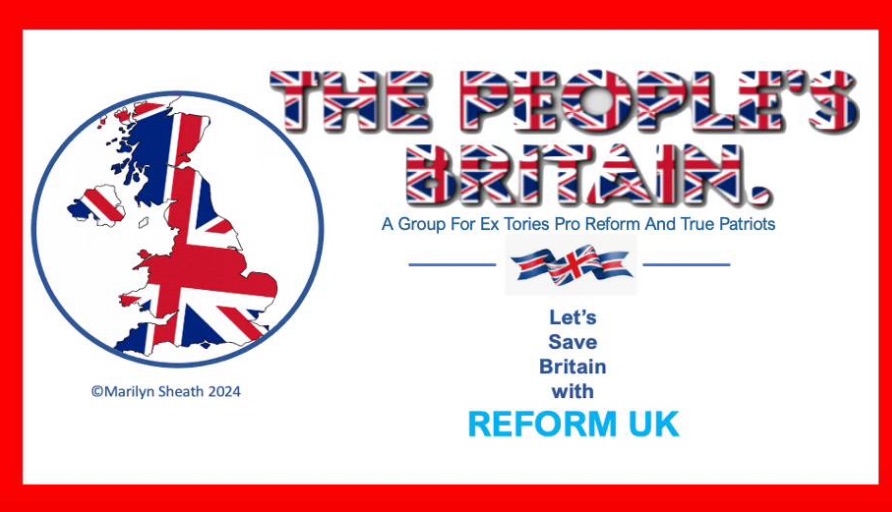
It is a “dangerous moment” as Mr Nielsen says. Nigel Farage’s Party “Reform” claim that they are the [only] “true patriots” in effect hijacking not only the flags but the very concept of patriotism itself:
Those of us who believe that a measure of patriotism has its place (especially in a sporting context) should resist this trend and reclaim the term and our flags.
I studied Sociology as part of my degree 50+ years ago and enjoyed it. Margaret Mead’s work was a key part of the studies. She felt the methodologies involved in experimental psychology research supporting arguments of racial superiority in intelligence were substantially flawed. There isn’t a hierarchy of cultures with “Western” at the top and “primitive” at the bottom. Later I read a brilliant book “Riding the Waves of Culture” co-written by a Dutch Shell colleague of mine Fons Trompenaars . As with Mead, Trompenaars rejects the sometimes postulated superiority of one culture over another. He says that to understand we have to ride the waves of cultural differences.
Contrast these approaches with that of Right Wing academic Professor Matt Goodwin. He tweeted:
“If you look at the top 20 nationalities given visas to work in the UK last year, only 1 is from Europe and only 3 belong to the Anglosphere”
This is barely disguised White Supremicist rhetoric. The conclusion is not really even hidden. Europeans and citizens of ex British Empire English-speaking “Dominions” (the Anglosphere) (overwhelmingly white) are preferable to the brown or black or Asian nationalities that dominate visa issue. It’s nothing to do with ability or experience, it’s race/colour Goodwin objects to.
Matt Goodwin
Race and colour are the most obviously visible aspects of culture. As is language. Australians and New Zealanders and (most) Canadians have English as their mother tongue and are white. Similarly most young Europeans these days are English proficient, and they are white as well.
Educated influencers like Goodwin (he’s far from alone) are vocal opponents of multiculturalism – the idea that nations benefit from a mixture of cultures among their people. Reform leader Nigel Farage says “we must discriminate when it comes to who can come into our country”…. and opines that multiculturalism had been a “huge error” and that “successive governments haven’t thought it mattered”.
Academics like Goodwin and clever politicians like Farage don’t need to provide rational reasons for their polemics . Slogans will do , and flags of course. These associate what is pure bigotry and xenophobia with a faux-patriotism and “pride” for your country. So the Union Jack and, increasingly the English St George’s flag are weaponised for petty nationalism. This has drifted into absurdity with the painting of the cross of St George on the ground at roundabouts – you couldn’t make that up !
History teaches us that political power can be gained not by reasoned and complex arguments but by imagery, slogans and the purveyance of a phoney blame culture. Reform is entirely predicated on this. Three quotes from Josep Goebbels can help us here:
If you repeat a lie often enough, people will believe it, and you will even come to believe it yourself.
A lie told once remains a lie but a lie told a thousand times becomes the truth.
Propaganda works best when those who are being manipulated are confident they are acting on their own free will.
Preposterous though the “patriotic” demonstrations are, and utterly lacking in either intellectual or practical substance, the demonstrators would no doubt argue that they have been “…acting on their own free will”. Farage gives them cover – he is an “identity” politician, deliberately shallow. (Trump is another of course). They relish binary challenge, reducing complex issues to a “For or Against” question. This cannot avoid over simplifying complex questions.
“… the revolution that Trump began is irreversible.” Dominic Green in The Times today
A depressing and self-evidently untrue statement. It was reversed as recently as 2020 when Trump was kicked out of office and we had a return to a traditional normality under Joe Biden and Kamala Harris. That this didn’t continue in 2024 was serendipitous in that Biden was too old and shaky to continue and America can’t cope with the idea of a female President. Certainly both the Hillary and the Kamala campaigns had their faults and faltered, but it was the bone-headed, simplistic and bigoted Trump who prospered not a Republican in a thoughtful tradition – a Teddy Roosevelt, an Eisenhower, a Reagan or a Bush. Let alone a Lincoln.
Great Republican Presidents
History teaches us that rabble-raising, nationalistic and single issue politicians can win democratic elections. And we now know from Trump’s dictatorship that even nations with respectable pasts (mostly) and a lauded Constitution can be vulnerable. Trump didn’t need Power to be Corrupt, he was that already. But given Power he created a unique power structure which more resembled 1930s Berlin than Washington DC.
The Democrats need to find a leader in the great tradition of Franklin Roosevelt, Truman, JFK and Lyndon Johnson. (Or even Bill Clinton). The Republicans need to shy away from bigotry and return to decency. Bush Senior would be a good model, or Ike. Or Reagan, Sadly there aren’t too many Ronnies around in politics these days…








 Paddy’s Blogs in a crazy world