COVID-19 was unprecedented and for a while we all floundered. But private enterprise in the form of the huge pharmaceutical corporations backed by anxious governments and NGOs and academia won the battle both with preventative enforced measures and with vaccine development. Not, of course, without tragic deaths everywhere along the way. Transnational cooperation was key.
Where COVID was a grotesque and avoidable accident Donald-25 resulted from enough American voters in a flawed electoral system falling for the second time for an insane Snake Oil salesman. It defies belief. And the checks and balances supposedly present in the US Constitution have catastrophically failed.
My enemy’s enemy is my friend
Once again transnational cooperation is essential. The West (the non American part of it) should cooperate solidly with China to tackle a common economic enemy. This will require a “My enemy’s enemy is my friend” imperative not dissimilar to that of Roosevelt and Churchill with Stalin. Messy and uncomfortable for sure, but essential.
The Trans issue got out of hand didn’t it? I remember meeting Jan Morris in Hong Kong back in the late 1980s. She signed her book for me and many others. The fact that she had needed to present herself as a woman after decades of being a man seemed uncontroversial and unremarkable. But biologically (and despite surgery) she remained male. Her biology wasn’t changed because it couldn’t be, though physically and psychologically she presented as a woman, and was accepted as one.
I’m not suggesting Ms Morris as a model just saying that if we accept the shorthand that sex and gender are different things, as I’m sure she did, with goodwill such changes can be accommodated and become unremarkable. But the goodwill has to be on both sides of the debate.
For the population at large we should unquestionably accept that a tiny minority of people is uncomfortable with the gender assigned to them at birth and decide to present themselves as of the opposite gender – i.e. they become “trans”. But these people do not change their biological sex any more than Jan Morris did. This places an obligation on them to accept that they are different. And to behave, especially in public, in a sensitive way. It’s not hard to define what that means is it ?
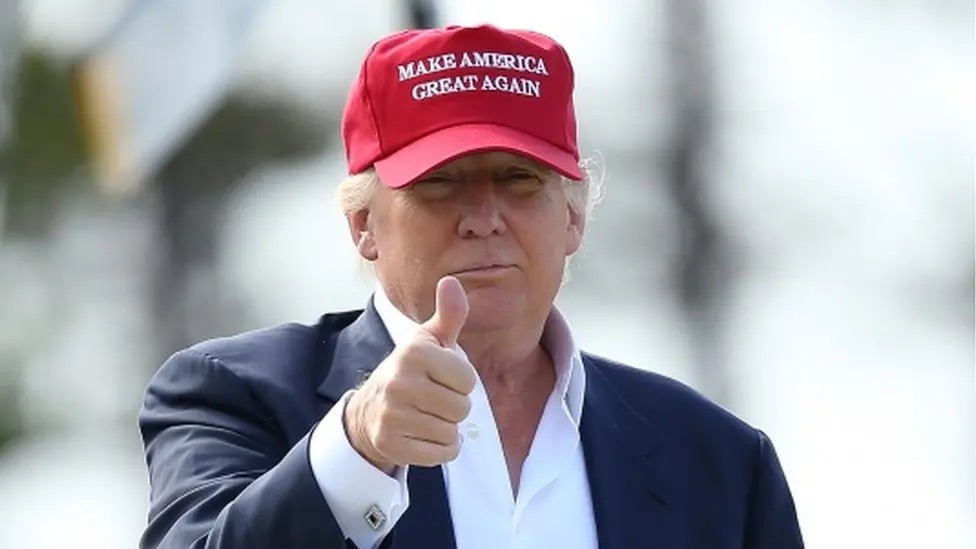
To “Make America Great Again” , a four word slogan clearly based on formulaic Advertising catch lines, includes within it some fundamental assumptions which are presumably taken for granted by Trump supporters who wear the caps, but are surprisingly unchallenged by his opponents.
The first is the action verb “Make”. It’s a transitive verb which Webster defines as “to bring into being by forming, shaping, or altering material. It is aspirational but it’s unclear whether it’s instructional or a promise. If the former Trump is telling Americans what to do. If it’s a promise Trump is saying he can be relied upon to help them do it. It’s probably a bit of both. Almost, but not quite, a call to work together for change.
The reason it’s ambivalent is the central dilemma of Trump’s personality. He’s no team player! In this he resembles at the extreme Vladimir Putin and the totalitarian European dictators of the Twentieth century. But also determined and often single-minded democrats like Margaret Thatcher. And, of course , the democrats in name only of today like Benjamin Netanyahu or Viktor Orban.
This confusion of responsibility lies at the heart of Trump’s persona. If he wants Americans to “make” change – to “bring it into being” – he has to say more than that it’s a good idea. He has to explain what change means and how it can be done. This he singularly fails to do. And this is in no small way because he cannot define what “Great” actually means.
“Great” is a shorthand of perfectionist status, but if it’s to be more than a subjective gut feel it needs quantification. Here the view from outside is crucial. We are truly what we are perceived to be by others. So America cannot by this criterion be “Great” just because (say) the majority of Americans think it is. Foreigners need to think so as well!
And “greatness” itself is problematic. There are many areas in which a nation can be “great”, and they are sometimes contradictory. By any measure China is economically great. But in another judgment area, human rights, they certainly are not.
For America it’s like a seesaw. Tariffs, for example, may help push up the balance of trade but simultaneously also increase inflation – let alone damage international relations and America’s standing in the world. Collateral damage if you like.
Then there is the fourth word “Again “. This is unequivocal – America was once “Great”, no longer is and we must return to the time of greatness. But when was America great ? What are the judgment criteria? Again Trump offers no explanation. He may be nostalgically looking back to the 1950s when superficially the country was getting richer and consolidating its preeminence in the world. There is a clear racial and wealth undertone here. The American dream was to benefit from the consumer explosion . “The Affluent Society” as JK Galbraith called it in 1958. But that was a “WASP” (White Anglo Saxon Protestant) cohort which excluded those who couldn’t tick all those demographic boxes.
But 2025 is not 1958, and there is no going back. America is far more diverse. The middle class is strong and comfortable and in some cases aspires to move up to very wealthy indeed segment. But in the boondocks it’s different. The United States is one of the richest countries in the world, and yet 37.9 million (11.5%) of its residents live in poverty. And racial divisions very much remain. Overt discrimination has mostly gone – Rosa Parks made her bus protest in 1955, and Martin Luther King led his march on Washington in 1963. But more recent events which led to the “Black Lives Matter” movement show that a divide remains. And Healthcare, despite improvements under Obama, is the ultimate divider. To get acceptable healthcare you need insurance and that costs roughly $12,000 per year on average. Half of US workers earn less than $50,000 so in the order of 25% or more of their income goes in healthcare. If they insure at all.
Trump’s White House is overwhelmingly white, male and rich. To them there can be little understanding of the needs of the average American and none at all of the substantial underclass. American society is very stratified. In the MAGA cult there is no understanding of poverty – in the circles they move in and the places they live in they don’t see it.
The European Welfare State model is scorned by Trump’s advisors – Stephen Moore his economic advisor has said “I’ve always said that Britain has to decide — do you want to go towards the European socialist model or do you want to go towards the US free market?” That Europe is “Socialist” will come as a surprise to most Europeans! That we all live in countries where nobody goes bankrupt if they need a cancer operation and that we generally look after those in need is a source of pride, but we are essentially neoliberal mixed economies not socialist ones.
Moore’s comment is revealing in that it is ignorant as well as elitist. But that applies to Trump and the rest of his team as well. The Tariff debacle could have been avoided if proper consultations had taken place. The great American colleges like Yale or Harvard are well stuffed with clever economists in the Berkeley tradition of Galbraith. I’m sure they modelled what Trump was doing and saw the disaster ahead.
MAGA is about the need for change and that should unite its critics and supporters alike. Bernie Sanders, the nearest American politics gets to genuine Socialism, has said “In 1863, at Gettysburg, Abraham Lincoln dreamed of a government ‘of the people, by the people, for the people.’ In 2024, in Mar-a-Lago, Trump is planning a government of the billionaire class, by the billionaire class and for the billionaire class,”
So yes America needs change but Musk and his other billionaire friends can surely look after themselves. The nearly 40 million Americans living in poverty and the 25 million without any health insurance are rather more deserving of politicians’ attention. Address that and you really could “Make America Great”.
When I was gainfully employed by a nasty big oil company we had lots of smart people and even more smart consultants who analysed things. And economists (Vince Cable was one of them; very good. William Hague another, likewise. Oh and Liz Truss – can’t win ‘em all). My oblique point is that if the high priced help needed advice there was no shortage of it. Despite this we didn’t always get it right but in general we weren’t too arrogant to ask for help when we needed it. Happy days.
My point, of course, is that if the President across the Pond needed advice on (say) tariffs there’d be a long queue of smart people from Harvard, or Yale or Princeton to offer it. They might just have told him that his Tariff plan dreamed up with (who? Elon Musk) had its potential downsides.
But (and it’s a big one) in the land of the Orange charmer it’s a bit pansy to ask for advice. And you don’t need to anyway because you didn’t get where you are today without knowing everything. Ask Dizzy Lizzie.
“Nationalisation” has always been a political act driven primarily by ideology. It is significantly different from situations where Government supports a failing business. Here ideology plays little or no part. Effectively Government temporarily provides access to funds (etc.) to help the business survive when conventional lenders (mainly Banks) are reluctant to do so.
British Steel Scunthorpe
The drivers of Government support do, of course, include political considerations. Closing a plant or a company that is a significant employer puts people out of work, increases the quantum of unemployment benefit payments and is socially disruptive. But the hard reality is that for a business to survive and prosper it needs more that temporary funding.
Steelmaking over the past few decades has moved to countries which offer competitive labour costs, economic access to raw materials and scale. China produces well over 50% of the world’s Steel. Other nations have roles to play but the main opportunity is added value production. British Steel’s production is negligible in global terms. Others do, or can do, better and (especially) cheaper.
There may be a social case to support British Steel, but there is no case to “nationalise”. The harsh reality is that we do not need subsidised steel production.
I remember Orpington. I grew up there and in 1962 the Liberal Party won a by-election there which gave me a brief moment of fame at my boarding school. The Constituency is a very Tory place but in that year it collectively chose to flash a warning at the rather complacent Conservative Prime Minister Harold Macmillan.
Over the years the Liberals have acquired votes, often temporarily, from nice Tories who would never vote Labour. They still do. By 2010 under their new “Liberal Democrat” guise they had gained enough seats to become Coalition partners with the Tories. This nearly killed them – in 2015 the public clearly thought that if you wanted a “nice Tory” government you might as well vote for David Cameron who was nice enough.
Cameron’s post Brexit successors weren’t nice because they stuck us with Brexit. The thinking part of Middle England didn’t like this and have voted accordingly. (Orpington, close to Nigel Farage’s home in Downe, stuck with the Conservatives sadly).
The case for the LibDems to acquire more ground from the Tories is a strong one and Brexit is a key part of it. Add in a bit of tactical voting from Labour voters in constituencies where Labour has no chance (necessary given FPTP) and you have a powerful opportunity for Sir Ed Davey which he has taken.
With the Tories being unconscionable and Labour turning nasty in power the LibDems, like Edna Everage, are winning with “Niceness”. And like Dame Edna if Sir Ed makes us laugh in gloomy times amen to that!
In an announcement that will send shockwaves through the European business and financial sectors Dutch/British multinational Shell has announced that it will move its corporate headquarters to Houston, Texas later this year.
Shell’s Lebanese/Canadian CEO Wael Sawan, the first non European to head the corporation, has conducted an extensive study in secret and has concluded that primarily for tax reasons it is in shareholders’ interests to relocate to Houston.
Shell’s Houston offices will be expanded to accommodate its new corporate HQ
Sawan, who has an MBA from Harvard, is known to have become frustrated at the lack of focus and drive from his Dutch and British colleagues at the top of the company. An insider revealed that Sawan sees Texas based ExxonMobil as the model for Shell’s future. “Exxon doesn’t mess around with the trivia of pretending to be into Renewables” hesaid “they are a ‘Drill, Baby Drill’ corporation and that’s what Sawan wants Shell to be.”
The re-election of Donald Trump was encouraging for the Oil Majors and the freed-up and deregulated US oil/gas sector is appealing to Shell as it stipples out its hydrocarbon based future. “Wael doesn’t like bloody windmills” the insider explained.
Laurent Pelly’s Die Meistersinger von Nürnberg originatedat the Teatro Royal in Madrid and is now being performed by the Royal Danish Opera In Copenhagen. It’s a wonderful experience in every way. The mood is set by the triumphant Overture which segued effortlessly into the hymn in the Church – one of the great transitions in musical theatre. From then on few if any in the audience took their eyes off the stage for five hours, it was that good.
Musically and vocally this is a fine production. Beautifully sung and with a masterful orchestral accompaniment under Axel Kober. A good test is the quintet in Act 3 which was compellingly well sung. The staging was minimalist – a curious use of cardboard boxes and a stage (which revolved) at an angle. The Meistersingers themselves were old and doddery and dressed in a dull, unremarkable way. All designed not to detract from the story or the music I think.
The temptation for modern day opera directors is to try and say something new with the great operatic war horses, like Wagner. Bayreuth is not exempt from that indulgence – their last Meistersinger was set in Wagner’s house (on the stage) with Lizst and the Wagner family appearing! And Danish Director Kasper Holten set the Opera in a London Club in a notorious production at the Royal Opera House! In such productions you sense the director is trying to impress fellow directors rather than the paying audiences! No such problem with Pelly’s work here in Copenhagen.
Curtain call in Copenhagen
Pelly wanted us to hear the music without distraction. And to follow the plot. The temptation with Meistersinger , because of its grand scale, is to gild the lily with costumes, scenery and special effects. There was none of that here, and all the better for it. But if understatement in presentation is your plan you better ensure that the essentials are outstanding. For example the chorus which has a key role to play in this opera has to be of the highest quality. It was, the ensemble singing was superb. The principals were experienced Wagnerians. As, I think, they have to be. A lead soprano told me in Vienna last year that she was comfortable with the full operatic range – except Wagner! The Wagner sepecialists were, she told me, a “bigger and a different breed” !
The principals all sang well and there were no attention grabbers – except perhaps Tom Erik Lie as Beckmesser who released the comedy of the character as well as the pathos. A word also for Jacob Skov Andersen’s David. This is often a dull role but Andersen played it almost as Frank Spencer – a bit gormless, but it worked.
Opera House in Copenhagen
It was a first visit for me to the splendid Copenhagen Opera House. A large and comfortable modern venue but without gilt or glamour. The audience were there for high class opera – and that is what we got!
“What is evil? Killing is evil, lying is evil, slandering is evil, abuse is evil, gossip is evil: envy is evil, hatred is evil, to cling to false doctrine is evil; all these things are evil.” Gautama Siddhartha, the founder of Buddhism, 563–483 BC.
You don’t have to be a Buddhist to find this definition useful ancient though it is. Of course we can equivocate around it. Is war to counter tyranny, which involves killing your enemy evil? Are there “just wars” ? And who decides if they are “just” ? Are white lies permissible if they are kind? And so on. Arguably to describe a person, or an act or a belief as “evil” is always subjective. Perhaps evil is a correct descriptor if an overwhelming majority of people believe it to be true.
This preamble leads me to the concern that prompted the thought about evil. We live in times where there is evil all around us, and in unexpected places. Richard Nixon was a crook, but was he evil? Lyndon Johnson presided over some evil acts in South East Asia. Does this mean he was evil – I’m far from sure that it does. Murderous dictatorships aside (Hitler, Stalin, Mussolini…) isn’t evil a tad too strong a word for politicians we don’t like? You can see where I’m going…
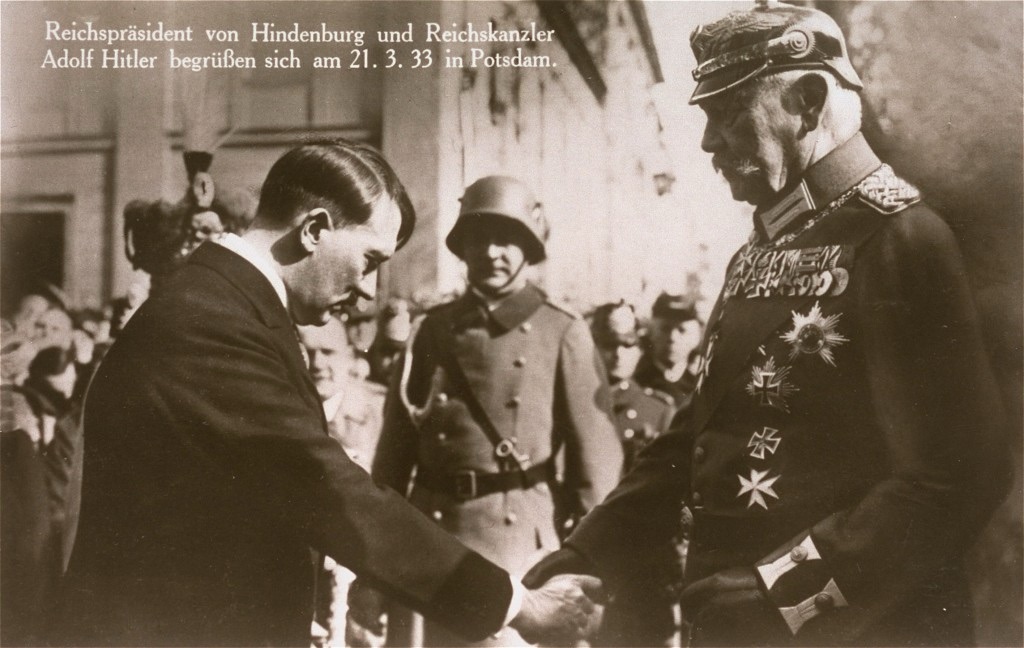
We know the motivations of Hitler and Stalin. Totalitarian dictators hold onto power, once secured, through repression, or much much worse. Hitler gained power legitimately in 1933 having been appointed by Hindenburg, the Head of State. Within a short time he cemented that power by what we might call “executive action” and confirmed by a phoney plebiscite. The aspiring dictator became the Führer.
“Executive Action” involves (usually) Heads of Government taking action without involving elected representatives. Hitler did it by dissolving the Reichstag – or, rather, turning it into a rubber stamp assembly. President Trump is basically ignoring Congress and issuing orders which are subject to no checks and balances.
In his first ten years in power Hitler governed by decree. There was not even the semblance of a democratic process. As it stands Trump is trying to do the same. However the two houses of Congress still exist as do the Courts. Some of the Executive orders are being or will be subject to challenge.
If we look at the Buddhist definition of “evil” and apply it to Trump’s actions there’s a scary coincidence. There are lies galore. There is slander of races, individuals and whole countries. There is unquestionably abuse of power. There is endemic gossip from the President and his acolytes. There is envy and hatred and more than one false doctrine.
Lord Acton famously said “Power tends to corrupt, and absolute power corrupts absolutely,” This was in 1887. Almost exactly one hundred years earlier the drafters of the United States Constitution unquestionably had the same thought in mind. They incorporated checks and balances in the Constitution to stop anyone, including the President, from exercising unbridled power.
The Weimar Republic arguably suffered from an excess of democracy making Germany ungovernable and leading to the rise of Hitler. America, in theory anyway, has traditionally had a balance between the Presidency, the executive, Congress and the Justice system. The coming months will see if that balance can be restored and evil averted.
The argument, propounded by Trump hacks and pundits from Vivek Ramaswamy to David Pyne, is that China is by far the greater threat to American hegemony than Russia. In this they are surely correct.” Juliet Samuel in The Times
China’s exports
Depends what you mean by ‘“hegemony. If you mean economic leadership the Chinese have already won. The West has long since contracted out much of its manufacturing to the Chinese and this will continue. But if you mean an actual military threat then China is not that. These facts are linked. The PRC needs peace with its client countries otherwise the income will stop. They certainly don’t want that.
Russia is a tottering economic power and now there has been an adjustment to the West’s (eg Germany) reliance on Russian oil and gas frankly Russian exports are irrelevant. Russia , unlike China, has no economic need for peaceful coexistence with the West. Should America continue to support Russia then the military threat is reduced. Bad luck on Ukraine though.
Take these realities together China will continue to have hegemony over America economically. Militarily it may threaten Taiwan but an isolationist America will keep well away from this. In short China is not a “greater threat” than Russia. And a negotiated settlement over Ukraine threatens nobody, except the Ukrainian people.










 Paddy’s Blogs in a crazy world