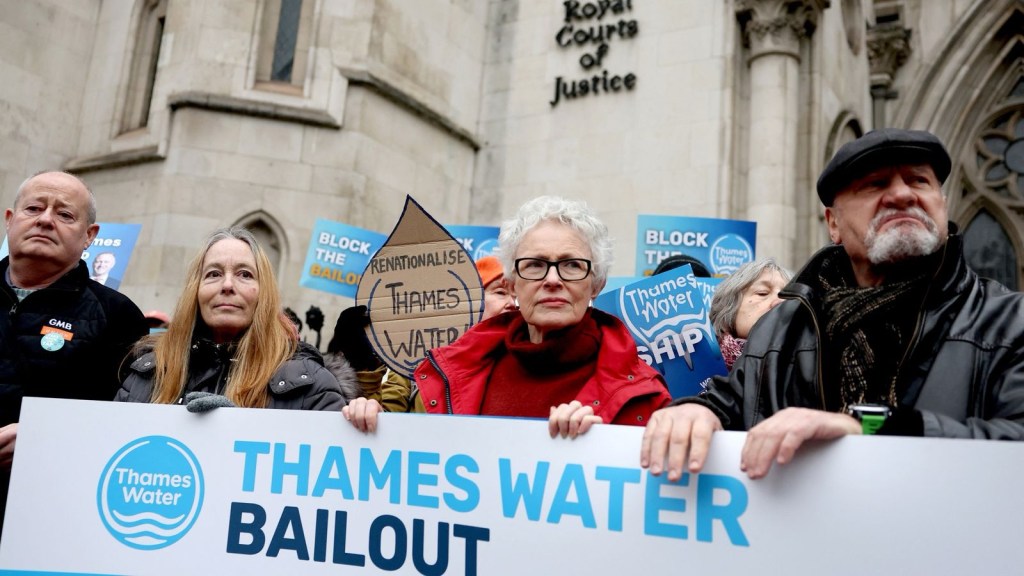
The governments of Margaret Thatcher and John Major created utterly dysfunctional models for some public services. Private sector monopolies. If you give a privately owned company monopoly rights and duties in a geographical area it will exploit its rights and ignore its duties. Exploiting means putting dividends and executive remuneration before investment and good service. That’s human nature.
We saw with Railtrack what happens when a privatisation ideology damages what was clearly an essential national asset. Indeed across the railway system as a whole commercial rather than public service considerations dominate.
The Water sector is an essential public service. This is not necessarily an argument for nationalisation. London buses, for example, offer good service despite being privately owned and operated. But this is within the context of an integrated public transport system in the capital run in the public interest.
Public interest is the key. It may be, as for the London buses, that a public/private partnership would work for Water. I have my doubts about this. Regulation has comprehensively failed and there has been underinvestment and borderline corrupt practices along the way. Fiddling on the margin with improved regulation whilst the whole model is defective won’t take the sector forward.
It was Brexit wot did it. As a fervent Remainer you’d expect me to say that but it’s 100% true. Cameron was in the One Nation Tory tradition, even moving almost Centre-Left in coalition with the LibDems. The Tory Right didn’t like that – look at their anger on Lord Ashcroft’s “Conservative Home” website during the coalition years.
In 2015 Cameron employed the brilliant Australian political guru Lynton Crosby to ditch the LibDems (the “barnacles on the boat” Crosby called them). The trick was to appeal to the mostly Eurosceptic Right Wing Conservatives by offering a Referendum on EU membership. This united a fracturing party, the LibDems were obliterated and Cameron got his majority. Thanks Lynton mate…!
But Dave had to honour his Referendum promise, blew it and walked off into the sunset. Party and governance chaos followed the Referendum disaster. But the Conservatives had two huge bits of luck. Labour had chosen the unelectable Jeremy Corbyn as Leader and Johnson, having pragmatically chosen the “Leave” campaign in the Referendum, plotted to oust the struggling Theresa May and succeeded.
The 2019 Boris election win, substantial though it was, became a Pyrrhic victory. One Nation Tories were driven from the Party. Ambitious pro Europe ministers like Truss and Hunt became unconvincing Brexiteers. Labour finally got rid of Corbyn. Johnson’s personality weaknesses couldn’t survive Covid where he was centre stage. But après Boris there was one heck of a deluge.
Liz Truss was a freak. She worked hard to become Leader and then imploded. It was completely unprecedented. I still find it hard to understand how a politician could reach the highest office and then explode so spectacularly.
Rishi Sunak was a political neophyte and was on a hiding to nothing. He had supported Brexit in the Referendum – a decision which reeked of opportunism. Neither before nor after the vote did he make a credible case for leaving the European Union. He was not, of course, alone in that ! But it did mean he rocketed up the Tory pecking order becoming Chancellor well before he was ready. He wasn’t a disaster so when Johnson was unceremoniously discarded it became him or Truss. Hobson’s choice you might think.
Sunak was in the right place at the right time when the men in white coats came for Truss. A man who less than ten years before had no political record at all was in Number 10. The rest is history. Sunak couldn’t win in 2024 but then no other Conservative leader could have won either. And in Opposition under the bizarre Badenoch the natural Party of Government isn’t even the natural Party of Opposition. Out thought on the flanks not just by the impressive revitalised LibDems but by the successors to what David Cameron called “fruit cakes and loonies and closet racists”
Badenoch’s Tories may be struggling but to be undermined by Farage and Co. is the ultimate humiliation. There is no substance at all to Reform. No policies. No political experience. No gravitas. But they from the pig-headed Right and the LibDems from the thoughtful Centre Left are making life very difficult for the Conservative Party.
There is no military threat to Britain that is not also a threat to Europe as a whole. We have alliances because of this fact. The Falklands was the last time we needed to defend our interests (as we saw them) unilaterally and nothing has materialised in the decades since that we will need to arm ourselves against on our own.
Let’s stop pretending that for Britain to determine a Defence budget is a decision we can make in separation from (at present) our NATO partners. Whilst we have NATO there is an obvious need is to revise its funding mechanism more fairly. The United States does bear a disproportionate burden and other members, including Britain, do need to pay their way more fairly.
It may be that an increasingly isolationist US will lead to the disappearance of NATO. This is not necessarily a bad thing. A united Europe does need to defend itself and the emergence of a European Defence Force (EDF) seems likely and logical.
The funding of an EDF is obviously open for discussion but a GDP related mechanism is a start point for these discussions. Similarly there will need to be agreement on bilateral deals between the EDF and friendly allies hopefully, but not necessarily, including the US. Other non European NATO partners like Canada will certainly be candidates for mutually beneficial alliances.
If one is seeking truth about the tragedy of Israel and Palestine and Gaza and the Settlers, and the dispossessed and the death and the destruction Lord Finkelstein , in The Times, tells it here. He eschews the binary. He avoids the “I’m a Jew, therefore…” almost entirely. He tells it as it is. And who can not share in his despair?
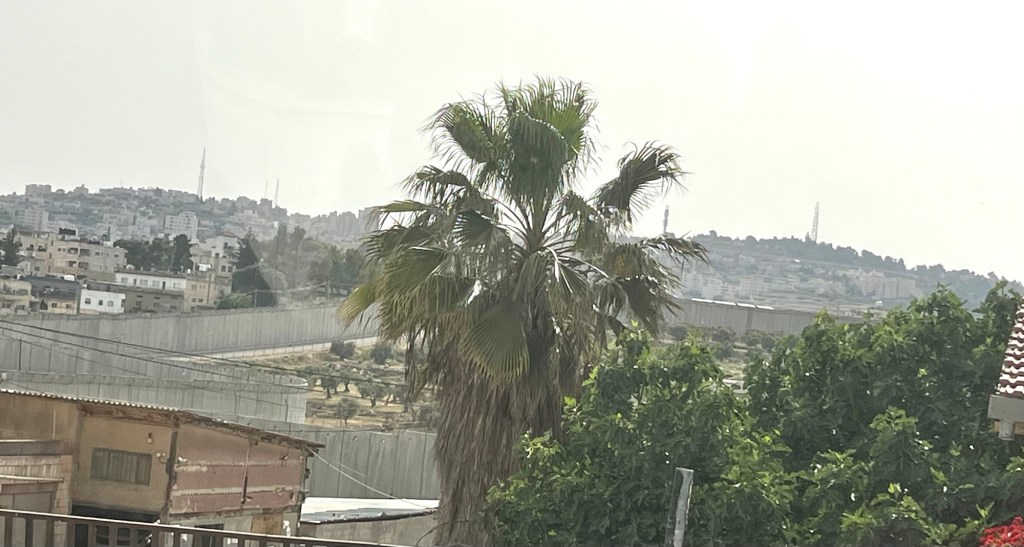
Bethlehem, and Israel’s wall “protecting” it
It had long been an ambition of mine to visit Israel and before that became impossible I managed it. I walked on the Mount of Olives. Climbed the Via Dolorosa. Saw the Jordan at Galilee. Bethlehem. Nazareth…
The thing abut the New Testament stories for me is that they represent a positive historical break. Above all by replacing “An Eye for an Eye” with “Turn the other cheek”.
But now the Holy Land is besmirched with revenge, other cheeks are not being turned. Israel needed to respond to the vile assault it suffered. But nobody, including Daniel F, can truly say that that response was proportionate. It just has not been.
I make no charge of genocide but understand why some do. I do, however, make a charge of opportunism.
Netanyahu did not, we must assume, directly incite the Hamas attack. But he sure has taken the opportunity to make part of his response to it to promulgate the goal of Greater Israel. And some of his compatriots go back two thousand years to justify their ambition, a denial of two millennia of history – including the emergence of a third Abrahamic religion!
A charge of Israel seeking Lebensraum, for that is what it is, is the most chilling irony.
Paddy Briggs is a British author and former Shell executive who transitioned into writing and journalism after a 40-year career in the oil industry. Educated at The Leys School in Cambridge and holding a degree in Business Studies, he has authored several books, including biographies and analyses of social and political issues.
Career and Writing
Briggs spent 37 years at Shell, where he led the company’s global service station rebranding initiative, described as “the world’s largest re-imaging programme” . In 2010, he was elected as a member-nominated trustee of the Shell Contributory Pension Fund, one of Britain’s largest pension schemes. This role sparked his interest in pensions, leading him to write monthly articles for the specialist publication Pensions Age for six years .
His published works include:
John Shepherd: The Loyal Cavalier (2009): A biography of the West Indies and Kent cricketer. Jumeira Jane (2001): A collection of comic verse published in Dubai. The Tragedy of Corrib (2011): An analysis of the controversial natural gas project in County Mayo, Ireland, focusing on the management and community relations aspects . Look Where You’re Going (2018): A biography of Alan Pickering, a blind pension expert and racehorse owner, highlighting his contributions to occupational pensions and his personal achievements .
Briggs also contributes to political commentary, having written articles for Byline Times on topics such as Brexit and the Conservative Party .
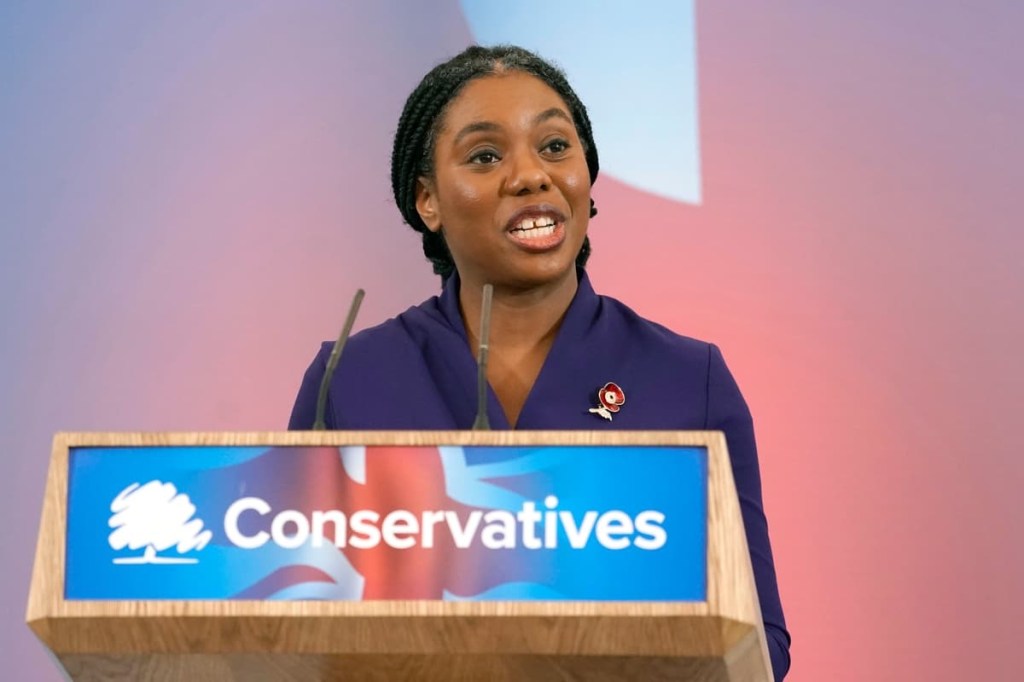
Mindful of Margaret Thatcher’s belief that “…if they attack one personally, it means they have not a single political argument left.” I do think Mrs Badenoch’s problems are personal. She is a very inexperienced politician who hasn’t learned the dark arts, and she doesn’t seem to realise it.
Thatcher had a voice coach to modify her rather phoney accent which sounded like she’d tried hard to leave Grantham, and overcompensated. Badenoch’s way of speaking is similarly odd. She has described herself as “to all intents and purposes a first-generation immigrant” though more recently she has played down her solidly Nigerian background – certainly her way of speaking shows no sign of it.
Badenoch’s achievements are considerable and admirable but they are entirely personal and driven, not political. Her views are off the shelf Centre-Right (more Right than Centre) and I cannot recall that she’s ever said anything original or interesting.
As she herself acknowledges Badenoch’s identity is unconventional for a British politician (as was that of her predecessor). But unlike Sunak she seems unable to persuade that in a multicultural society coming from left field can be turned into an advantage. She is also, in public anyway, utterly humourless. When the Prime Minister is not a barrel of laughs it’s a shame her manner is full of snide not sparkle.
I saw the recent TV programme about the rebuilding of Notre Dame after the horrendous fire. The attention to detail was extraordinary. They attempted, and seemingly succeeded, to exactly replace everything destroyed with a precise replica. It was an astonishing achievement technically but also a defiant one emotionally.
Coventry Cathedral, old and new
I remember the opening of the new Coventry Cathedral and feeling an overwhelming sense of failure. The Luftwaffe had won, the building they burned to the ground was gone forever except for a few memorial bits left. The new Cathedral bore no resemblance to its predecessor. Like it or not it wasn’t a confident “We will not be beaten” statement. It was “You won”.
Making a judgement about what to preserve/replace and what to demolish is subjective. Fortunately we didn’t have to make it with St Paul’s Cathedral which miraculously survived the Blitz. Would we have rebuilt it stone for stone? Coventry suggests perhaps not.
We are all guardians of the past and creators of the future, with architecture especially but also in a myriad of the daily decisions we make. We cannot learn from the past if we destroy it and we cannot influence the future if we forget that in part we are responsible for how it evolves in the decisions we make today.
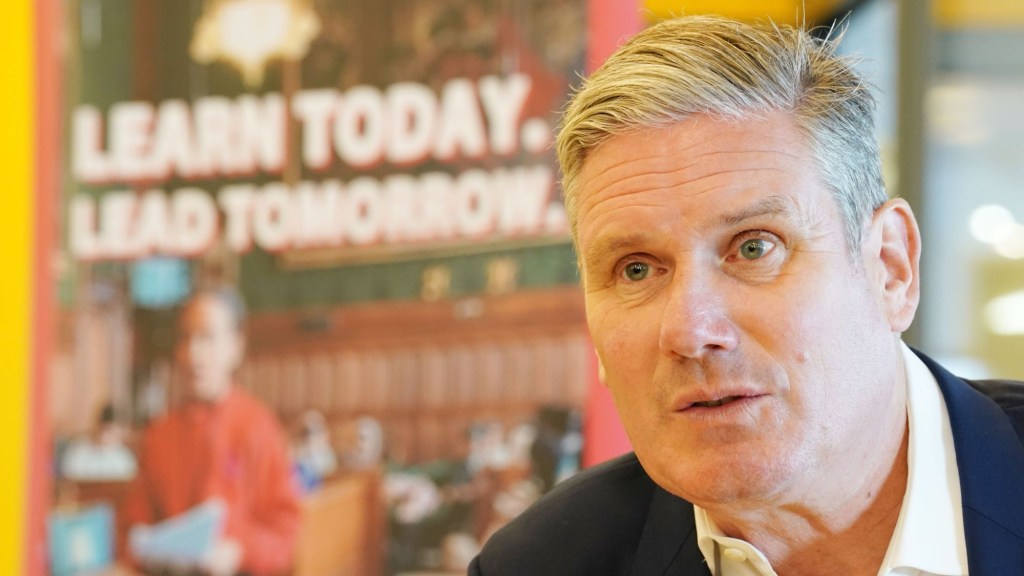
“My vision of Britain in decades to come is of a proud, independent, prosperous country, able to work with friends and partners across the world from a position of mutual strength.” Keir Starmer
Sir Keir has effectively here defined the rationale of the European Union. The people who bleated on about “Sovereignty” are the same people who now are running “Reform” or voting for it. They were wrong then and they’re wrong now. Countries are interdependent and that has to be formally recognised and membership of the EU is the way to do it.
Similarly Starmer’s waving of the red flag at “Immigration” without even acknowledging in passing the value that the Windrush generation, and countless others, have brought to our shores.
Starmer’s challenge is to counter Reform not by imitating them but by eloquently explaining why this toxic bunch of unprincipled and prejudiced carpetbaggers is morally, practically and historically wrong for Britain. We are not Trumpland. He should say so.
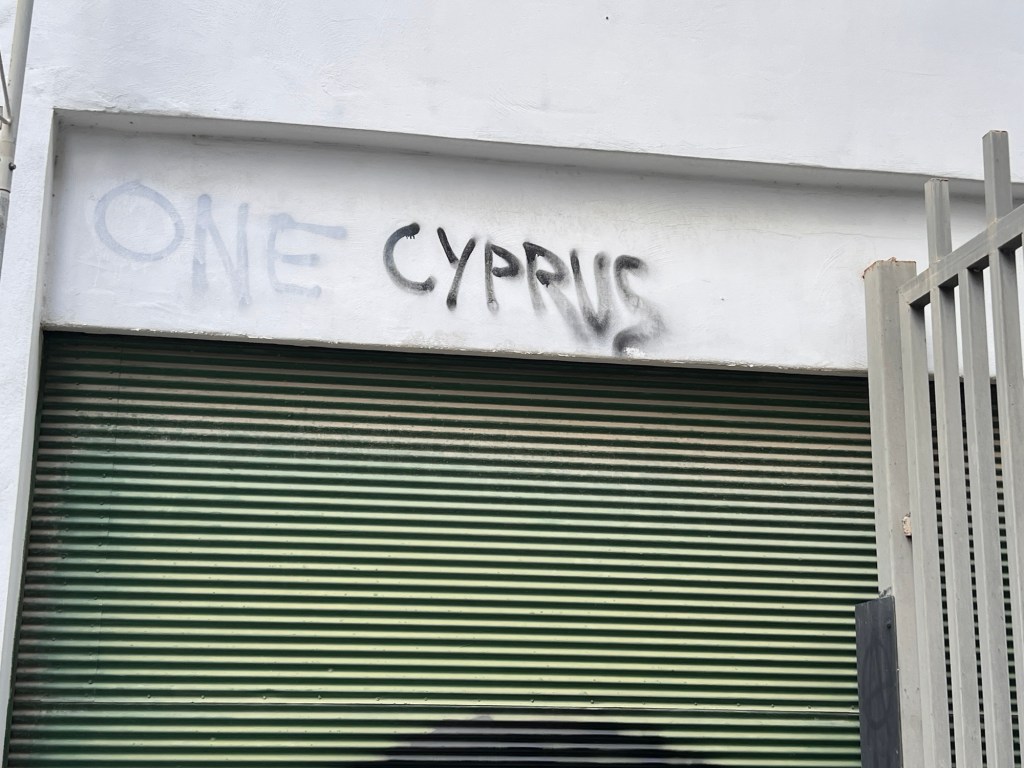
My wife and I recently visited Northern Cyprus for a week’s holiday. This blog summarises what we saw and our conclusions.
Background
Northern Cyprus or to give it its preferred name The Turkish Republic of Northern Cyprus is a long standing oddity among nation states. Mainly because the rest of the world, Turkey aside, doesn’t recognise it as a state at all. Technically Cyprus is not divided and the whole island is part of the Republic of Cyprus a legitimate national entity, member of the United Nations and of the European Union. In reality, however, the island is divided between the Turkish north and the much larger Greek south.
Cyprus was a united entity effectively as a British Colony for eighty years but rumbling below the surface in those times were two intractable problems. Many Greek Cypriots wanted “Enosis” – to be united with what they saw as their mother country Greece. Understandably this was not something the Turkish Cypriots wanted one little bit! And that was the other problem. Whilst Greeks and Turks lived together mostly amicably they were different culturally, linguistically and in religion. Whilst the Turks certainly didn’t want to be governed from Athens they weren’t that keen on post colonial independence dominated by Greek Cypriots either.
It was the “Enosis” threat that materialised first in the early 1950s. The British did not handle the armed uprising by EOKA well and the heavy-handed response to what was seen, not unreasonably, as terrorism was counter productive. It was a messy process of withdrawal from Empire. Not the only one of course.
Post colonial Cyprus
A post colonial Cypriot Republic was declared in 1960. This was unstable. Enosis hadn’t disappeared and the Turks concern about Greek domination was justified . The coup in 1967 which brought the “Colonels” to power in Athens escalated the Greek demands for Enosis both in Athens and on the island.
On 15 July 1974, the Greek military junta carried out a coup d’état in Cyprus, to unite the island with Greece. This coup ousted president Makarios III. In response to the coup, five days later, on 20 July 1974, the Turkish army invaded the island. However the rationale for this invasion was rejected by the United Nations and the international community, and that rejection remains in force today.
The Republic of Cyprus has de jure sovereignty over the entire island. However, the Republic of Cyprus is de facto partitioned into two main parts: the area under the effective control of the Republic, in the south and west and comprising about 59% of the island’s area, and the north, administered by the self-declared Turkish Republic of Northern Cyprus, covering about 36% of the island’s area. The international community considers the northern part of the island to be territory of the Republic of Cyprus occupied by Turkish forces. The occupation is viewed as illegal under international law – that is it amounts to illegal occupation of EU territory since Cyprus became a member of the European Union in 2004.
Northern Cyprus today
Despite its pariah status as an illegal entity Northern Cyprus has a viable and peaceful existence as a sort of disconnected province of Turkey. At the end of our recent holiday President Erdogan of Turkey visited the island and reaffirmed Turkey’s commitment to northern Cyprus. He declared Turkey and Turkish Cypriots the “rightful owners” of the region and vowed their presence would persist “for centuries.”
Nicosia is now one of the few divided capital cities in the world. Comparisons can be made, of course, with the once divided Berlin and the division of Germany which endured for over forty years after World War II. My impression, albeit after a very brief visit, is that Cyprus is different. Although Germany was divided ultimately the German people, despite political division, remained culturally one nation. Post 1989 when the Berlin Wall fell, reunification progressed remarkably smoothly.
The divide in Cyprus is different. There is not a homogeneous Cypriot culture – Greek Cypriots and Turkish Cypriots are different. The languages and the religions of the Turks and the Greeks are not the same! This does not mean they can’t get on of course. Lawrence Durrell in his masterly “Bitter Lemons” described how in Kyrenia and his village of Belapais there was an amused and peaceful accommodation between Greek and Turk. But my impression is that that spirit of tolerance has largely disappeared. That does not anticipate conflict, just that the logic for a united Cyprus is idealistic, but impractical.
The movement of Turkish Cypriots north and Greek Cypriots south after 1974 reaffirmed the division of the island. And reaffirmed that the island is practically and culturally divided. The forces for separation are much stronger than the forces for unification. A united federal Cyprus looks like a pipe dream.
The North struggles to an extent because it is not recognised internationally. This harms its economy and the freedom of its people. But tourism and, remarkably, the presence of many tertiary education establishments (which attract students from around the world) do make the “region” viable – it’s certainly a fascinating and historic place to visit.
The United Nations still patrols this beautiful but divided island
The logical solution is to negotiate a settlement that recognises the sovereignty of Northern Cyprus, not as a province of Turkey but with close links to it. On the island there would be freedom of movement across the territory and, no doubt, many shared entities like airports and infrastructure. But neither community would rule the other. That would require both structure and goodwill. Possible ? I really don’t know!
Defined benefit (DB) (also known as final salary) pension schemes, which provide a guaranteed, inflation-linked income for life that’s linked to your salary and length of service, used to be the norm in the private sector. They were so expensive to run that they have all but disappeared — and so have the generous employer contributions that went with them.” Joanna Noble on The Times today
The best way to see a DB scheme was that it was deferred salary. Employees forwent some of their income in order to build pension rights for the future. They were not especially “expensive to run” and those costs were paid for not by the employer anyway, but out of the Assets of the ring-fenced Pension Fund.
The switch to Defined Contribution (DC) was primarily driven by Employers’ wish to reduce their funding of pensions. In fact the quantum of those contributions was a relatively modest cost burden for a well run and profitable company. And ironically, as companies moved away from proper pension funding for all, they started paying their directors and senior executives astronomically higher remuneration. One law for the rich…!
Most auto-enrolment is linked to a DC scheme and in truth these vehicles are not pension schemes at all. They are savings schemes which for the retiree offer benefits which are orders of magnitude less beneficial than the DB scheme they replaced. Private Sector employees could not organise to fight the decline of DB. Unlike in the Public Sector where a form of DB is still the norm thanks to the Unions!
The decline of decent retirement pensions in the private sector is one of the scandals of modern times and successive governments did nothing to stop it. Today’s Private Sector employees can work for forty years or more with no guarantees as to what their DC scheme will give them. That will depend on the buoyancy of the scheme’s investments on the date of their retirement.







 Paddy’s Blogs in a crazy world