Finding the courage and caring to help others

Max Hastings has an excellent piece about courage in The Times today.

My father was a Prisoner of the Japanese on the Burma railway for more than three years. He rarely talked about it – he was not alone in that. He was not a hero – at least not in his own view. But I have found one or two books about the railway in which he is mentioned. He kept the earphone of the camps’ clandestine radio in his shoe. He and other officers liaised with Thai locals to smuggle food into the camps. If he had been discovered he would have been shot – or worse.

Dad wore a poppy on Remembrance Day but eschewed completely both the sentimental and the boastful faux-patriotism that is common today. He hated war and violence with a vengeance, he had seen too much. He would have rejected completely the characterisation of all soldiers as “heroes” which is also all too frequent in modern times. Some were, most were not.

Dad didn’t want to go to war in part, I think, because of his own childhood. He was born four days before the Battle of the Somme started. As he grew up he was surrounded by those scarred by the War to end all Wars. Some were silent men of courage. Some innocent victims who put their war experience behind them. In 1939/40 Dad volunteered and eventually joined up. It was not an act of courage, but one of duty.

As a child in the early 1950s some of my school friends played with toy guns , I did not as they were banned in our house. But my father was not a bleeding heart pacifist. He didn’t want to be a hero though he did have a buried grievance about being ignored when he got home in 1945. He was not alone in this either. When the largely fictitious “Bridge on River Kwai” film came out I went with Dad to see it. His reaction was interesting. He said it was nonsense, but he was pleased it had been made as in his view the subject had largely been ignored. He was right. The railway gradually became better documented and stories of courage began to emerge. Including his, but by then he had died.

It’s a cliché to say we do not know our potential for courage until it is tested for real. But it is also a very subjective thing – one man’s courage is another’s foolhardiness. The idea of silent heroes is an appealing one with its ring of modesty and lack of bombast. I remember Dad referring to one of his friends as “having had a good war, but he doesn’t talk about it. His Military Cross stays in its drawer”. Dad was not decorated but it seems he had a courageous and therefore “good war” as well. He was one of “…The strongest people [to] find the courage and caring to help others, even if they are going through their own storm.” as Roy T Bennet put it in “The Light in the Heart”.

Tinkering with tax and regulation in Britain to further some antediluvian libertarian ideology just won’t work.

“Virtually all economic growth comes from innovation.” Matt Ridley in The Times today.

It doesn’t. Economic growth comes from demand either domestic or from abroad. New ideas and products can help stimulate demand but it is growth in the sale of existing goods and services that is the main driver.

If you trash your manufacturing base whilst your international competitors are growing theirs that will contribute to your economic decline. Britain has been doing this for 50 years. The substitution by the service sector of the disappearing factories has covered up this process. There have been moments of innovation from Sinclair to Dyson but these have either faded away or not been significant enough to count much.

It’s the big guys on the block who innovate

The most innovative modern companies are in sectors like computing where the Americans (Apple) and the Far East (like the Korean Samsung and the Chinese ) dominate. Britain is nowhere. We just don’t make things any more. Our vehicle manufacturing is significant but these foreign owned companies can and will review where in Europe they have their plants. Britain is now a pretty unattractive prospect as recent decisions by Honda and Nissan have shown.

The Brexit agreement did not cover services and there is little doubt that Britain’s economic isolation will lead to the relocation of many financial services firms from London to more welcoming and flexible European locations.

The Gross Domestic Product of a country is driven in part by its size and in part by the efficiency of its new wealth creation but whilst it is beneficial to be innovative far more important is to have a sound basis to what you currently do. Economies of scale are absent in what is left of Britain’s manufacturing. This has led to the disappearance of traditional industries with only small scale and niche production remaining.

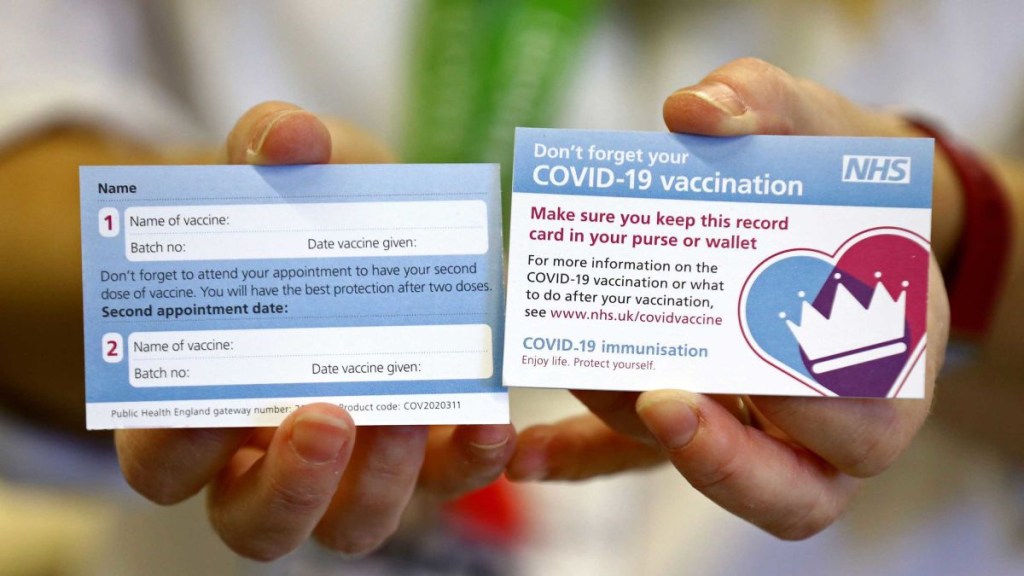
Britain is not a victim of high taxation nor excessive regulation , and energy prices are no higher here than elsewhere in Europe. And to spread lies about Europe’s “lethargic” approach to the approval of COVID-19 vaccines compared with the U.K. is petty and cheap.

The modern world is interdependent and whilst there is always the opportunity for clever entrepreneurs to exploit good ideas don’t hold your breath. The inevitable decline caused by our rejection of cooperation in Europe and our walking away from Free Trade – the Single Market and the Customs Union – will be hugely damaging.

Economies can adapt to new circumstances and innovation can help this. But it is the “big companies” that Ridley so decries here who mostly do this in the modern world. All the vaccines come from Big Pharma. Just as all the next generation of electronics will come from the likes of Apple and Samsung. Tinkering with tax and regulation in Britain to further some antediluvian libertarian ideology just won’t work.

Popular culture has always been full of ageing lechers pursuing innocents.

Max Hastings writes about Flanders and Swann’s “Have Some Madeira, M’Dear” in The Times today. He says . “I doubt that any entertainer today would perform a number about an ageing rake” – he’s probably right. Flanders and Swann held a mirror up to society and like all great satirists it distorted a little as it reflected, but not by much. Britain in the 1950s was a society riddled with male chauvinism, and worse. Employers hired women only as typists and secretaries and even in The Arts there were few female conductors, film directors or composers allowed prominence.

Flanders and Swann were part of the process of change as were the new novelists and playwrights. The Angry Young Men were all men, but at least the discrimination against women was one of the things they could be angry about. “Look Back in Anger” begins with a wife expected to know her place at an ironing board.

“Beyond the Fringe” was around the corner. It was gentle and very male satire. – but in many ways F&S were tougher. A target of both of them, and also of Osborne in “The Entertainer”, was English delusion and exceptionalism. How we could do with them today – there is no better portrayal of this dominant national character trait than in “The English, the English, the English are best”.

The pompous old fool in “Have some Madeira , M’Dear” was a man of his times but he didn’t go away quickly. Indeed he’s still around. Popular culture from the “Carry On” films to “The Navy Lark” and “Round the Horne” was full of ageing lechers pursuing innocents. It still goes on, even in Parliament it seems.

I grew up in the very hierarchical 1950s and through most of the decade we were all expected to know our place. Women were at best patronised and at worst abused. Many were seen as “Fair game”. Diana Dors and Jayne Mansfield were certainly in your face, but their prominence was based solely on their allure, not their brainpower. Ruth Ellis was hanged as much for her promiscuity as for her crime.

I worked in a London office of a well known company in 1964. One of the quite senior managers could not keep his hands of his secretaries and they had regularly to be replaced. He kept his job and indeed rose to some prominence in other fields. He may not have used Madeira in his attempted seductions – but this ageing rake got away with it – as did thousands more.

For the English like me who know Scotland well the prospect of an independent Scotland in the EU is very appealing.

Brexit is and was an English Nationalist project. Many Brexiteers are viscerally anti-Scots and openly contemptuous of the distinctive nation north of the border. Whilst they wave the Union Flag at every opportunity they forget that the flag of St Andrew is a part of it. They laud Britishness when it suits them but in reality what they actually mean is little old England.

To leave Europe was in essence driven by Little Englanders. The Scots mostly wanted none of it and are understandably aggrieved that they are being taken out of the European Union against their will. Meanwhile most countries in the EU see Scotland as they see themselves – historic nations with the same right to self determination that they have. The exception is Spain where the Catalans have as strong a case as the Scots for an independence that their central Government is unwilling to concede them.

The combination of a majority for independence north of the border and a sympathetic EU should settle the matter. The case for the Union is rarely made as a patriotic case for Britain but usually as an accountants’ case for the financial benefits that it brings to Scotland. The EU knows this and can comfortably underwrite financial subsidies to support the Scots breakaway from England. They will delight in doing it as well ! They’ll find a way to placate the Spanish and bring them on board I expect.

For the English like me who know Scotland well (I lived there for many years) the prospect of an independent Scotland in the EU is very appealing. Scotland has a far stronger unitary culture than England without the regional divides and metropolitan domination that characterise England. Whereas xenophobia is rife south of the border Scotland has never struck me as being anti other nationalities, except the English of course.

The United Kingdom is a relatively modern concept but it has outlived its usefulness in a post Brexit world. Whereas the myth of membership of the EU being a threat to British Sovereignty was bunkum the fact of the U.K. denying Scotland sovereignty is very real. As, of course, is the fact of the Union standing in the way of the inescapable and righteous logic of a reunited Ireland. I doubt that the Welsh will be far behind in going for independence either. Wales is a perfectly credible independent state in the EU which comfortably includes nations as small as Malta or Cyprus. Even, effectively, Gibraltar!

The break up of the United Kingdom may be an unintended consequence of Brexit, but it shouldn’t have been a surprise. I doubt that Scottish and Welsh independence, and Irish reunification, would have happened without Brexit but they now seem inevitable. Whoever is Prime Minister when all this happens better make sure that they have enough flags of St George in stock to put behind the podium when the make the announcements,

We Britons are genetically, historically, culturally and emotionally European. But not all of us knew it

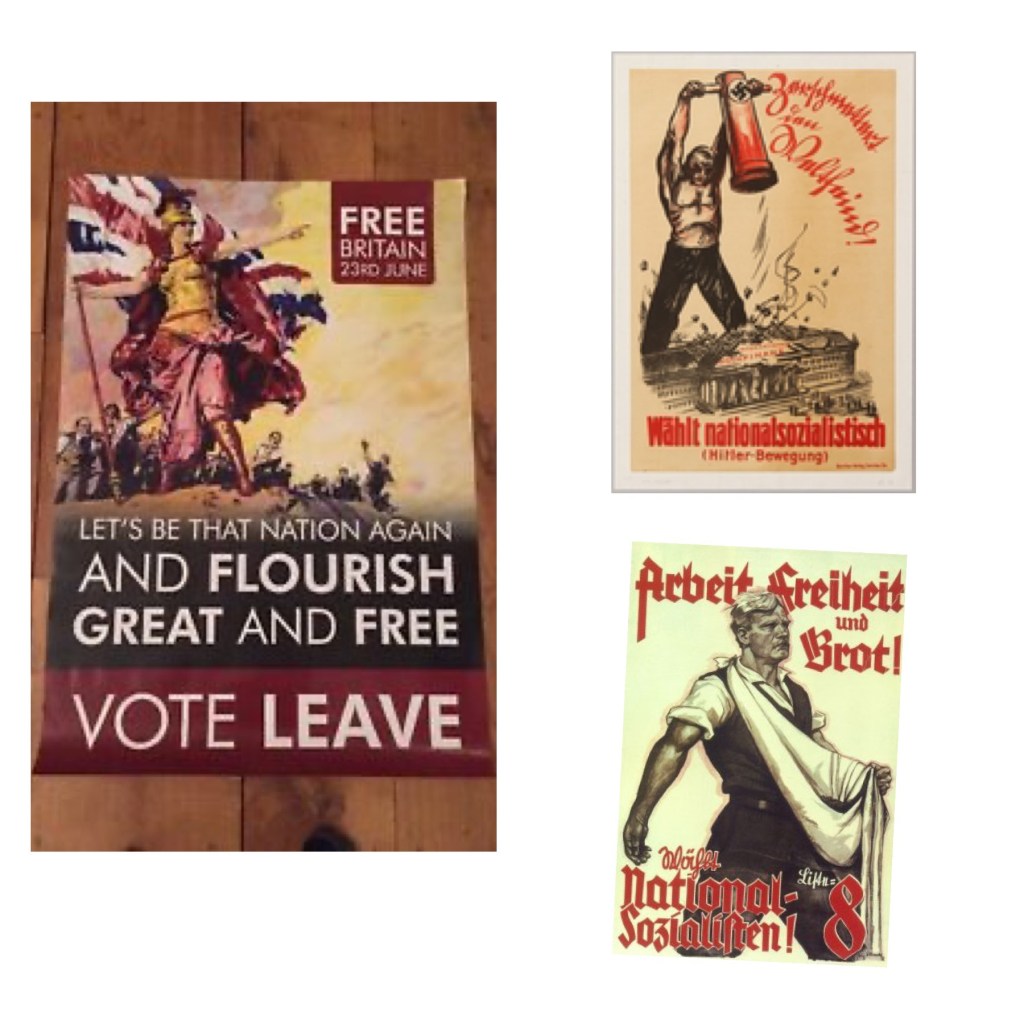
“One of the most dishonest smears from angry Remainers in June 2016 was that in voting against a trading and administrative bloc, every Brexit voter was not just venomously racist but was rejecting the Renaissance, the Enlightenment, Mozart, Marie Curie, Van Gogh, alpenhorns and proper patisserie.” Libby Purves in “The Times” today.

The sad reality is that the average Brexit voter wouldn’t have a clue what Libby Purves is talking about in her excellent article. The referendum didn’t operate at the level of Goethe or Van Gogh but at the level of Nigel Farage. Yes that’s the same Farage as the man with a European name, ancestors and a German wife. I don’t think Farage mentioned the Renaissance once and those that voted for his malignant ideology wouldn’t have heard of it.

Farage and culture – unlikely bedfellows

I’m a member of the metropolitan middle class elite. A product of a good education, career and a fair dollop of good luck. I’ve been to La Scala and the Philharmonie and the Louvre and walked in The Alps. I’ve lived for some years on the “continent “ and speak one European language fluently and others a bit. I have pride in being European. This is not a boast , simply an illustration of a divide. People like me were outnumbered and out thought in the reductio ad absurdum of the “Leave” campaign.

In a battle in the gutter with a mendacious message on a bus and Farage standing in front of a xenophobic poster Mozart didn’t get much of a look in. We Britons are, of course, genetically, historically, culturally and emotionally European. But not all of us knew it and some of those who did – Boris Johnson for one – ignored tradition and reality to lie for their own advantage. They’re still at it.

What to do in a Britain where 52% of the voters drank the Kool Aid?

Max Hastings , in The Times today, with his wonderful gift for making modern history comprehensible to the non professional reader may one day try and explain in more detail all our current madness. For now he seems as bewildered as most of us. Michael Gove, a modern day Jim Jones in the same newspaper puffs and blows his pseudo-patriotic guff whilst pouring out the Kool Aid – but he doesn’t explain either.

The reality is that the causes of collective madness are hard to grasp. Read the story of how scores of adults drank the lethal Kool Aid in the Guyanese jungle. We know what happened, but why? No idea. Brexit makes no rational sense. But like in Jonestown does that mean it cannot be explained? Maybe it should be – 52% of the referendum voters drank the Kool Aid.

Jonestown – drinking the Kool Aid

The lethal affect of this insanity is now around the corner. It would help to know how we got here. The point about the “tribal identity” Max Hastings refers to is that it isn’t our recent identity but one that harps back seventy years – and much more. That England was Imperial and genuinely “Great Power” in character. But it was already slipping away. As Dean Acheson told us in 1962 we had lost an Empire but not yet found a role.

In “Nemesis” Max Hastings describes poignantly how ineffective the Royal Navy was in the latter stages of WW2 in the Far East theatre. The baton had been passed to America and GB wasn’t even a bit part player. Without the Empire Britain became largely irrelevant on the world stage. “Global Britain” was an anachronism in 1960. Today it is embarrassingly preposterous.

The future stippled out for us as one of the leaders of a modernising and uniting Europe seemed for a time to have been understood, if not embraced. But now we’ve cast that aside in favour of…what? Search me.

We may rescue some “soft power” not just in the Grantchester tea rooms but in science and tourism and The Arts and Sport. But we won’t actually make anything to speak off and it seems that even our vibrant financial services sector will slip away to Frankfurt or Dubai.

The thought of Priti Patel, clip board in hand, checking whether a aspirant migrant from Poland or Paris or Prague meets her criteria should put them all off to good.

So what of Little England ? Sad, silly and adrift we will be a museum of the past.

Michael Gove in The Times today waffles on incoherently about the post Brexit opportunities for Britain. Well one of the architects of Brexit would say all this wouldn’t he ? But it’s bunkum – none of the fictitious “benefits” of Brexit Gove lists is substantial or even true. Just vague pseudo-patriotic puffery revealed in those oft-repeated words “Take Back Control”. The truth, an alien concept to this man and his cohorts, is that we never lost it.

The “deal” announced with such self-congratulatory bombast illustrates why no nation , and certainly no European nation, is independent in the modern world. The deal restricts Britain’s freedoms and constrains our independence of action. It is Brino – Brexit in name only – if by Brexit you mean taking back control as Gove claims here.

The 21st Century world is interdependent like never before. In Europe partners created a structure to both acknowledge this interdependence and to further it. “Ever closer Union” – the antithesis of “Take Back Control” – does involve some surrender of sovereignty but does that make any one of the 30 nations either in the EU or closely allied to it any less of a nation? Of course not.

Michel Barnier described the “deal” as being “Lose/Lose” and, of course, he was right. Europe and Britain are both the poorer for it. Those of us who have travelled extensively across mainland Europe and the continent’s more geographically disconnected members (all in the EU) do so to relish the differences. Countries like (say) Finland and Croatia are no less Finnish nor Croatian for being in the EU. And nor was Britain if only we’d seen it.

EU membership gave we Brits benefits unthinkable to previous generations. The right to live, work and travel freely across thirty countries should never have been surrendered. There is no more symbolic representation of Union than this – but it is so much more. Economically, socially, culturally and emotionally the “Four Freedoms” said, rightly, that no modern man is an island entire in itself. And nor is the nation of which he is a citizen.

After 1st January the only way is up. But the medium term outcomes of Brexit look extremely hazardous for the United Kingdom. The viability of Scotland as an independent nation in the EU is very much enhanced by Brexit. The EU27 won’t have to dig too deeply into their pockets to smooth the way. It will happen. No doubt the Welsh will do the same. And if the Northern Irish can bury their sectarian differences, as they did when they signed the Good Friday Agreement, then a reunited independent Ireland is another certain outcome.

So what of Little England ? Sad, silly and adrift we will be a museum of the past. Clinging on to our past “triumphs” waving a flag of a Union that no longer exists and in terminal decline. The Celts will soon forget us, they never liked us much anyway.

Can you be “Sure of Shell” any more? Only where they “stick to their knitting”.

In his seminal business book “In Search of Excellence” Tom Peters described the main characteristics of successful companies. One of them was that they tended to “Stick to the knitting”. There are few better examples of this than Shell.

In my 40 years with Shell as an employee and later as a Trustee Director of the British pension fund I saw how good we were at things within our areas of experience and competence. And how bad at diversification. The exploration for and exploitation of hydrocarbons, oil and gas, was what we did. And we did it well. All the way from the well head to the petrol station we were on top of our game. You could be “Sure of Shell” all the way along the supply chain.

But get out of our comfort zone we were hopeless. The list of failed step out activities is a long one – from Nuclear Energy in the 1960s to the latest “Shell Energy” farrago we simply did not know what we were doing. We failed in metals with “Billiton”. We failed in electricity generation with “Powergen”. We failed in coal, forestry, solar and wind. The list is a long one.

The idea that Shell could run a Broadband business is quite preposterous – we couldn’t run an operation marketing Gas to commercial/industrial customers an area where you’d think we had some relevant competences. “Shell Energy” aimed at the domestic gas market, is yet another step out too far.

The success of Shell, the reason that Shell shares have always been a blue chip investment, is that we looked after what we knew best. We had geologists, engineers, rig builders, tanker captains, pipeline experts, oil traders – even a few marketers like me. And lots of accountants. We did our core competencies well. And we invested so much in the Oil and Gas business that for a time Shell was the worlds largest commercial capital investor – in any sector.

When we were good we were very good, but when we were bad we were awful. We once ran a corporate tv commercial lauding our involvement in Forestry which included the line “One Day it may be our biggest business”. We withdrew from Forestry the following year!

The future of the energy sector as demands to get greener and move away from hydrocarbons is complex but the reality is that the only thing that Shell brings to the Renewables table is money. There is no corporate memory on renewables just as there clearly wasn’t for domestic gas. You can buy a gas marketing company, as Shell did, but that doesn’t mean you have the competence to run it.

Can you be “Sure of Shell” any more? Only where they “stick to their knitting”.

General Sir Nick Carter: “To win against Russia and China we must beat them at their own game” … Ho Ho !

There is an interview with Britain’s top soldier in The Times today. Much of it is silly “Britain contra mundom” fantasy – grotesque and silly exceptionalism. The decline in numbers of our Armed Forces is recorded and NATO gets a brief mention. But the reality is that it is only as a part of alliances that the U.K. matters at all. We do not need to be a major military power in our own right and haven’t been for decades. Of course when Russia is militarily strong and on Europe’s borders it needs to be kept in check. But that is not a concern for Britain alone.

new European defence model is urgently needed and, despite Brexit, Britain needs to be part of it. A European Defence Force (EDF), politically accountable to the EU and to the European Parliament, is the way forward. That’s direct accountability not the accountability by proxy of NATO.

If Russia is in our backyard it is not the only global threat – but again we need to get real. Britain alone can do nothing about Iran or China or North Korea all arguably real threats to global peace. Sending gunboats to the South China Sea to protest about Hong Kong is as laughable as it is pointless. Being a division of America’s military might in Iraq, when our European neighbours sensibly kept their distance, was surely the last instance of Britain’s delusion of independent military significance.

If the Falklands was invaded again we certainly couldn’t defend it on our own. And there are no other distant possessions that we could defend either. Our global role, on our own, and our ability to be able to assemble a task force has gone and will not return.

Threats need to be met first and foremost with diplomacy not with weapons. But it helps to carry a big stick. The gunboats near Hong Kong and the ludicrous threat to use them to defend our fishing rights close at home were utterly preposterous. The stick was barely visible and waving it made us look ludicrous.

When there was an empire to defend then Britain did need to rule the waves. Today in retreat in our lonely island offshore of Europe and isolated from it we may posture about military significance – but the reality is we have none. Except , of course, with our allies. We should play an appropriate and active part in NATO and in due course in an EDF. We have a lot to offer as part of an alliance – nothing at all as a flag-waving faux great power stick in the past.

Let’s just get on with a third runway at Heathrow and stop faffing around

There are plenty of illustrations of Britain’s laughing stock status in the modern world. Our utter failure to complete major infrastructure projects on time, on budget or at all (in some cases) is one of them. In layman’s language we just faff around.

Berlin’s new airport – potentially an international hub to outshine Heathrow

Whilst most of Europe has joined Japan and, more recently China, in having high speed rail networks we have just one short line in Kent. Whilst cities from Dubai to Berlin have modern airports London has four ageing ones each in the wrong place with inadequate capacity and little or no coordination (and no transport) between them.

Pessimism about future air travel is misplaced. Whilst the pandemic has reduced demand this is surely a temporary blip. And when demand turns up again, as it will, London will be ill-equipped to cope. I lived in Hong Kong in the 1980s when the planning for a major new airport was underway. It was delivered ten years later an island having been reconfigured to make way for it !

LHR has always been a hub airport with long distance travellers frequently changing planes there. This generates income both for the airlines that operate out of it and for the nation. Inadequate capacity drives this traffic away – to Amsterdam or Paris and in the future, one suspects, to Berlin whose new airport has just opened.

Of course Little England may drive demand away if the worst happens and Brexit tanks our economy. But if the presumption is that somehow we will weather the storm of our isolation one way or another we will need substantially increased airport capacity for our capital city. If a brand new high capacity airport is ruled out then a third runway at Heathrow and a second one at Gatwick will be essential. Let’s get on with it.