“Hamilton” is in a good tradition of liberal musical theatre

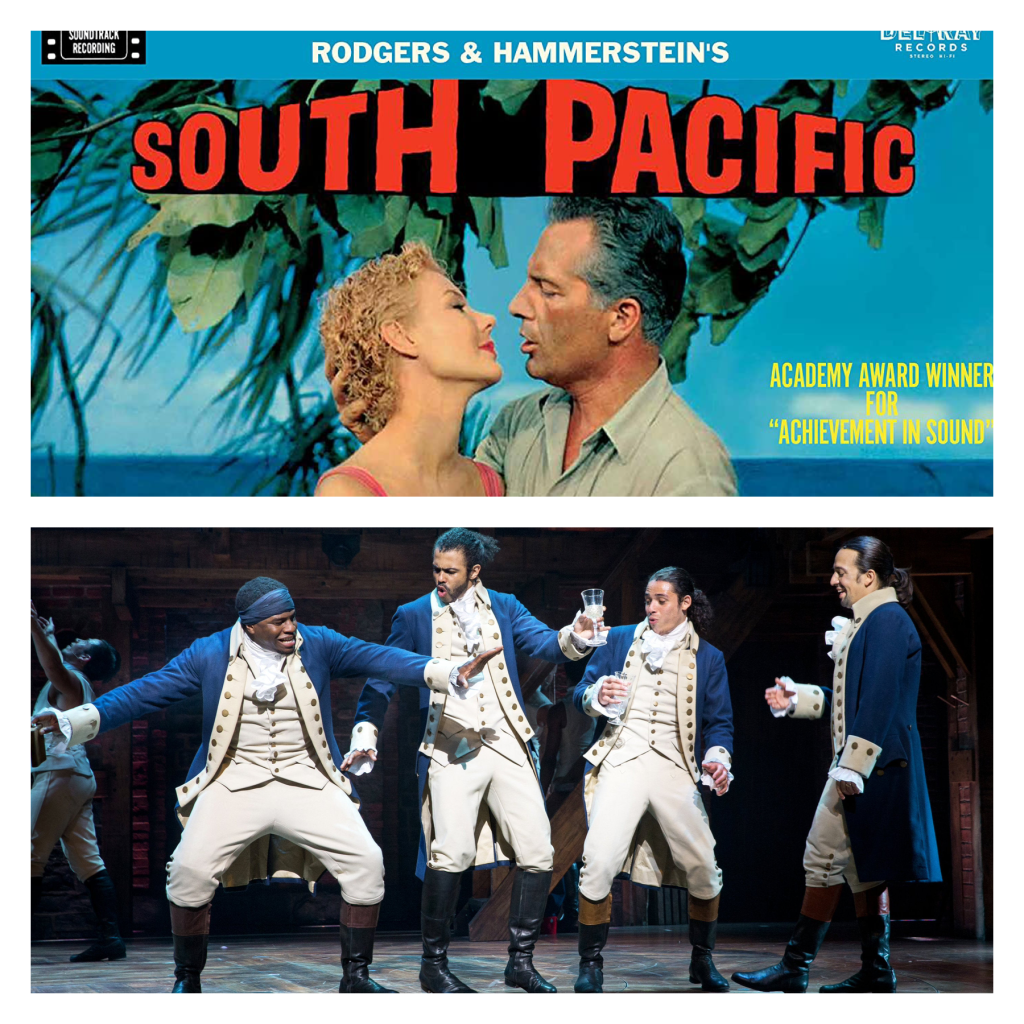
Musical theatre had a good track record of taking liberal positions. Rodgers and Hammerstein, especially, were courageous in their themes and characters. Take this plea for tolerance from “South Pacific” back in 1949:

You’ve got to be taught to hate and fear

You’ve got to be taught from year to year

It’s got to be drummed in your dear little ear

You’ve got to be carefully taught

You’ve got to be taught before it’s too late

Before you are six or seven or eight

To hate all the people your relatives hate

You’ve got to be carefully taught”

“Hamilton” stands out today partly because all too many new musicals are shallow “juke box” confections. Blame the puffery of those dancing in the aisles to Mamma Mia for that. But they do get bums on seats.

Musicals, at their best, are proper theatre with stories that matter and thought-provoking themes. R&H did it, as did Sondheim and Lerner and Loewe. And many others. “Caberet”, “Guys and Dolls”, “Les Miserables”…. So “Hamilton” is far from unique, good though it is.

In the British General Election campaign reason has lost out to emotion 

“ The liberal who is rationally committed is more reliable than the liberal who is emotionally committed.” 

Ted Sorensen, who said this, was despite the eloquence of the language in the speeches he wrote for John Kennedy, something of a pragmatist. “Fine words” he might have written for JFK, “butter no parsnips”.

Walter Mondale, an unsuccessful candidate for the Presidency in 1984 challenged a rival by borrowing (from Wendy’s hamburgers) the question “Where’s the beef ?” Again it was a call for solid facts rather than emotion.

There is an underlying truth here that is disconnected from ideology. You could, I think, substitute the word “conservative” for “liberal” in Sorensen’s remark without damaging that truth.

Which brings me to the British General Election campaign in which, so far, reason has lost out to emotion – proper plans to uncosted and ill-thought-through promises. On both sides Sunak versus Starmer has become a battle of insults and unsubstantiated allegations (raw emotion) rather than rational argument.

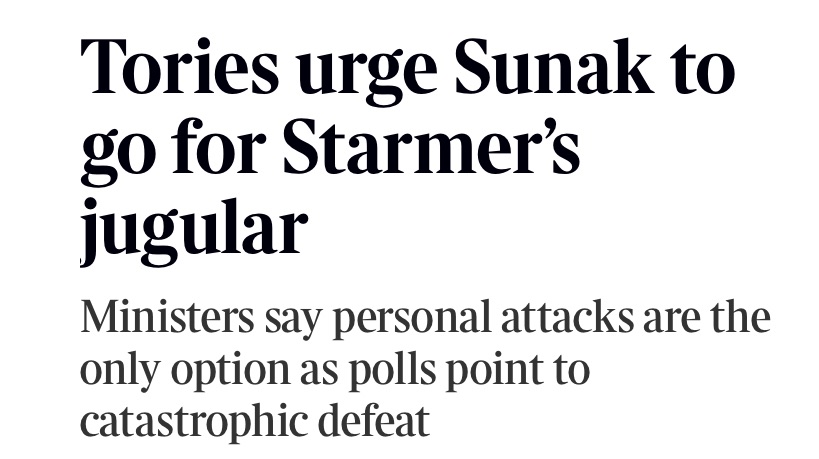
And now we are told that Tories are being encouraged to make “Personal attacks” on Keir Starmer – in other words to turn Sorensen’s maxim on its head and resort to the rawest of emotion rather than rational argument.

It’s not a golden era is it ?

“Schindler’s List” – thirty years on

It is now thirty years since Steven Spielberg’s extraordinary “Schindler’s List” was released – I watch it every few years and see something new every time. The film is not an overtly campaigning or political movie and nor was Thomas Keneally’s non fiction novel, “Schindler’s Ark” on which it was based. They both tell a fundamentally true story.

One of the challenges of artistic creation is to be subtle even in the face of history that is horrific. War films rarely achieve this. “All Quiet on the Western Front” was an exception and there have been a few others but all too often they have been blood and guts hero stories rather than giving genuine insights into the human condition. “Schindler’s List” isn’t really a “war film” at all – in essence it symbolises the depths to which citizens of “civilised” countries can plunge.

The myth is that The Holocaust was an aberration flowing from the genocidal madness of Germany’s leaders. It was that, but never forget how many thousands were complicit in implementing “Sonderbehandlung” (“special treatment”) as it was euphemistically called. In the film a group of officers discuss this in a matter of fact way as if the gas chambers were perfectly normal. It is a morality free zone at Auschwitz.

Oskar Schindler is the contrasting phenomenon to the norm of time and place. He succeeded because he left no evidence that the Nazis could use to prosecute him – he was once locked up by them but was cunning enough to get out. He established a pragmatic “friendship” with the grotesque Austrian Amon Göth who was Commandant of the Kraków-Płaszów concentration camp. The Light and Dark contrast of Schindler and Göth is a key theme of the film.

The messages of “Schindler’s List” are , I think, personal rather than being overt. For me “challenge the norms” is one. Mind you to be effective in that challenge in Kraków in the 1940s took a special type of cleverness and courage which Schindler had.

There is no hierarchy of horror in history. The family murdered in Auschwitz is the same as one slain in Gaza. The quantum makes The Holocaust exceptional but at a personal level it’s the same. Otto Frank lost his daughter Anne and his wife Edith in Bergen-Belsen. Over the past eighty years from Stalin’s Gulags to Mai Lai to Tiannamen Square to Netanyahu’s attacks in Palestine families have continued to be bereaved. Not “collateral damage” but as targets.

Where have all the graveyards gone, long time passing?
Where have all the graveyards gone, long time ago?
Where have all the graveyards gone?
Gone to flower, every one!
When will they ever learn, oh when will they ever learn?”

You cannot decouple wealth creation from wealth distribution.

A commitment to Growth is fine, but Starmer needs also to address what he plans to do with the output of a growing economy

A Labour leader embracing the benefits of Growth is all very well. But you cannot decouple wealth creation from wealth distribution. Obviously a growing economy is better than a stagnant one. But the product of growth generated mainly in the private sector can only be redistributed via corporate and personal taxation.

Growth is measured in “Gross Domestic Product “ (GDP). Key word here is “Product” , this includes tangibles (manufactured goods) and intangibles (services, especially financial services).

In a mixed economy the private sector is the primary driver of growth – they, in classic terms, use the factors of production (Land, Labour, Capital and Enterprise) to make goods and services.

But along with these goods and services the economy needs public services most of which are, or should be, provided under the control of national and local government. We have seen that “control” absent or ineffective in recent decades. Look no further than the Water sector to see overwhelming evidence of this. Water and other private sector monopolies have, scandalously, been run with shareholders and board directors as the primary beneficiaries not the public.

Healthcare is a key “public service” – the benefits of having a healthy population go beyond moral ones. The economy will grow better and be more productive is people are healthy. How often do we forget or even fail to measure these pragmatic benefits of the NHS?

Certain public services like public transportation are, and mostly should be, paid for by users. But again proper Cost/Benefit Analysis would show that some public subvention is beneficial and justified.

There is no “Magic Money Tree” in that rather hackneyed phrase. Investment in infrastructure and employment in the essential public services sector has to be paid for either by taxation or borrowings, or by instituting payment in relation to use. Road pricing can generate income from motorists but is unpopular (eg ULEZ). Charging for some healthcare is also unpopular and extending that is unlikely to be politically viable.

No potential government can truthfully rule out increased taxation if public services are to be maintained or improved. What Labour should be doing is arguing for a shift from regressive to progressive taxation. It’s not Marxist to argue that a wealthy modern state should follow the “from each according to his ability, to each according to his need” principle . That means taxing , mainly, wealth and income not consumption.

The Conservative Party has become not neo- Thatcherite (their delusion) but Powellite (the truth).

I think that political labels are losing their meaning, if they ever had one. If forced to label myself I would choose “liberal” because, shallow though it is, it probably comes closest as a single word descriptor to describing my personal politics. And yet the Tony Crosland Gaitskellite version of “socialist” isn’t far away either. “Social Democrat” and “Liberal” aren’t that far away from one another. The LibDems in their very name embrace this truth.

The modern day Conservative Party in Parliament and, especially in its membership, is more Powellite than Thatcherite – and a long way from Macmillan, Butler and Heath

The post war pre Brexit Conservative Party, the Thatcher years aside, was not extremist. Heath removed Powell. Nor were successive Labour governments and shadow governments (Michael Foot aside) extremist before the insanity of Corbyn. Britain was governed from the centre ground. “Butskellite” was more than just a handy descriptor. Both main participate had their lunatic fringes. But Harold Wilson was Bevan when campaigning and Gaitskell in office. Edward Heath talked “Neoliberal” but had to govern a mixed economy. Blair undid little that Thatcher/Major had introduced

But Brexit hasn’t gone away and One Nation Conservatives are a threatened species. My liberalism is strongly underpinned by my internationalism, the two go together. But internationalist Tories like Clarke, Patten, Heseltine and before them Heath weren’t exactly liberals! And yet they and thousands of other internationalist Conservatives were cast aside as the Party became not Thatcherite (their delusion) but Powellite (the truth). Remember the most vocal Conservative opponent of the Common Market was the nakedly nationalist and imperialist Enoch Powell.

The centre didn’t hold and we can analyse the reasons. Brexit is, of course, the primary one. Whilst Cameron must take most of the blame for launching the referendum and then mismanaging the 2016 campaign Corbyn was almost as much to blame giving lacklustre support to continued EU membership which had been central to his party’s manifesto only a year earlier.

Brexit turned the Tories hard Right, and Labour hard Left. The Conservatives are still there. Starmer is the heir to the centrist policies of the past whether they be of Blair or Macmillan. Sunak emphatically is not.

Farage, he screwed Britain once – he’s quite capable of doing it again

In. 2014 @IainDale chose Nigel Farage as his “Most influential person on the Right”, ahead of David Cameron. Ten years on this looks a perceptive choice. The EU Referendum designed to marginalise Farage had the reverse effect because he played a major part in Leave’s victory

Iain Dale’s “Most Influential person on the Right” choice in 2014

Does anyone doubt that the Conservative Party has been irreversibly changed by Farage’s external threat? It’s happened because of Brexit, his single issue proposition. His predicable anti Asylum seeker and anti Immigration stance today is part of his National Conservative stance. A stance that is virtually identical to the “Popular Conservatives” actually in the Party.

The One Nation Tories of yore have become a distant memory – in part a consequence of the Farage threat. Post Brexit the likes of Ken Clarke, Dominic Grieve, Michael Heseltine and more have sought new homes. And those Tories who stayed active (or returned in David Cameron’s case) have had to swallow the Brexit Kool-Aid. Cameron, who led the “Remain” campaign, is now a Brexiteer !

Nigel Farage is a shallow, narrow and bigoted man. I have described the time I spent with him elsewhere – suffice to say that to have suggested then that he could be a serious political influence would have been preposterous. But beware. He will be elected in Clacton. All bets are off

.

Even Lewis Carroll couldn’t have imagined someone as malignant and mad as Trump

Trump, the Mad Hatter

The Trump story is a sort of malignant Alice in Wonderland. Nothing is but what is not. Donald Trump’s all too visible deficiencies should have prevented him being elected in 2016. But it was the year of the world’s two largest English-speaking nations taking leave of their senses in elections. I reflected at the time that at least Trump would only be in office for four years – we Brits wouid be stuck with the consequences of Brexit for a decade or more. I was right. At least so I thought.

Trump’s failed Presidency and its hideous coda on January 6th 2021 should have seen the end of this repulsive man. That it didn’t is attributable to three main factors. Firstly a movement grew in America, much larger than a cult, which totally irrationally, sanctified Trump and even saw him as the representation of their simplistic religious beliefs. Second the Republican Party adopted Trump despite the fact that his history, performance and behaviour had nothing in common with the party of Lincoln, Reagan and Bush. And third commentators actually made the case for Trump – a case based on the bizarre notion that the Conservative Right had no one better.

I would add that some people who should know better made the case for Trump because they personally benefited from his presidency, or thought they did. An American senior ex colleague of mine, a rich man, supported Trump because the stock market did well during his time in the White House. Self interest before decency and logic.

There is no precedent for the Trump phenomenon, certainly in modern times. Richard Nixon was a crook but a brilliant though deeply flawed one. Many of his successors had their moments of fallibility but in the main they all earned respect from opponents and the public alike. Now after his conviction nobody, even surely his most fanatical supporters, can respect Donald Trump.

It’s too easy to blame American culture and society. True a totally rational nation would have had checks and balances that would have prevented the “Donald” from being in any way near power. But there was a gut anti-establishment appeal in Trump that led many deprived and deluded electors to vote for him. The “It can’t get any worse” syndrome.

Well it did get worse and the very fact that despite everything people are today, post the New York verdicts, promoting Trump for President puts us firmly in Mad Hatter territory. Oh my fur and whiskers!

Will inequality and the need for redistribution be addressed in the Election campaign? Don’t hold your breath

““The test of our progress is not whether we add more to the abundance of those who have much; it is whether we provide enough for those who have too little.

JFK: Volume 1: John F Kennedy: 1917-1956″ by Fredrik Logevall

The quote is that of a very young John Kennedy before he left Harvard, before he took his first steps in politics and before his war service. It has the classic Kennedy “Ask not what your country can do for you…” balanced rhetoric we were to become familiar with later.

My point about what JFK said way back in 1938 is that it frames the key political question not just in those distant days but always, especially today and especially in Britain today.

John Kennedy was not an idealistic young student protesting against the iniquities of the capitalist system. His father was one of the wealthiest men in America and though a supporter of Roosevelt’s New Deal was hardly an enthusiastic one and no sort of Socialist ! And nor were his children.

But John Kennedy was looking at America and modern Europe (which he had recently extensively toured) and seeing the extremes of wealth and privilege, on the one hand, and poverty and distress on the other.

Roosevelt had seen the extremes as well and with his “New Deal” had been in a position to do something about it. In Britain it wasn’t until after the War that Attlee’s government created the Welfare State to address the “Two Nations” reality – a hundred years after Disraeli looked at Victorian Britain and coined the term!

In 2024 Britain and America we have to an unacceptable extent returned to Two Nations and to argue for economic redistribution conflicts with the institutionalised norm of laissez-faire neoliberalism which governs us. The “Sunday Times Rich List” records in some detail the “abundance of those who have much” in these polarised times.

Food banks in Britain are a response to need and some politicians of the Right see their proliferation as an achievement. That’s how low we’ve sunk. I have used the term “redistribution” deliberately to suggest that it is not the quantum of the economy that is the main problem (though a growing economy is obviously better than a stagnant one). It’s how the wealth of the economy is distributed that we need to address.

“Trickle down” , as a national goal along with its cousin “Levelling up” implies that you can leave it to the system to benefit all. Up to a point, but as Roosevelt and Attlee showed us, intervention is essential in times of extreme distress for many.

The point about economic distress is that it is uneven:

We have in London the richest region in Northern Europe, but in Britain we also have nine of the ten poorest regions. Take London out of the British economy and we are the poorest country in Europe. This should be debated in the General Election campaign but if it is the inherent structural reasons and potential cures will be ducked.

The young John Kennedy was right – judge a system and a country on how well it provides for those who have “little” not on how it celebrates those wallowing in abundance. Gordan Gekko said in “Wall Street” “Greed in all of its forms. Greed for life, money, love, knowledge, has marked the upward surge of mankind” The “Greed is Good” mentality has far from disappeared in modern Britain and the Times “Rich List” symbolises this. As do the seven figure salaries the head honchos in Britain’s top firms pay themselves, whilst median disposable income for the poorest fifth of the population actually decreased by 3.8% to £14,500 in 2022.

Will inequality and the need for redistribution be addressed in the Election campaign? Don’t hold your breath.

Spurs season – a tough but fair assessment

Top of the League unbeaten after ten games, then losing nearly half (12 out of 28) of the remaining League fixtures. Beaten by Fulham in the League Cup and kicked out of the FA Cup early (admittedly by Manchester’s City!). And all this with no European tournament complications.

The fall in the League shows the problem. Not, in my view, a lack of quality players but failure to select and use what we had properly. The opposition rumbled Postecoglou’s inflexible tactics and knew what to do. He was implacably rigid until the final City game when, with a back three, the team played well and were a tad unlucky.

After failing with high quality managers in Mourinho and Conté Spurs chose a middle aged unknown in Postecoglou. Any half decent coach could do well in a League with only one credible opponent in it as he had in Scotland. The Premier League is different and Arne soon stumbled in his first experience in it.

Decades of failure to win a trophy continues for Tottenham but with one of the best grounds in Europe, a well run and financed Business model and a strong brand we really should be doing better. Having sold one of the game’s best forwards with no replacement of approaching the same quality it was going to be a struggle. But it’s Aston Villa with nothing like Spurs advantages who will be in the World’s best club competition next season and Spurs will be playing on Thursdays. Not good enough.

The “Useless degrees” of Rod Liddle

“…almost all of our universities are staffed by third-rate academics who inhabit monocultural bubbles devoid of rationality, and that every year hundreds of thousands of gullible kids find they have been fleeced to the tune of £40,000 for a useless degree as a consequence of the entirely mistaken belief that this might enable them to gain lucrative employment. Or, indeed, any employment.” Rod Liddle in the “Sunday Times”

It was ever thus . Take the London School of Economics (LSE) for example. Such a hotbed of radicalism that some of its graduates in the 1970s and later became outspoken Lefties and even joined the dreaded BBC! A breeding ground for revolution and Marxism that was.

LSE Alma Mater of Rod Liddle

Of course the students at the LSE weren’t pursuing the goal of learning for its own sake – broadening the mind you might call it. No they then were seeking “lucrative employment” , for example in journalism where despite being unable to produce rational copy they could persuade gullible employers to pay them to rant.

As a student of that era myself emerging blinking into the real world after four years of anti Vietnam War and Anti Apartheid protests I and my fellow long haired graduates struggled for employment. Other than most, like me for example, who then had forty year plus careers in business or medicine or the Arts (etc.).

We Baby Boomers were beneficiaries of the growth of tertiary education opportunities from the foundation of “red brick” universities. This gave the unmoneyed from humble backgrounds a chance. Scandalous!