
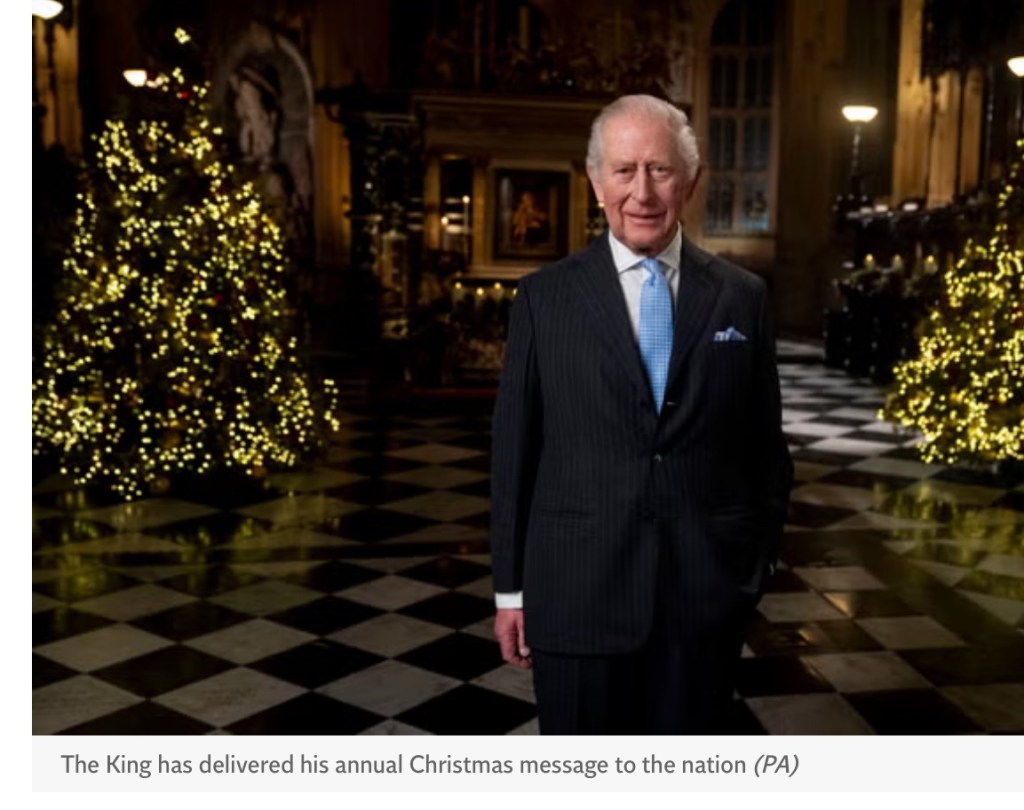
“As I meet people of different faiths, I find it enormously encouraging to hear how much we have in common; a shared longing for peace and a deep respect for all life.” HM the King
I’m not sure that Charles would see this but his statement comprehensively undermines Christianity (and other religions as well). The opposite, no doubt, of what he intended.
The point , of course, is that most religions – and certainly the Christian Faith – trade on their unique rightness and truth. As one Christian blog puts it:
“Christianity the faith founded on Jesus Christ, is the world’s largest religion, with over two billion followers. While many religions claim to be the path to spiritual enlightenment, Christianity stands apart as the one true faith. This claim is not based on mere sentiment but on the divine revelation of Scripture, the person of Jesus Christ, fulfilled prophecy, historical evidence, and the transformative power of the Gospel.”
This is unequivocal stuff and history teaches us that the singularity of Christianity is non negotiable. You’re either a Christian or a heathen (the latter include non believers, believers in other religions and heretics).
Charles has form in this area. In 2020 he said “I personally would much rather see it as defender of faith, not the faith, because it means just one particular interpretation of the faith.” In effect his view seems to be that to believe in some religious faith is better than to believe in none. So there is a conflict between the “One true faith” position which is the base case for Christians (or most of them) and “the faith” which includes them all. For Charles Christianity is “just one particular interpretation…” – a curious position for the head of the Church of England to take!
The problem is, of course, that faiths are not unitary – they do not have the same core values. The three “Abrahamic religions” Judaism, Christianity and Islam are all monotheist and share prophets. But they are emphatically not the same. Indeed, for example, the Old Testament and the New Testament have very different teachings illustrated by the former’s adherence to “An eye for an eye” and the latter’s “turn the other cheek”. Judaism is not the same as Christianity, though they do overlap.
Over the centuries wars have been fought over religious differences – the Crusades (Christians v Muslims) and Muslim v Hindu for example. And within religions the differences can be just as great – Protestant v Catholic of Sunni v Shiite for example.
Charles sees commonality in the “different faiths” – this is less profound or surprising than it may seem. To preach in favour of a religion you implicitly deny other religions. That’s what missionaries did and there is similar zeal from pulpits every Sunday. But there will also points of common thought – for example Islam and Christianity strongly share the idea that giving to charity has deep moral and spiritual merit, though they express and structure it in somewhat different ways.
Charles seems to want it both ways. To preach the virtues of Christian Faith whilst also accepting the merits of other religions – he is close to saying that all religions are equal , that there is some deep (and good) commonality that they share. I suspect that for many in the Church of which he is head this goes way too far.
 Paddy’s Blogs in a crazy world