
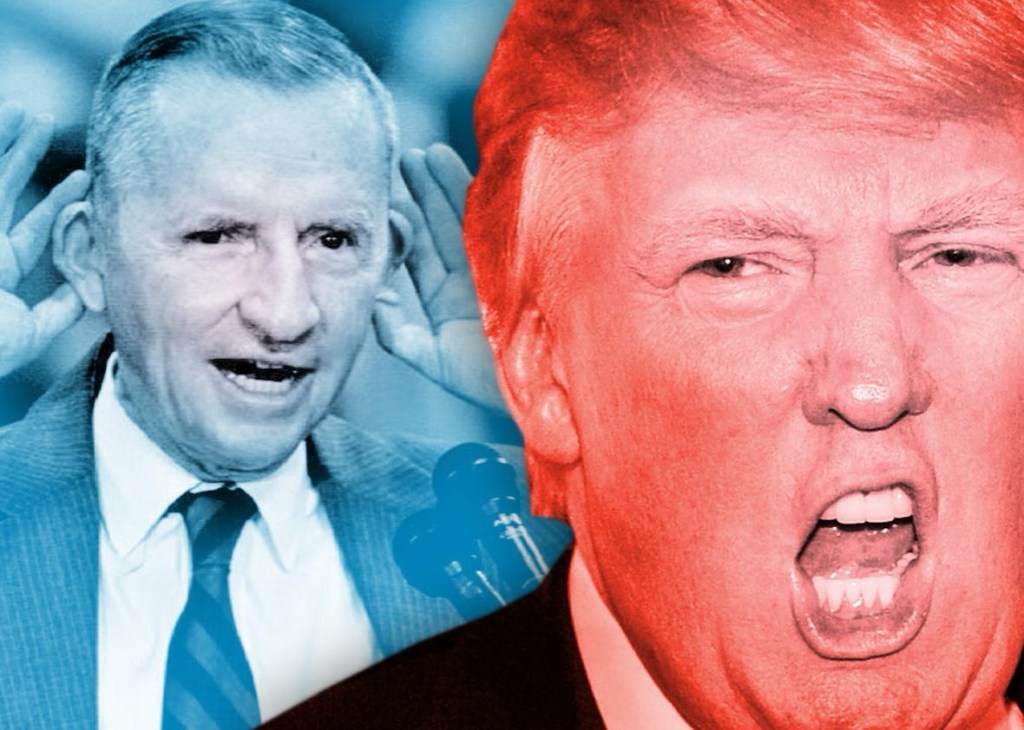
In Britain we’ve had the Labour Party taken over by Jeremy Corbyn and the Conservatives by Liz Truss – neither could be described as being of their party’s One Nation/centrist traditions (or fit for high office). We have flirted with the extremes. And we still are. Reform is very much in the Trump disruptive mould and “Leave” in the 2016 Referendum campaign appealed to the gut not the brain, and won. “Reform” , incidentally, takes its name from the third Party in the US formed by Ross Perot and which got nearly 20% of the vote in the 1992 US Election. His influence lingers on.
Francis Fukuyama around the same time as the 1992 US Election argued in “The End of History and the Last Man” that the progression of human history as a struggle between ideologies was largely at an end, with the world settling on liberal democracy. With Clinton in the White House and Blair in the wings to move into Number 10 this seemed, Perot aside, a good call. They called it the “Third Way” to emphasise the difference with the binary ideological past.
The search for an explanation as to why the Third Way, and to an extent liberal democracy itself, has collapsed is fraught because it seems to defy common sense and conventional political logic. The causes are complex but if we look for one defining event I suggest that it was 9/11.
America, Pearl Harbor aside, had before 9/11 never been attacked. We Europeans knew what it was like – they didn’t. The subsequent lost wars in Iraq and Afghanistan were based on the presumption that overwhelming military power will always prevail. The lessons of Korea and Vietnam were ignored. Losers can be dangerous, they often, as now, segue to the extremes. (See also Germany in the 1920s and 1930s).
Trump is, like Perot, a protest against liberal democracy. As is Farage’s Reform. Whilst the Right generally likes military adventures in the name of “Freedom” it doesn’t like losing them. The reasons for America’s longstanding support for Israel are politically complex but resolute. In a macro political climate that is confrontational and binary the US will, rightly or wrongly, keep supporting and arming Netanyahu.
Opponents of Trump might object to the idea that his election in 2016 was a consequence of military failure but the “MAGA” slogan has an unmistakable militaristic ring about it. His election in 2024 was qualitatively different – here the underlying “failure” , as presented, was domestic. Ross Perot had reduced arcane and highly complex technical arguments about quotas, tariffs, and regulation down to simple “truths”. Like Trump, Perot harkened back to a golden age of U.S. industrial manufacturing. He was an unashamed economic nationalist, as is Trump.
Macroeconomic management in an economy as large as that of the US requires a subtle hand on the tiller. Trump’s inconsistent vacillations on tariffs just cause confusion and, unlike Perot, there is no intellectual underpinning for them whatsoever. However a political manifesto which includes knee-jerk positioning on populist issues like immigration will, and did, have mass appeal. Combine that with tax and other benefits (like patronage for government contracts) for the rich elite of Mar-a-Lago (and similar) and you’ll get enough Electoral College votes – as Trump did.
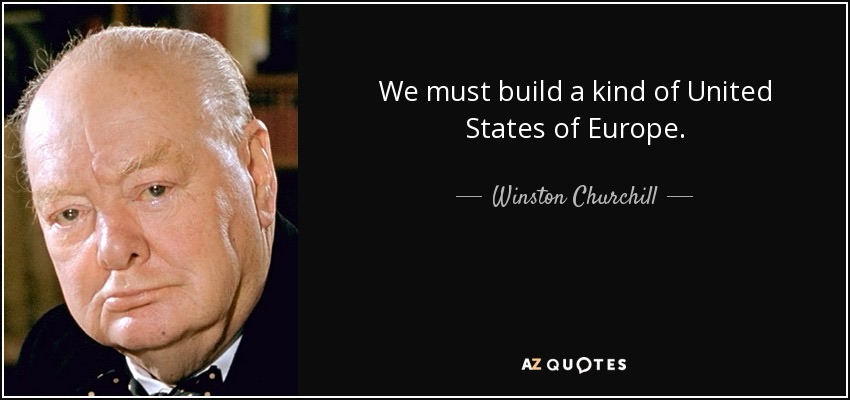
Whether there is a prospect of Fukuyama’s liberal democracy returning may depend mainly on Europe. There are challenges from the Right in many member countries of the European Union but the Union itself is holding firm. Churchill saw a “United States of Europe” as being a guarantor of avoiding descending into the deadly conflicts that had so scarred the first half of the Twentieth Century. That unity may be facing its biggest test.
For some Right Wing European politicians Donald Trump in the White House was a godsend giving some legitimacy to their nationalist and populist positioning. But in the main Europe remains democratic and liberal and the institution of the EU is designed to keep it that way. Trump may well have left the G7 early because he felt outnumbered by those who think transnational cooperation (anathema to Trump) and liberal democracy (likewise) is worth preserving. But it’s fragile and nothing is certain.
 Paddy’s Blogs in a crazy world