
My wife and I recently visited Northern Cyprus for a week’s holiday. This blog summarises what we saw and our conclusions.
Background
Northern Cyprus or to give it its preferred name The Turkish Republic of Northern Cyprus is a long standing oddity among nation states. Mainly because the rest of the world, Turkey aside, doesn’t recognise it as a state at all. Technically Cyprus is not divided and the whole island is part of the Republic of Cyprus a legitimate national entity, member of the United Nations and of the European Union. In reality, however, the island is divided between the Turkish north and the much larger Greek south.
Cyprus was a united entity effectively as a British Colony for eighty years but rumbling below the surface in those times were two intractable problems. Many Greek Cypriots wanted “Enosis” – to be united with what they saw as their mother country Greece. Understandably this was not something the Turkish Cypriots wanted one little bit! And that was the other problem. Whilst Greeks and Turks lived together mostly amicably they were different culturally, linguistically and in religion. Whilst the Turks certainly didn’t want to be governed from Athens they weren’t that keen on post colonial independence dominated by Greek Cypriots either.
It was the “Enosis” threat that materialised first in the early 1950s. The British did not handle the armed uprising by EOKA well and the heavy-handed response to what was seen, not unreasonably, as terrorism was counter productive. It was a messy process of withdrawal from Empire. Not the only one of course.
Post colonial Cyprus
A post colonial Cypriot Republic was declared in 1960. This was unstable. Enosis hadn’t disappeared and the Turks concern about Greek domination was justified . The coup in 1967 which brought the “Colonels” to power in Athens escalated the Greek demands for Enosis both in Athens and on the island.
On 15 July 1974, the Greek military junta carried out a coup d’état in Cyprus, to unite the island with Greece. This coup ousted president Makarios III. In response to the coup, five days later, on 20 July 1974, the Turkish army invaded the island. However the rationale for this invasion was rejected by the United Nations and the international community, and that rejection remains in force today.
The Republic of Cyprus has de jure sovereignty over the entire island. However, the Republic of Cyprus is de facto partitioned into two main parts: the area under the effective control of the Republic, in the south and west and comprising about 59% of the island’s area, and the north, administered by the self-declared Turkish Republic of Northern Cyprus, covering about 36% of the island’s area. The international community considers the northern part of the island to be territory of the Republic of Cyprus occupied by Turkish forces. The occupation is viewed as illegal under international law – that is it amounts to illegal occupation of EU territory since Cyprus became a member of the European Union in 2004.
Northern Cyprus today
Despite its pariah status as an illegal entity Northern Cyprus has a viable and peaceful existence as a sort of disconnected province of Turkey. At the end of our recent holiday President Erdogan of Turkey visited the island and reaffirmed Turkey’s commitment to northern Cyprus. He declared Turkey and Turkish Cypriots the “rightful owners” of the region and vowed their presence would persist “for centuries.”
Nicosia is now one of the few divided capital cities in the world. Comparisons can be made, of course, with the once divided Berlin and the division of Germany which endured for over forty years after World War II. My impression, albeit after a very brief visit, is that Cyprus is different. Although Germany was divided ultimately the German people, despite political division, remained culturally one nation. Post 1989 when the Berlin Wall fell, reunification progressed remarkably smoothly.
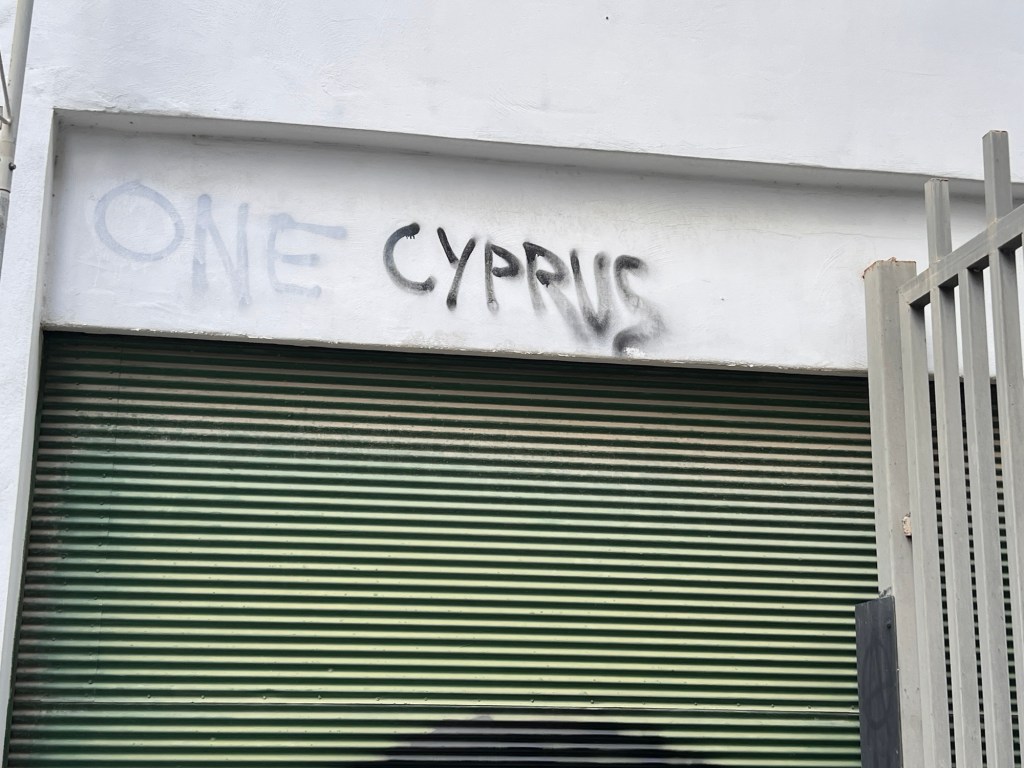
The divide in Cyprus is different. There is not a homogeneous Cypriot culture – Greek Cypriots and Turkish Cypriots are different. The languages and the religions of the Turks and the Greeks are not the same! This does not mean they can’t get on of course. Lawrence Durrell in his masterly “Bitter Lemons” described how in Kyrenia and his village of Belapais there was an amused and peaceful accommodation between Greek and Turk. But my impression is that that spirit of tolerance has largely disappeared. That does not anticipate conflict, just that the logic for a united Cyprus is idealistic, but impractical.
The movement of Turkish Cypriots north and Greek Cypriots south after 1974 reaffirmed the division of the island. And reaffirmed that the island is practically and culturally divided. The forces for separation are much stronger than the forces for unification. A united federal Cyprus looks like a pipe dream.
The North struggles to an extent because it is not recognised internationally. This harms its economy and the freedom of its people. But tourism and, remarkably, the presence of many tertiary education establishments (which attract students from around the world) do make the “region” viable – it’s certainly a fascinating and historic place to visit.

The logical solution is to negotiate a settlement that recognises the sovereignty of Northern Cyprus, not as a province of Turkey but with close links to it. On the island there would be freedom of movement across the territory and, no doubt, many shared entities like airports and infrastructure. But neither community would rule the other. That would require both structure and goodwill. Possible ? I really don’t know!
 Paddy’s Blogs in a crazy world