
To “Make America Great Again” , a four word slogan clearly based on formulaic Advertising catch lines, includes within it some fundamental assumptions which are presumably taken for granted by Trump supporters who wear the caps, but are surprisingly unchallenged by his opponents.
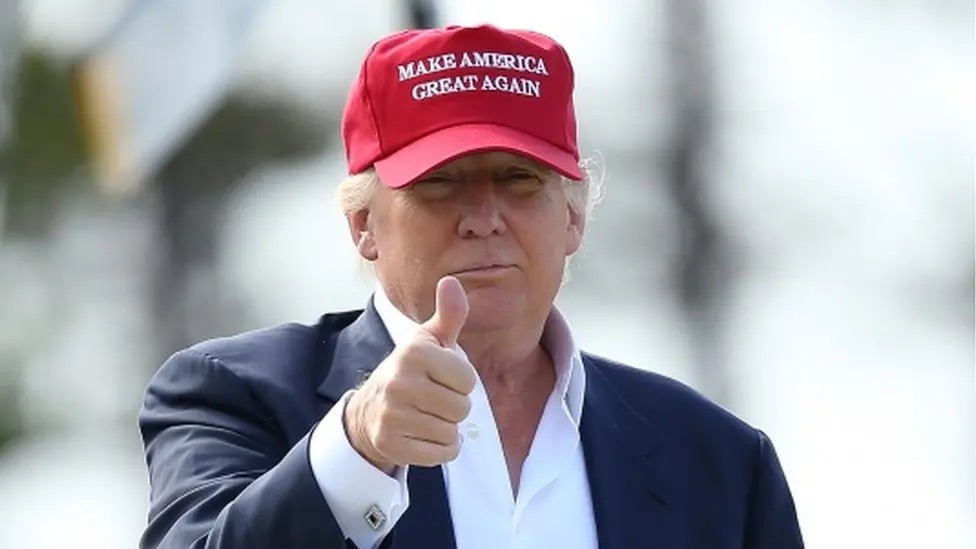
The first is the action verb “Make”. It’s a transitive verb which Webster defines as “to bring into being by forming, shaping, or altering material. It is aspirational but it’s unclear whether it’s instructional or a promise. If the former Trump is telling Americans what to do. If it’s a promise Trump is saying he can be relied upon to help them do it. It’s probably a bit of both. Almost, but not quite, a call to work together for change.
The reason it’s ambivalent is the central dilemma of Trump’s personality. He’s no team player! In this he resembles at the extreme Vladimir Putin and the totalitarian European dictators of the Twentieth century. But also determined and often single-minded democrats like Margaret Thatcher. And, of course , the democrats in name only of today like Benjamin Netanyahu or Viktor Orban.
This confusion of responsibility lies at the heart of Trump’s persona. If he wants Americans to “make” change – to “bring it into being” – he has to say more than that it’s a good idea. He has to explain what change means and how it can be done. This he singularly fails to do. And this is in no small way because he cannot define what “Great” actually means.
“Great” is a shorthand of perfectionist status, but if it’s to be more than a subjective gut feel it needs quantification. Here the view from outside is crucial. We are truly what we are perceived to be by others. So America cannot by this criterion be “Great” just because (say) the majority of Americans think it is. Foreigners need to think so as well!
And “greatness” itself is problematic. There are many areas in which a nation can be “great”, and they are sometimes contradictory. By any measure China is economically great. But in another judgment area, human rights, they certainly are not.
For America it’s like a seesaw. Tariffs, for example, may help push up the balance of trade but simultaneously also increase inflation – let alone damage international relations and America’s standing in the world. Collateral damage if you like.

Then there is the fourth word “Again “. This is unequivocal – America was once “Great”, no longer is and we must return to the time of greatness. But when was America great ? What are the judgment criteria? Again Trump offers no explanation. He may be nostalgically looking back to the 1950s when superficially the country was getting richer and consolidating its preeminence in the world. There is a clear racial and wealth undertone here. The American dream was to benefit from the consumer explosion . “The Affluent Society” as JK Galbraith called it in 1958. But that was a “WASP” (White Anglo Saxon Protestant) cohort which excluded those who couldn’t tick all those demographic boxes.
But 2025 is not 1958, and there is no going back. America is far more diverse. The middle class is strong and comfortable and in some cases aspires to move up to very wealthy indeed segment. But in the boondocks it’s different. The United States is one of the richest countries in the world, and yet 37.9 million (11.5%) of its residents live in poverty. And racial divisions very much remain. Overt discrimination has mostly gone – Rosa Parks made her bus protest in 1955, and Martin Luther King led his march on Washington in 1963. But more recent events which led to the “Black Lives Matter” movement show that a divide remains. And Healthcare, despite improvements under Obama, is the ultimate divider. To get acceptable healthcare you need insurance and that costs roughly $12,000 per year on average. Half of US workers earn less than $50,000 so in the order of 25% or more of their income goes in healthcare. If they insure at all.
Trump’s White House is overwhelmingly white, male and rich. To them there can be little understanding of the needs of the average American and none at all of the substantial underclass. American society is very stratified. In the MAGA cult there is no understanding of poverty – in the circles they move in and the places they live in they don’t see it.
The European Welfare State model is scorned by Trump’s advisors – Stephen Moore his economic advisor has said “I’ve always said that Britain has to decide — do you want to go towards the European socialist model or do you want to go towards the US free market?” That Europe is “Socialist” will come as a surprise to most Europeans! That we all live in countries where nobody goes bankrupt if they need a cancer operation and that we generally look after those in need is a source of pride, but we are essentially neoliberal mixed economies not socialist ones.
Moore’s comment is revealing in that it is ignorant as well as elitist. But that applies to Trump and the rest of his team as well. The Tariff debacle could have been avoided if proper consultations had taken place. The great American colleges like Yale or Harvard are well stuffed with clever economists in the Berkeley tradition of Galbraith. I’m sure they modelled what Trump was doing and saw the disaster ahead.
MAGA is about the need for change and that should unite its critics and supporters alike. Bernie Sanders, the nearest American politics gets to genuine Socialism, has said “In 1863, at Gettysburg, Abraham Lincoln dreamed of a government ‘of the people, by the people, for the people.’ In 2024, in Mar-a-Lago, Trump is planning a government of the billionaire class, by the billionaire class and for the billionaire class,”
So yes America needs change but Musk and his other billionaire friends can surely look after themselves. The nearly 40 million Americans living in poverty and the 25 million without any health insurance are rather more deserving of politicians’ attention. Address that and you really could “Make America Great”.
 Paddy’s Blogs in a crazy world