
Above the proscenium at Frank Matcham’s “Richmond Theatre” is a large key panel bearing an inscription by Alexander Pope: “To wake the soul by tender stroke of art”. And whilst your soul may be awoken at a performance there that is rather in the hands of the Ambassador Theatre Group (ATG) who use it as a venue for touring productions – Richmond is a receiving theatre these days rather than a producing one (the annual pantomime aside). But despair ye not! Just down the road is the wonderful Orange Tree Theatre (OTT) – a world class and original producing theatre under the direction of Tom Littler who despite his youthful looks is one of the brightest talents in British Theatre.
The OTT attracts exceptional acting talent despite its small scale. The most recent was “Churchill in Moscow” with Roger Allam, no less, as WSC. I went to the final performance enhanced by the presence in the audience of Sir Ian McKellen who recently played a two hander with his friend Allam – the engaging “Frank and Percy”.

Allam did not try and impersonate Churchill but brought his strong bias for authenticity to the role. He is a most versatile actor incapable of being typecast because of this versatility. A lesser actor might have tried a “We shall fight them on the beaches” voice – Allam was very much more subtle than that !
The play covers Churchill’s brief visit to Moscow in August 1942, a pivotal moment in the war. The Soviets were under enormous pressure from Operation Barbarossa which was pressing towards Moscow. German armies were surrounding Stalingrad. Britain and the Soviet Union were effectively alone in countering Hitler in Europe as America concentrated on Japan after Pearl Harbour. But the Americans were genuine allies with convoys helping the Russians, albeit at times at huge cost. O tempora, o mores !
Stalin was a dictator and a tyrant, but “my enemy’s enemy” had come into play. Churchill knew this of course and his visit was intended to underpin the alliance by establishing a measure of personal rapport with Stalin.
Howard Brenton’s play clearly used Simon Sebag Montefiore’s comprehensive biography of Stalin as source material. The drama follows the story Montefiore tells remarkably closely. The clash between the Georgian peasant and the English aristocrat is excellent material for drama! The only significant adjustment Brenton makes is to make the interpreters female rather than male but pretty much everything else, poetic license aside, is as it happened.
The two men could hardly have been more different but neither had much doubt about his own strength – but over the course of the play they come to appreciate the other man’s strengths as well. But it was touch and go at times. As his biographer puts it “the conviviality was ice thin”. Churchill was inclined to go home early more than once because he felt Britain was being insulted by Stalin
A crucial breakthrough came when Stalin introduced Churchill to his pretty sixteen-year-old daughter Svetlana. In the play the young actress Tamara Greatrex, a graduate of the National Youth Theatre, plays this character very well in her first professional engagement. Stalin is given something of a kindly persona “My father was in one of those aimiable and hospitable moods when he could charm anyone” she wrote later !
In the play whilst Stalin’s ego is ever present Roger Allam conveys Churchill keeping his own in check. This is very subtle acting indeed. Peter Forbes’ Stalin is rightly less restrained but nevertheless pragmatic. At the end there seems little a genuine warmth between the two men. Helped, no doubt, by copious toasts and a steely mutual capability for holding their liquor!
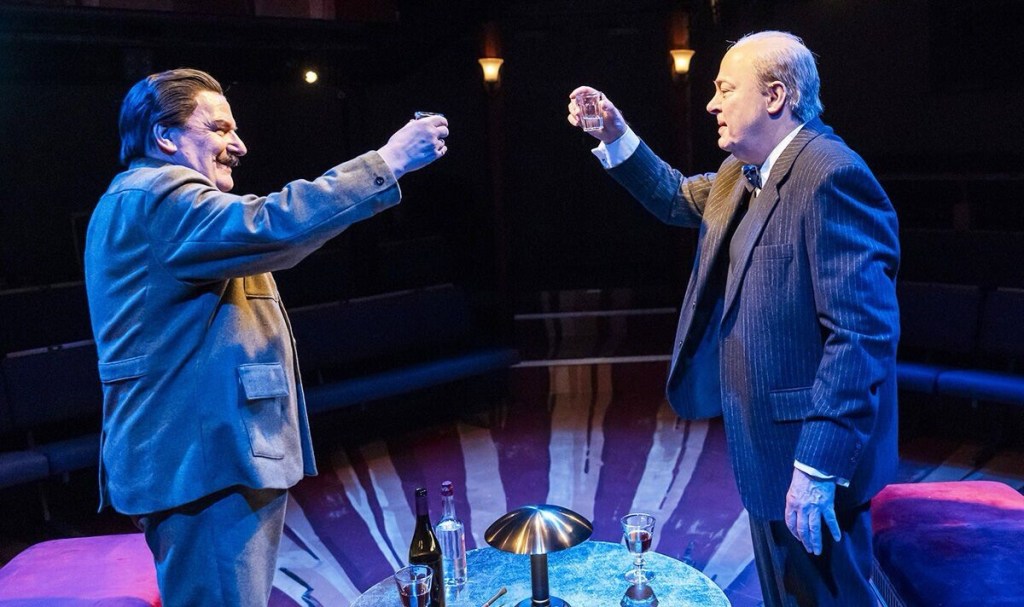
When in 1946 Churchill described the “Iron Curtain” descending under Stalin’s control we can see that there was never any ideological meeting point between the two men. But in 1942 pragmatism won the day.
 Paddy’s Blogs in a crazy world