

The Menier Theatre in Southwark has a good record in producing high quality musicals despite its small stage and limited facilities. “Funny Girl”, “Into the Woods”, “Fiddler on the Roof” , “The Boy Friend” among others in recent times. This year we’ve had original works in “The Third Man” and now “Close-Up The Twiggy Musical”. I enjoyed the former but doubt that it will transfer to a West End theatre as many of the Menier’s productions have in the past. The same may apply to “Twiggy” unless some drastic surgery is carried out on it.
Musicals, at least since “Oklahoma!”, have had a storyline as important as the songs (except for the mostly gruesome “Jukebox” musicals which are really a genre of their own. The ghastly “Mamma Mia” has a lot to answer for.) “Twiggy” borders onto this genre but is actually much better than that.
Twiggy’s life, in the musical, is a good story spanning as it does 60 years of “Working Class girl from Neasden makes good”. And some of the stories within that life are pretty remarkable from under age sex, via exploitation and an iconic* look to genuine stardom on Broadway. Didn’t she do well ?
She did. She was one of the key figures of the swinging sixties, photographed by David Bailey who as ever captured his subjects unique appeal:
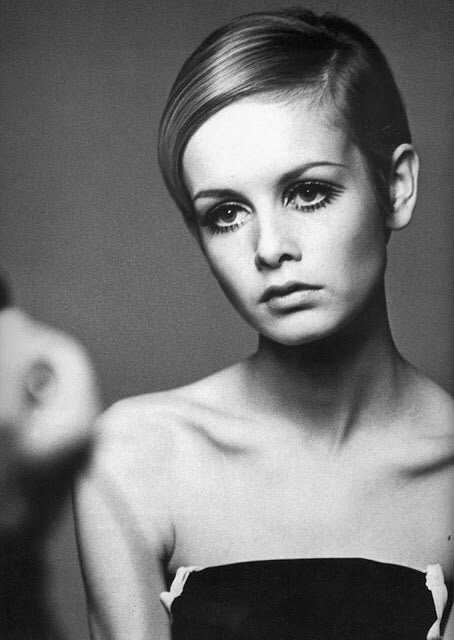
Her modelling career was masterminded by the creepy Justin de Villeneuve a clever phoney who, as alleged in the musical, not only took Leslie Hornby’s virginity at 15 but helped himself to more than a fair share of her huge modelling earnings. In the musical he is brilliantly played by Matt Corner – a terrific performance.
But oddly Twiggy’s modelling years are rather rushed by. We needed to see more of her work in the years which launched her as an icon*. We see Twiggy’s move into fashion promotion and sales, she has a shrewd eye for quality of materials and manufacturer. We soon realise she’s no dumb blonde.
Crucial to those early years were her parents – the confident Lancastrian Norman Hornsby and her batty Londoner mother Nell. They are proud of their daughter’s success and do not exploit her – they leave that to others. Steven Sirlin and Hannah-Jane Fox are excellent in these. parts. (The former also impersonates David Frost well in an interview in which Twiggy charmingly gets the better of the inquisitor in chief !).
Soon “Twigs” is moving away from Swinging London to Hollywood where she stars in “The Boy Friend” (1971) and eventually to Broadway with the highly successful “My One and Only” (1983). The progress is seemingly effortless and driven by more that Twiggy’s unique beauty. Despite no theatrical or musical training she can act and sing at the highest level.
Twiggy’s personal life once she was out of the clutches of de Villeneuve was to revolve around her marriage to actor Michael Witney in 1977 – it was blighted by his alcoholism. He is well played by the evergreen Darren Day. This is a storyline that could do with some cutting in the musical. It was important in Twiggy’s life but is rather too centre stage for too long. It skews the dramatic balance.
The music is contemporary to the action but here Ben Elton (writer and director) was restricted by what the copyright holders would let him have. Rather than commission an original set of songs he selects from the. catalogue. I think this works but it risks the “jukebox” charge.
I saw understudy Harriet Bunton in the leading role. Physically she’s no Twiggy (who is?) but it was a very good performance. The cast as a whole is excellent – mostly song and dance.
If “Twiggy” is to be more than a Menier one-off it needs revision, some of it fairly drastic. I think the potential is there but a reviser would need to start by identifying what the real story of the subject is. We need fewer moments of “How did she do that ?” (become a film star for example ) and more “This is how she did it”.
*The words “Iconic” and “Icon” are grossly overused, often meaninglessly. Here I think they are appropriate. If anyone was an icon Twiggy was !
 Paddy’s Blogs in a crazy world
Excellent review Paddy, thank you. You missed your true vocation.
LikeLike