Gas is an international commodity, but we can control the price of our own production

That the voters have little or no idea how our energy sector works is hardly surprising when journalists and politicians don’t understand it either.

Gas is a commodity which internationally is priced in an almost perfect market. That price is at the intersection of the supply and demand curves. If, as at present, supply is constrained whilst demand is constant then the price goes up. Our Gas supply sector (retail) takes its product at international prices. It has no alternative.

The pricing realities for Gas in Britain would be the same whoever owns the retail sector. After the botched privatisation of thirty years ago we have a multitude of private sector gas retailers who compete on the margin by offering largely synthetic pricing deals to customers. None of these “suppliers” has a significant strategic or acquisition cost advantage over the others. The competition is largely artificial .

Taking private sector retailers into public ownership and creating a single publicly owned supply entity would eliminate the phoney retail competition but it would have no effect on international prices at all. Economies of scale could reduce local costs and eliminating marketing costs would also be beneficial. But these benefits, though measurable, pale into insignificance compared with the effect of changes to international (wholesale) prices.

Post War price of crude oil

Back in the 1970s the world had to adjust to a huge increase in oil prices taking the price of refined products to unprecedented levels. Similar forces are at work now with Natural Gas. It’s supply driven. In the 1980s prices fell back as supply increased and again this is paralleled today. If supply from Russia returns then oil and gas prices should fall again.

Let me return to the specific situation we have with gas in the U.K. Fifty percent of our consumption is from indigenous resources, mostly from production from British waters offshore. The producers (see above) include multinationals like Total, BP and Shell and some independents like Harbour Energy – the largest producer of all. The suggestion in some quarters that these companies could be nationalised is laughable and can be ignored. But other actions are feasible.
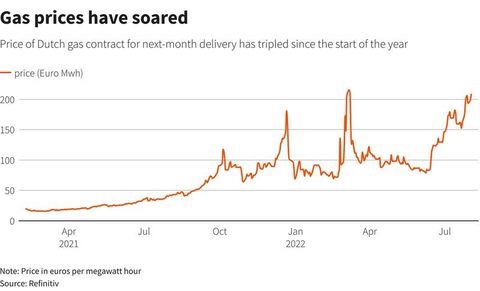
These producers price their output at the market price I referred to above. Hence when the sell it to the retailers that’s the price the latter have to pay. The graph showing the price of Gas from the Netherlands above is illustrative. The recent rise mainly caused by shortages of Russian gas since April is clear. However although traditionally domestic output in the U.K. has been priced at international prices in fact it doesn’t have to be. It’s our gas !

There is nothing to stop the U.K. Government paying U.K. producers a lower price for their gas. For example a price similar to that in Summer 2021 before the massive world price escalation (see graph). Remember producers were perfectly content with their receipts in 2021 and have done nothing to justify the serendipitous windfall profits they have made over the last year.

Obviously there is nothing we can do about the price of gas for the 50% we import. But for our home produced 50% there certainly is. Set that at a much lower level and reduce retail prices in line. The producers would complain of course, it would in effect be a windfall profits tax. But it would be a positive move in times of high inflation and stress.

Who we are is more than what we know

Education is surely about more than stuffing our heads with knowledge. Yes we do need to know things but it’s what we do with what we know that really counts. The best schools and universities, and homes for that matter, are in the game of teaching the application of knowledge as much as they have a responsibility to impart that knowledge.

Wisdom is applied knowledge. To make wise decisions you have to understand (“know about”) the subject. Or know where to find someone who does. An “expert”. Politicians may have in depth knowledge but generally that’s not why we vote for them. We want them to use their intelligence to brief themselves and then do the right thing. We are mostly disappointed.

The best teaching is broader than the inculcation of facts.

When knowledge plays prejudice all too often the latter wins. There is an iteration here. Politicians are highly selective in their use of facts ( a key element of “knowledge”). Or they make things up.

I spent much of my career in a fiercely knowledge based business – highly technical and scientific. My own skills, such as they were, were more qualitative. Lateral thinking and judgmental rather than quantitative. This dichotomy links to the Left/Right hand side of the brain factor.

It’s not better to be narrowly creative or solely evaluative. We are all a mix. Real Wisdom comes when we get the balance right. Ground breaking scientists are those who have the capability to think outside the box of their knowledge.

Who we are as individuals is a complex mix of personality and intelligence and knowledge. To be the “Smartest guys in the room” (the phrase used to describe the crooks at the top of Enron) wasn’t much help without integrity and principles.

An education system has to focus in part on imparting knowledge but as I say it’s more than that. Reading about schooling as recently as the nineteenth century is scary ! This is because religion was the driver of education. In those days morality was Christian morality. So a “fact” (e.g. that the Earth was created in six days) was taught even though it may clearly be nonsense. Anything that challenged the Christian belief set was disallowed and rejected.

We enter a classroom with a portfolio of “facts”, opinions, prejudices and reason in our heads. The teachers role is to deepen and widen the fact portfolio, but also to add process (how you think) and structure. And to equip you to be sceptical and be prepared to challenge. That, for me, is why schools and universities must be secular. Thinking has to be free of superimposed and arbitrary rule books.

My gut feel is that it is not the “economics”driving Shell’s Cambo decision but concern about the public reaction

The economics aren’t good enough”, says Shell to explain its decision to withdraw from Cambo, the oil exploration off Shetland. I’m not so sure.

The principal driver of any upstream investment decision is the assumption about the oil price. And there is no more volatile and difficult to forecast factor than that. Obviously if the development costs of Cambo are exceptionally high then it requires a high oil price assumption to justify the capital expenditure. But are they?

My gut feel (no inside track !) is that it is not the “economics” at all but concern about the public reaction that is at the heart of this. Shell has become a very diffident corporation in recent times failing to robustly defend its business. Oil/Gas corporations like Shell do not (these days) create demand for hydrocarbons they supply it. This is not sophistry but reality. The criticism directed at the likes of Shell is mostly misplaced and ignorant.

The world needs oil and gas and until it stops doing so someone has to supply it. The need to reduce dependence on hydrocarbons is self evident but the main mechanism for this has to be government and consumer decisions.

If, over time, we continue to switch into renewables for power generation and to means other than oil fuels for our transportation on land, sea and air Shell, BP and the rest will lose customers. So be it, a good thing most of us would say. But for the foreseeable future we will continue to be hydrocarbon dependent. Shell should confidently state the reality of energy supply/demand and the part they play in it.

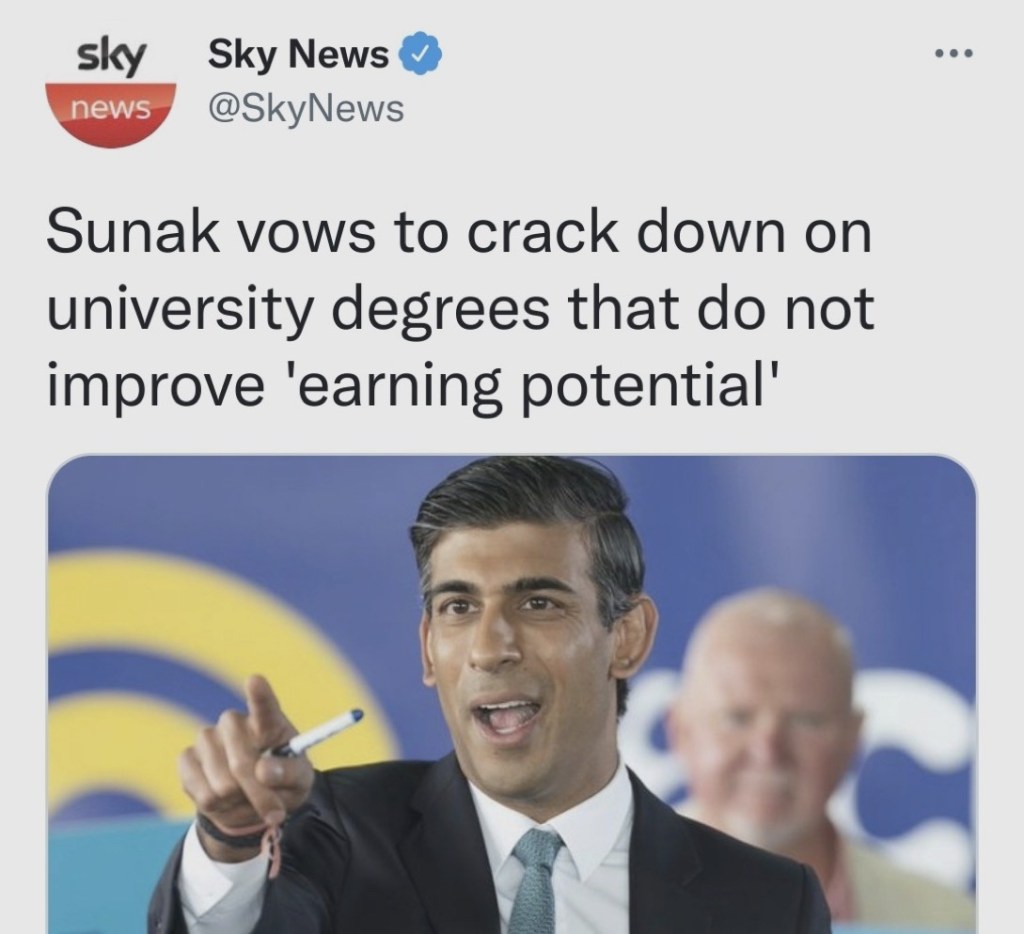
What know they of life who only “earning potential” know ?

This is profoundly chilling. As it happens I did a degree which was vocational with subjects that helped me throughout my Business career. But that is far from the only way. University is about so much more than providing you with a toolkit for employment.

But it’s the “earning potential” which sent a chill down my spine. Maybe in Sunak’s world, heavily influenced by his time in the United States, success in life is measured by “what you make” – in American parlance. But don’t we need people who are motivated by more than their paycheck?

Perhaps it will come as a surprise to Sunak but millions of people in Britain choose a vocation rather than a job where they can maximise their wages or salaries. Teachers, nurses and a raft of other people across the public and private sector choose to work in a job to make a difference not to feather their nest.

Universities offer courses to equip people with a vocational bent to prepare themselves for careers where “earning potential” is way down the list of priorities. I have young relatives in teaching, nursing, midwifery and other professions who studied these subjects at university. They are probably all bright enough to have had a well-remunerated career, like Sunak, in Financial Services. But they preferred to work somewhere where they could make a difference.

When I extolled a career in the public sector because of its favourable pension arrangements a friend said to me that he disagreed because “someone has to create the wealth”. This is a common fallacy and one that Rishi Sunak seems to share. We live in a mixed economy where there is a mutual dependency between the Public and the Private sectors. Whatever job we are in we are part of the national wealth creation process.

Many years ago when I lived in The Netherlands the son of a Dutch friend of mine was studying the Poplar tree at University. He had done so as an undergraduate and was now going even deeper on a post graduate course. I don’t think that the “earning potential” for poplar tree experts was very high but this young man was very satisfied by this rather esoteric area of study. Mr Sunak would want to turn him into a banker. Which would’ve have been a shame don’t you think ?

Only the reassertion and repair of the “centre” can repair broken Britain

Not everything in binary Britain is broken, but much is. The centre has not held. Privately provided public services are at a nadir of performance and an apogee of price. So are those, like the NHS, that are nominally in the public sector. The solution is not, necessarily, more public ownership nor more privatisation but more competence and efficiency.

On public services Keir Starmer has a huge opportunity to present credible alternatives. But they will come from the centre, not the extremes. Many in his Party are screaming an outdated “Nationalise it” mantra at a time when the Conservative Party’s leadership candidates are calling for a renewal of Thatcherism. They are both wrong.

Britain still produces 50% of its Natural Gas from British resources, mainly offshore. There is no reason why Government should not legislate that the (private) producers are paid the price they received before the escalation in world Gas prices. It’s our gas, we should be able to insist that it’s priced at a level that we can afford. The cost of half of our Gas supply would fall by more than half if we did this.

My proposal on Gas pricing is, I accept, a form of windfall tax. But why not ? The producers would receive a price they were once perfectly content with. Only the situation in Russia/Ukraine drove down supply and drove up prices – the producers did nothing to justify the windfall profits they are making. This proposal is not driven by Socialism or Conservatism but by a call for equity and common sense.

The NHS is a massive public/private partnership relying both on public sector employees and, some, private sector suppliers. The judgment as to who does what in the Service should be patient and cost driven, not ideological. Procurement of goods and services should not be dictated by old-fashioned ideologies of Left or Right. There is a “third way”.

I’m told by those closer to healthcare than me that there are many inefficiencies in our healthcare systems. I can believe it. This is not necessarily a consequence of ideology (though it may be) but of failed management. The case for “contracting out” should be properly made and tested but it should neither be promoted nor rejected for purely ideological reasons.

Throughout our society we have not just public service inefficiencies but downright scandals. Water supply is a private sector monopoly, the worst social model of all. Monopolies like this make money with few if any checks and balances. It’s a licence to print money at our expense.

Sarah Bentley, CEO of Thames Water is paid a basic £750,000 a year and received a £3.1m “golden hello” over three years to compensate for loss of bonuses at her previous employer Severn Trent. It was reported in the Financial Times that a further £120,000 in pensions and perks could raise her potential package to £3.27m a year. Remember this company is a private sector monopoly with no competition!

The “Third Way” I am urging Sir Keir Starmer to adopt will no doubt be condemned from Left and Right as “centrist” which has become a term of abuse. Even worse it will be seen by the self-appointed guardians of socialism as “Blairite” ! Well if Sir Keir becomes a new Blair that’s fine by me, so long as he doesn’t start invading countries.